

Writer: William Shakespeare
Director: Max Lewendel
With inventive captioning and with actors delivering their lines with measured commitment, Icarus Theatre’s Julius Caesar is certainly clear. But the busy screens above and on either side of the stage are distracting and the stolid acting drains the passion from Shakespeare’s greatest tragedy.
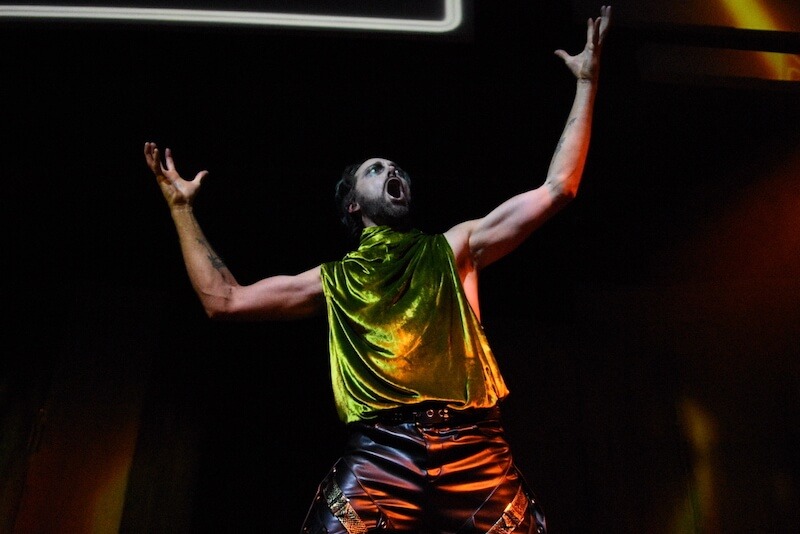
Set in a steampunk dystopia, Icarus has tried hard to update this tale of betrayal and demagoguery. Julius Caesar himself never appears in person in this production, but instead is rendered as an onscreen avatar, perhaps a reference to the power of social media on political campaigns. When the senators murder him, slashing at the screen, he disappears into pixels. Other conversations are reimagined as FaceTime video calls and, at the end, the characters are armed with machine guns rather than swords.
However, this impressive vision is let down by some laboured acting where the resolution to make every word count slows down the action, especially in the first half when the conspiracy to murder Caesar is initially discussed. In a gender swap, Rowan Winter plays a cold, calculating Brutus who doesn’t need much persuading to pick up the dagger alongside her fellow senators. Winter gives no real sense that Brutus is killing her erstwhile friend for the sake of Rome and blustering around on stage, she gives no indication of the moral dilemma she faces.
The gender swap works up to a point, but it reaches an impasse when wife Portia bemoans her lot as a woman. Brutus doesn’t seem to have been held back by her sex. Another gender swap is more successful; Gabrielle Shepherd, in full Mad Max costume, makes for an engaging, excitable Casca.
As Cassius, Michael Skellern embodies a more traditional style of Shakespearian acting, always booming his lines towards the audience. Nevertheless, he gets the only joke in the whole 130 minutes when he looks at the captioning to check something that he has previously said. James Heatlie takes a while to grow into Mark Antony, but his character lacks the charisma of a leader who so easily stokes up the crowd. Better is the less emphatic performance of Michael Elcock in his roles as both Cinna and Octavius.
As director Max Lewendel takes his time in the first half, the idea of superstition among the Romans is foregrounded. With the help of animation, there is more emphasis than in other productions of Julius Caesar on the belief in omens. In such a digital production, it’s a surprise that these irrational delusions should be such a part of the updated play. However, with fake news such a part of the internet, we can see how our belief in the supernatural has only taken a new form.
Is Julius Caesar on the GCSE syllabus this year? If so, Icarus’s production would be perfect for schools as its video game version is incredibly easy to follow. It’s just a shame that the emotions and ambitions of the characters play second fiddle. For an audience which is already familiar with the play, this Julius Caesar is only screen-deep.
Runs until 5 October 2024

1 Comment
spot on.
I think I was sitting next to you last night.
The gender politics was bonkers & I couldn’t get the point of the goth angle at all.
The surtitles were a horrible distraction – esp when they didn’t quite correspond to the spoken lines.
I see that they had an intiimacy coordinator but that was presumably only for the gropathon & mild S&M at the start, which added nothing at all to the production.
I overheard your conversation about Real Thing. I saw the production with F Kendall years ago (at Donmar???). You are right – these Islington double handers have not worn well.