

Writers: Jeon Chul-hong and Kim Han-min
Director: Kim Han-min
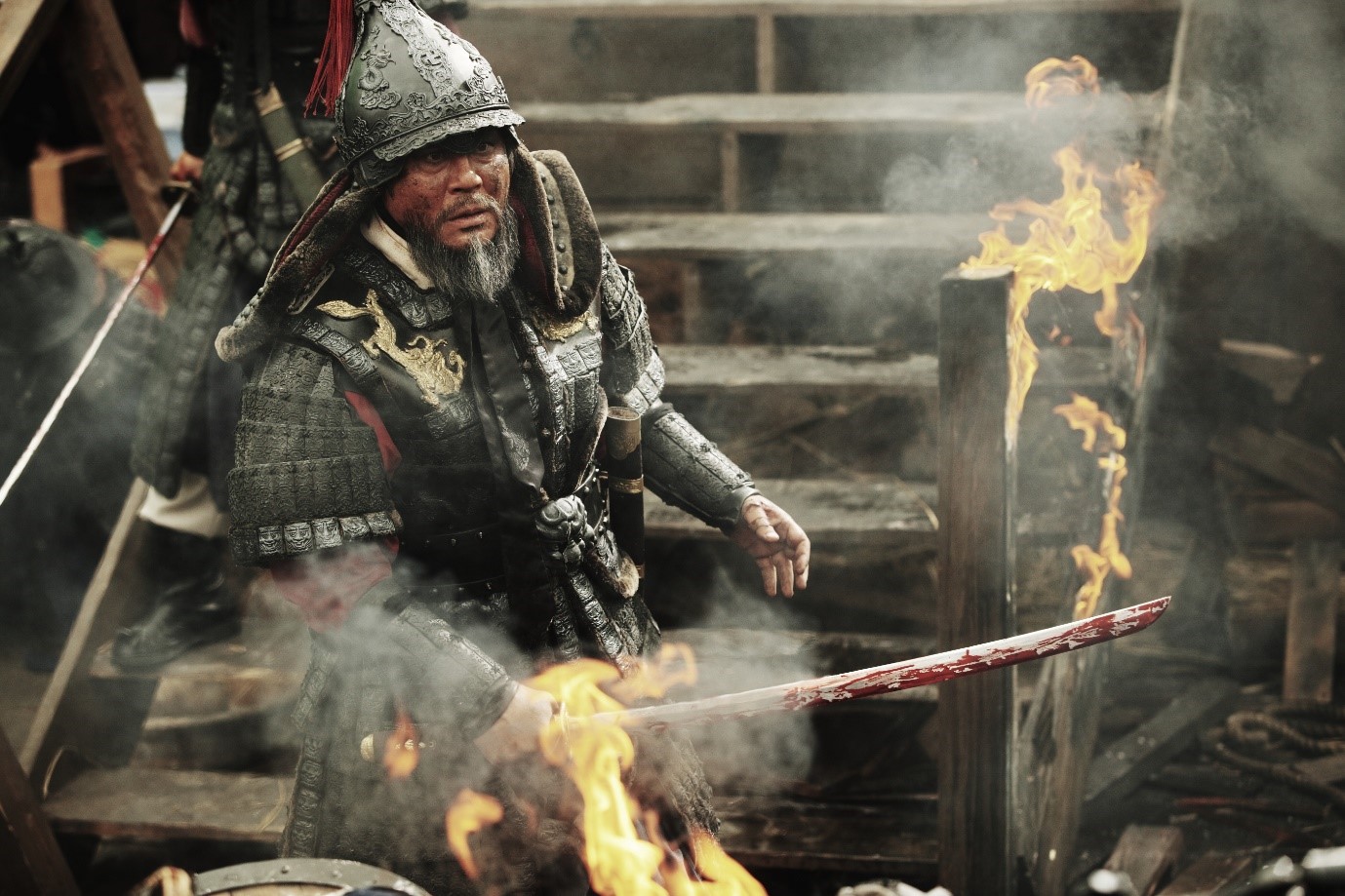
The Admiral: Roaring Currents tells an epic story and does not disappoint in portraying convincingly the sheer scale of events.
In 1597 Japan is bent on expanding their empire. A series of defeats has left the Korean armed forces close to collapse. In desperation disgraced naval commander Yi Sun-sin (Choi Min-sik) is reinstated and ordered to guard the strategic port of Joseon against invaders.
The odds are against Yi Sun-sin who, it is established early in the film, is not in good health. The invading fleet comprises over 300 vessels while ongoing conflict has reduced the Korean navy to a mere dozen battle-ready ships. The Japanese authorities are taking no chances and have employed a pirate Kurushima Michifusa (Ryu Seung-ryong) to lead their ships knowing he will not hesitate to breach the rules of war by using sharpshooter assassins to take out Yi Sun-sin if possible.
Nature is also against Yi Sun-sin, the roaring currents of the narrow sea passage through which any ships must travel are unstable and could serve as an ally or enemy. The invaders could ride the waves and let the momentum crush the defending ships, but Yi Sun-sin might be capable of using a whirlpool as a defence mechanism if his meagre force can hold out long enough for the tides to turn.
Fully half the movie is devoted to the sea battle, but director Kim Han-min (who co-wrote the movie with Jeon Chul-hong) builds a chaotic mood of potential violence from the beginning. The Japanese sea captains far from being aloof commanders are portrayed as prone to childish temper tantrums – conversations inevitably descend into full-voiced arguments usually ending with swords being drawn. It is almost comedic possibly intended to point out the ridiculous nature of the conflict. The only actual joke is, however, gallows humour- Yi Sun-sin’s subordinates wonder if a single line formation of ships actually counts as a tactic.
The tone is Shakespearian; the eerie noise of the roaring current invokes a guilt-induced fantasy in which Yi Sun-sin is confronted by the restless ghosts of the soldiers who died under his command. As the French elite sneered at the out-numbered British soldiers in Henry V the Japanese commanders, wearing immaculate and highly ornamental uniforms, openly mock their opponents.
In The Admiral: Roaring Currents the actors come second to spectacle. Choi Min-sik brings battered dignity and worn-out regret to his role but the majority of the cast feel like very colourful cameos. Even the showdown between the admiral and the pirate does not play out as a personal one-to-one faceoff.
In a period of artificial CGI-generated cosmic battles the carnage in The Admiral: Roaring Currents has a brutal authenticity. Yet there is no danger of the viewer becoming numbed by repetition as Kim Han-min ensures a staggering variety of threats ranging from dodging whirlpools, ships colliding, explosives being inadvertently detonated or hand to hand combat. The director shows a fine appreciation of suspense as an attacking vessel is sucked down into a whirlpool seconds away from sinking the admiral’s ship.
For pure spectacle little can top Yi Sun-sin’s ship hemmed-in on all sides managing to blast its way to freedom. It would take a hard heart not to be inspired by a flotilla crewed by peasants working together to pull the admiral’s vessel out of the whirlpool.
The Admiral: Roaring Currents is a film that gives spectacle a good name- it is a roaring triumph.
The 17th London Korean Film Festival 2022 runs from 3 November – 17 November in cinemas across London. For more info: https://www.koreanfilm.
