

Writer and Director: David Beton
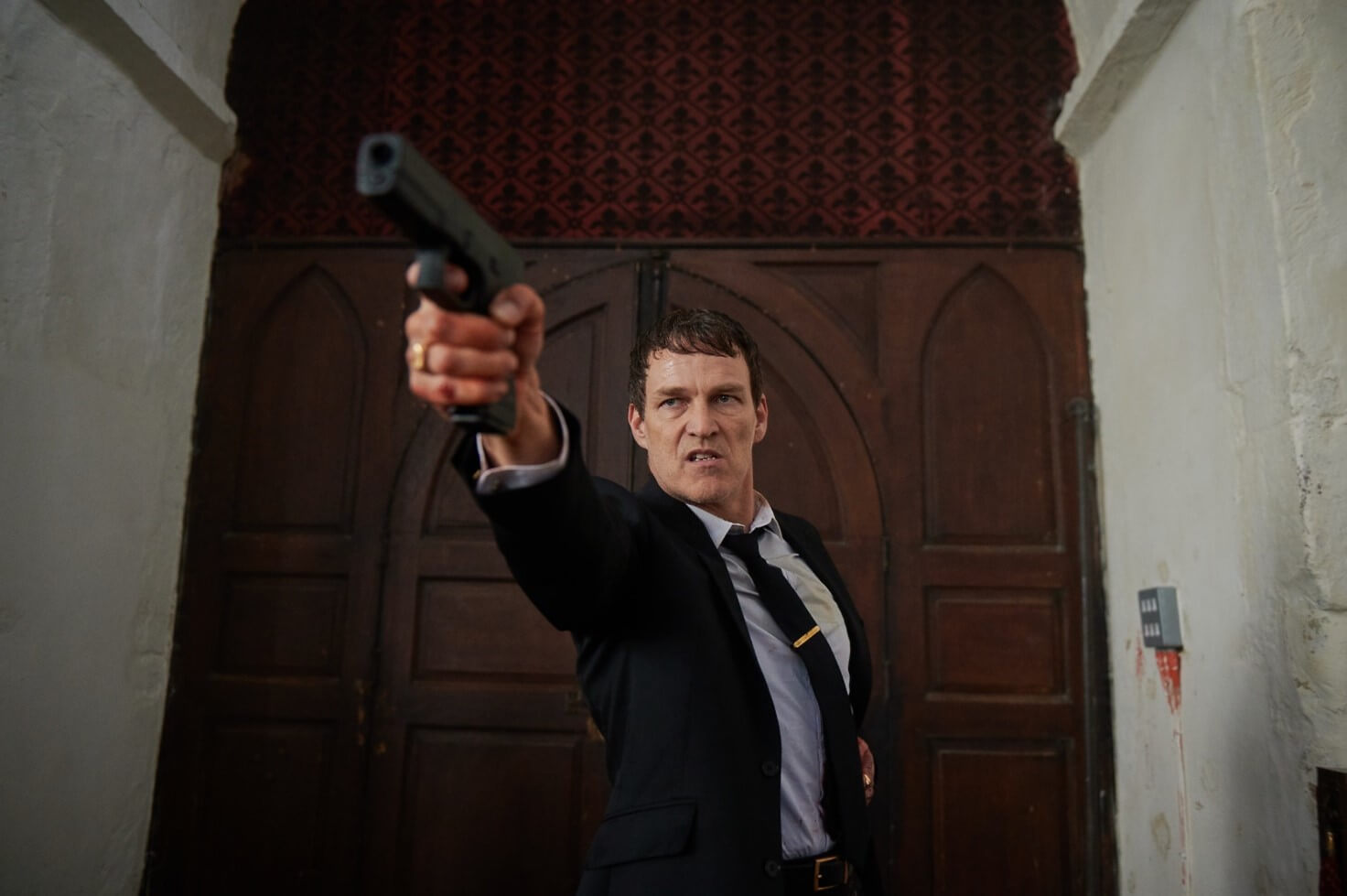
Billed as an intense, high octane thriller, Confession is built on a simple narrative premise. A gunman – wounded but still dangerous – bursts into a Boston church. The priest is the only person in the building. With the action played out in real time, the gunman urges that he has a confession to make. He is here not for vengeance, but absolution.
Written and directed by David Beton, this is a one-location drama. The film is packed into an 80-minute time frame, and plays with the audience’s preconceptions as the story takes a number of sharp turns. Confession should be a compact, claustrophobic experience, leaving us on the edge of our seats. Unfortunately Confession fails to meet this expectation, leaving us with disparate elements that don’t gel together.
The issue with Confession is not lack of dramatic pace – the film practically hits the ground running – but in the distribution of these high impact moments. The film’s structure feels uneven – too little exposition at the beginning, and too much in the final ten minutes, with reveal after reveal shoe-horned in. Instead of a slow introduction, and steady build, there is no time allocated to introduce either lead character. As a result, our stake in what happens to either Victor Strong (played by Stephen Mayer) or Father Peter (Colm Meaney) is diminished. It isn’t a question of likeability either – we simply do not have enough information to go on.
What is frustrating about Confession is that the cast isn’t one of its problems. Meaney clearly wants to give us more as Father Peter, but with so much of the character unrevealed, there isn’t a great deal of space in which to manoeuvre. Meaney and Mayer do work well together: they have a natural chemistry which helps to fill the holes in the script. But the characterisation never seems to expand: despite the performances, Father Peter and Victor Strong feel like types, flatly drawn and easy to predict. At times the dialogue feels almost perfunctory, like an unsteady first draft.
The saving grace of Confession is how it looks. With Andrew Rodger as Director of Photography, the inner sanctum of the church is lit in bruising greys and blues. The atmosphere created by Rodger, through light and shade, builds a sense of drama lacking in the actual film itself. The church appears brooding and contemplative by turns. Brilliant flashes of stained glass, beautifully handled profiles of the actors as they confess their relative sins. Rodger’s work not only elevates Confession, the location is brought to life with such care that it effectively becomes another character, and as such, redirects our attention away from what else is happening on screen.
This is a film of missed opportunities, not least as it rolls towards an improbable and hyperbolic finale. This is a film of what ifs: the most obvious being that if it had been more evenly polished, Confession would be an infinitely better watch. As it is, Confession looks the part, but is, ultimately, unsatisfying.
Signature Entertainment presents Confession on Digital Platforms 31st January.
