

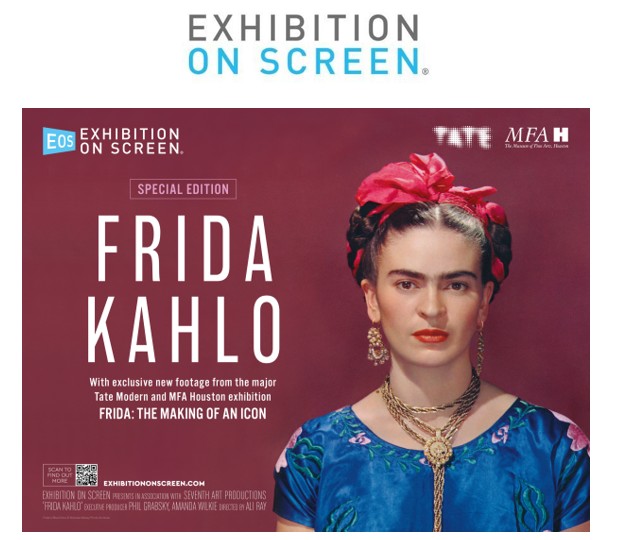
Director: Ali Ray
Reviewer: Maryam Philpott
Largely a re-release of the Exhibition on Screen film from 2020, this new version of the story of Frida Kahlo adds a 10-minite addendum focusing on the collaborative exhibition between The Museum of Fine Arts Houston and Tate Modern that brings this biography of the Mexican artist up to date. Unlike many of the films in this series, there is little material based in galleries or showing the curation of the exhibition, and instead offers a much broader and fairly familiar lifestory of Kahlo, her personal and artistic interaction with Diego Rivera, and how this informed the art she created.
Filled with talking head expertise who provide lots of insight into Kahlo’s story drawn from her personal sources, photographs and letters including her marriage, the trip to New York immediately afterwards in 1931 where Kahlo retained her Mexican dress – which one contributor argues was a political statement in the context of “revolutionary transformation” in art offering “the art of the people.” Throughout, analysis of self-portraits and other painted impressions, the speakers explain how Kahlo’s representation of self developed in her painting, and how it evolved during her time as an artist.
In a familiar story in this re-release the, perhaps the most important segment is the final 10 minutes which examine the development and staging of the new exhibition Freida Kahlo: The Making of an Icon described as “not a retrospective” by the Houston curator but showing her development from local artists to ‘consumer icon.’ This part of the film is the most engaging, placing Kahlo’s work alongside that of around 80 other artists who were influenced by her work, adding to the timeline after her death when her work is revived and remembered from the 1970s.
The association that this final 10-minutes makes with counter-culture development, used by revolutionary groups in Mexico is particularly interesting and could have been a larger portion of the documentary as the film moves beyond the personal story of Kahlo to examine instead the impact of her image and the iconography that inspired other artists and political movements. With so little time, there is no way for the viewer to know how much of this is overstated as there is no detailed analysis of the individual pieces on show from Kahlo or other creatives, nor is there a tour of the exhibition for those who cannot attend in person.
It might have been more interesting to recut the original documentary, mixing new footage from the current exhibition through the biographical detail and art analysis to underscore the shape of the new show and its meaning. The overall argument that Kahlo remains relevant and commercially viable today is clear from this Exhibition on Screen revival but with a limited final chapter, it doesn’t really answer its own question about why her work, her style and her face continuing to inspire others today.
Exhibition on Screen’s Frida Kahlo is in UK cinemas from 19 May.
