

Animator: William Kentridge
Composers: Nhlanhla Mahlangu and Kyle Shepherd
The arts are full of interesting and unusual collaborations that explore concepts or stories on a much larger canvas and through different forms of cultural communication. William Kentridge’s Sibyl does just that combining film, animation, dance, Greek mythology and a chamber opera which originally premiered in Rome. Kentridge’s first show at the Barbican Theatre, this abstract exploration of the uncertainty of fate alongside the equally insistent desire to know our future is a fascinating experiment in combining art forms.
The first part of the evening is given over to a 20-minute film entitled The Moment Has Gone, projected onto a graphic curtain at the front of the Barbican stage covered in pictures of notes, accounts and letters. The film dramatises Kentridge’s process of animation, the individual creation of moving images and sequences, some of which the audience will see later in the opera, capturing cycles of creation and destruction, pinnacles of artistic civilisation and the simpler beauty of arable landscapes.
The film has no direct story, it cuts between Kentridge’s studio where two versions of the artist create side by side, filling the screen with charcoal smudges, continually contrasting the two-dimensional image and the three-dimensional creator and his tools. But these pictures move and become images hanging in a gallery observed by a well-to-do man as the viewer is pulled in and out of different stories accompanied by a piano piece composed by Kyle Shepherd and performed live by a chorus of singers performing a melancholy tune.
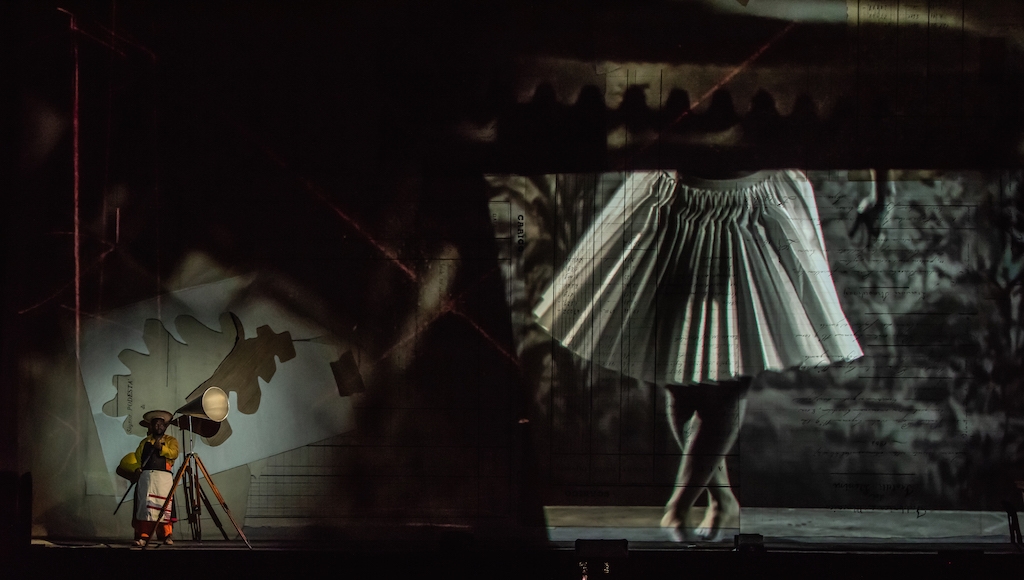
The second piece is the chamber opera itself, Waiting for the Sibyl, which has an absurdist look designed by Sabine Theunissen. Across six individual scenes, the characters explore predictions made by the Sibyl and the difficulty of interpreting them individually with paper notifications replacing the leaves of legend. These statements become part of the projected animation, behind the mute but dancing Sibyl whose words are voiced by another singer but are projected as proclamations in English.
Ranging from statements about things to resist, to beware and discard, each scene explores the problems of prophecy and knowing what to believe. In the second scene set in an office, a worker holds letters to his ears to hear their content sung to him, none the wiser as to which ones he should listen to. In the final scene, the performers use their jackets to blow paper predictions around the stage, mixing them up as the wind does in the original story of the Cumaean Sibyl.
Viewers will need an outline understanding of the Greek myth to make sense of all of the reference points but the visual connections between Kentridge’s animation, Theunissen’s spare set design and Greta Goiris’ costumes is strong, the latter particularly notable for big round skirts and hats made of pleated and corrugated card in bold colours that evoke tribal and fantasy designs that keep this piece firmly in the realm of myth.
Performed by vocalists Ayanda Nhlangothi, Zandile Hlatshwayo, Siphiwe Nkabinde and S’busiso Shozi, there is often a haunting lament in Nhlanhla Mahlangu and Shepherd’s music that is mournful but also quite beautiful, given energy by dancers Thulani Chauke, Teresa Phuti and Thandazile ‘Sonia’ Radebe. This innovative combination of art forms is to be much admired and, if it is ever safe to predict the future, this may be the first but probably not the last Kentridge work to be performed at the Barbican.
Runs until 24 April 2022
