

Writer: Sharleen Cooper Cohen
Director: Philip Wm. McKinley
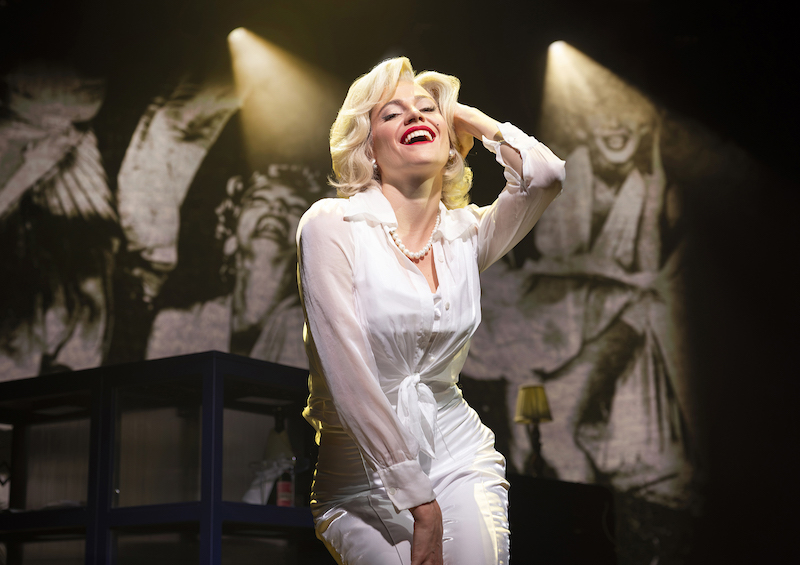
Tucked along the Victoria Embankment, the Emerald Theatre has been entertaining Londoners since 1921. Originally a movie theatre and later a music venue and cabaret space, Dita Von Teese, The Psychedelic Furs, Motorhead and Pearl Jam have all performed here. Renovated last year into one of the West End’s newest theatre spaces, it offers a venue dripping in vintage glamour and shadowy retro decadence—a fitting environment for the world premiere of Who Killed Marilyn? , which stars singer Pixie Lott in the lead role and who magnetically embodies the Hollywood icon.
Did Marilyn Monroe, the Hollywood icon, so misunderstood by the world, really commit suicide or was there something more sinister at play? Was she murdered? If so, by whom and why? Marilyn fans will be well versed about her troubled upbringing, mentally unstable mother, her search for love and acceptance, professional exploitation, numerous marriages, many lovers and desperate desire for children. Feminists feel she was ruthlessly exploited by men, eaten up and spat out by the patriarchy; her astute intelligence and bookish curiosity were suppressed as non-commercial, inconvenient truths.
Throughout the play, Justin Williams’ set design centres on Marilyn’s bed where she was found dead after an overdose. Intermittent projections from Libby Ward appear onto the background, including newspaper headlines, different locations or a melange of Marilyn heads in dry ice to create something dreamlike, hallucinatory and slightly ghoulish. The device used to tell the story is familiar from Billy Wilder’s 1950’s Sunset Boulevard, where screenwriter Joe Gillis narrates his own death.
Here, we start with some unwelcome guests and a dead body while Marilyn watches the proceedings and offers her insights. There are a whole series of flashbacks: her difficult marriages to Joe Di Maggio and Arthur Miller, her dealings with Sir Laurence Olivier in The Prince and The Showgirl, and, of course, the build-up to her death – when all, according to this version, is revealed.
This interpretation by both a female writer and performer gives Marilyn Monroe agency and voice as well as the vulnerability with which we are familiar. Despite Marilyn Monroe having been commodified, imitated, caricatured and parodied, this potentially high-risk role for singer Pixie Lott is carried off with style and spirit. This Marilyn Monroe swears, calls out the men who used and abused her and wants us to know what happened that night.
Lott is at ease in her own body; lithe, sensual, flirtatious and fiery, she slips into Marilyn’s skin with natural feeling; a female performer who feels the pain and injustice of another woman and performer. Through this sympathetic understanding, Lott effectively reanimates the icon through a captivating performance and commentary that – some exposition aside – is wry, astute, intelligent and witty. We even get a beautiful rendition of the notorious Happy Birthday Mr President—the only song in the entire play.
The whole directorial rendering of Who Killed Marilyn? is drawn from pulp fiction, comics and B-movies with a film noir aesthetic reflected in lighting, sound and costume choices. Bold and theatrically realised, it’s well-paced with whip-smart dialogue and empathetic characterisations. An inky celluloid blue is dispersed across the entire production from the suits of the shadowy male characters to the projected backdrop.
Christopher Reid’s edgy and insistent sound builds tension and keeps the audience engaged, while the costumes from Jasmine Swan present Marilyn in angelic white throughout, a modern interpretation of the 50s siren. The strong supporting cast of male actors (husbands, lovers, agents, doctors, therapists)—who all sought to own, control, claim or suppress Marilyn—are well drawn, and a special mention goes to Julie Armstrong, who plays both Eunice, the arse-covering housekeeper, and the snarling mobster boss. The darlings of the American Democrats—the Kennedy dynasty – have never seemed more self-serving, power-hungry, or cruel.
Marilyn Monroe became a brand and an industry in her own right, one that was feasted on by the jackals of Hollywood and media throughout her life and that continues unabated after her death. Right now you can buy a £25 ticket to see a photography exhibition about her (Marilyn Monroe: A Portrait) at the National Portrait Gallery. Who Killed Marilyn? gives the Hollywood star the chance to have her say: “This time, I’ll not be silenced.” It had much propensity to be schlocky, trashy, and exploitative, but the combination of commercial and artistic choices, as well as the revelations at the heart of the play, make this entertaining, gripping theatre – and essential viewing for fans of both Pixie Lott and Marilyn Monroe.
Runs until 29 October 2026 and then tours
