

Writer: John Corbyn
Director: Laurel Marks
In order for a play to resonate with its audience, it must do one simple thing extremely well: speak to human experience in a way that cannot otherwise be easily articulated. Appealing theatre will speak to the lives of its audiences, but memorable theatre will open up new conversations and new understandings, facilitating discussions that would not otherwise happen. And very few plays articulate this as well as When Everyone Talks At Once, a play which categorises itself as an ‘investigation of men’s experiences of depression’, but in reality does far more.
An ’investigation’ doesn’t quite do this play justice. An investigation sounds clinical and detached: this is a play that tries to physically capture the sentiment and experience of depression, but without feeling hackneyed or forceful. When Everyone Talks At Once is a lot of things at once: it’s a mystery, a message, an enigma, a story, a personal experience. It feels a lot like a modern day successor to Waiting for Godot – there’s a lot that remains unspoken, but also a lot to be said about it.
The premise revolves around four unnamed male ‘subjects’, who having agreed to participate in a psychological test of sorts, have been placed in a waiting room. There, they are given unspecific instructions, for a test they do not fully understand, by a mysterious unnamed lady (Francesca Marago) who gives away very little. Marago’s role is smaller, but her carefully practiced movements and enigmatic answers imply that there is more here than meets the eye. I
nitially treating their situation like an escape-room, the subjects’ situation soon devolves into a much more profound discussion about purpose. The Beckett parallels are at once glaring (the audience spend the whole time waiting for something to happen), but are also subtle and effective, exploring purposelessness through several different lenses. It’s a hard narrative to summarise, partly because not a lot actually happens, but mainly because this is a play to be experienced, not related or read about.
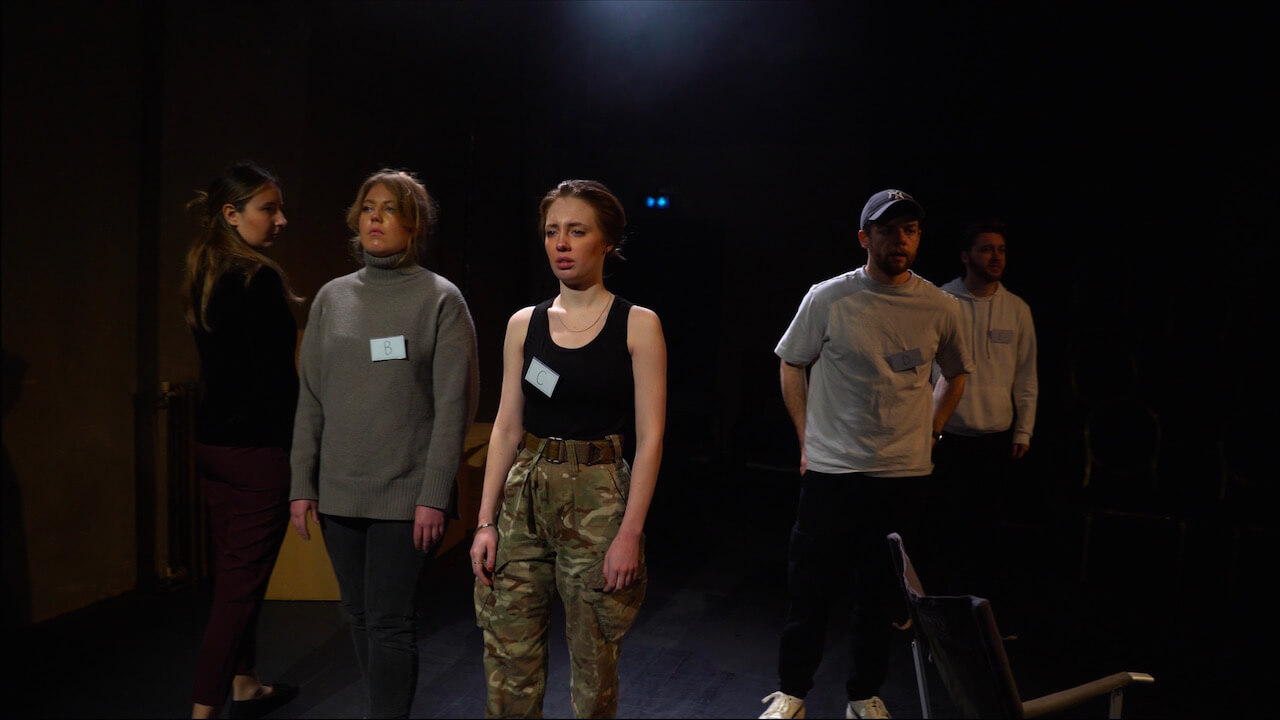
There’s a thrilling sense of impending claustrophobia which the play manages to sustain throughout its performance, and which is successfully maintained by a carefully considered performance from its cast and effects team. In the face of their inescapable predicament, subject B (Rebecca Stomberg) is jovial and jokey; subject C (Bethany O’Halloran) is reticent and reserved; subject D (Dan Plumb) is macho and stoic, and Subject E (John Corbyn) is more uncertain.
Their choreography is understated and impressive – there’s one scene where they engage in multiple games of rock, paper, scissors, demonstrating a clever commitment to remembering a sequence. It’s these small moments which convey an ominous sense that the audience should not take the situation at face value – the whole situation feels ethereal and dreamlike, especially given the punctuated episodes of interruption from the unnamed lady. Haunting music and cold lighting pervades a minimalistic stage, further adding to the increasingly unnerving situation.
True to character, the play leaves us asking questions and wanting more – but it’s a deliberate stylistic choice, leaving us to stamp our own interpretation on this episode of ambiguity. At just over an hour, this piece feels concise and pithy and does not drag or outstay its welcome. The succinctness of the performance, however, is supplemented by an additional informal talk at the end with the cast, writer (John Corbyn) and one of the play’s charity partners – Inner Allies. This rare opportunity to hear from the creatives themselves gives a clearer context to an already powerful performance, allowing the creator to expound upon his personal experiences with depression, whilst also deferring to the charity team at Inner Allies to detail their services and advice. It’s a beautiful touch which informs the audience, without detracting from the performance, reminding them that there is an explicit and important purpose and lived experience behind the writing, without spoiling the plot.
Clearly, here is a creative team who feel intensely about an important cause, and who have been brought together in their mutual support of that cause to create an original and subtle piece of art. It’s theatre to open up discussions and conversations, to convey a message more effectively than in words alone, and most importantly to revel in its own ambiguity.
Runs until 11 February 2023
