

Writer: Paul Kalburgi
Director: Kay Brattan
While it’s refreshing to see a play that doesn’t hurry pell-mell to its conclusion, We’ll Always Have Paris is far too long, stretching out to almost two and a half hours. Some scenes could easily be cut without affecting the story or its measured approach to grief and online dating.
Take the first scenes, for instance. Cyril Blake plays a series of men messaging our protagonist on Tinder. Some are quite amusing, but it’s very familiar stuff in theatre and at times only serves to show off Blake’s accent skills. It takes a long time to reach the crux of the play, and Paris is only reached in the second half.
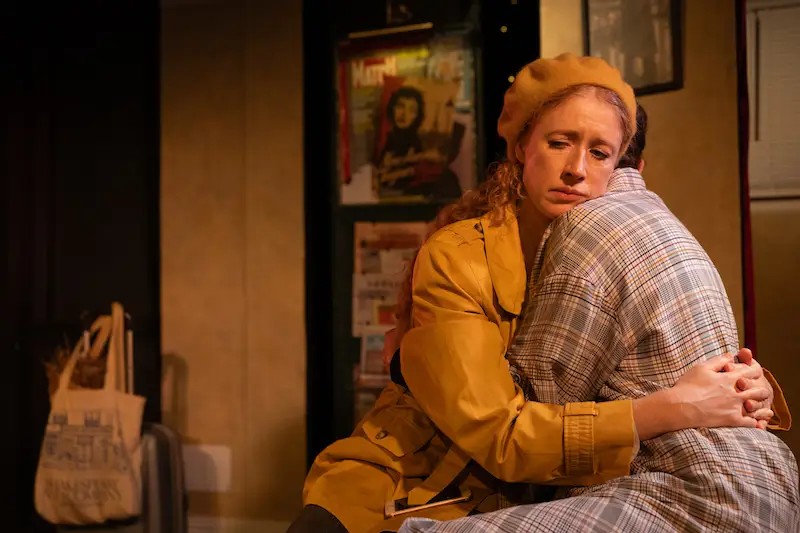
Miranda Colmans is Ginny, a 40-something woman who is grieving the death of her fiancé, Jerry. Her mother (Eliza Williams in a few different roles) tells her that after a year of grieving, it’s time to get back on that horse. The thing is that she doesn’t really want to, and all the guys she talks to on the dating apps appear to have very distinct sexual kinks. In the day, Ginny works at a rep cinema, and projections of black-and-white romcoms are screened on the louvre-door-inspired set. At night, she watches more films on an old-fashioned projector while she drinks white wine.
Kay Brattan’s stately direction lingers on these evenings at home, making sure that the audience, too, feels these endless days as Ginny explores her unresolved grief. Writer Paul Kalburgi toys with the romcom structure, introducing men (again, all played by Blake), who perhaps could be her future lover: the man who works at IKEA, the postman (unlikely) and Sebastian, the personal trainer, who works at a gym in Paris. When Ginny books her plane ticket to Paris, it seems as if the latter will be the boy in this boy-meets-girl remix.
Certainly, there’s a 90-minute show here, although the Parisian resolution is more suited to a play written 10 years before. However, the clues are pretty well hidden. Always on stage, Colmans is brilliant, and her unhurried performance of the world-weary but still hopeful Ginny is finely portrayed.
While the elegant set reveals different locations (Ginny’s flat, a restaurant, even Pont Neuf at one point), there is rather too much lugging on and off of heavy props. A row of cinema seats is brought in; a bed, too, but at least in this case, it’s carried on with comedy. Indeed, there are so many IKEA boxes and lint rollers on stage that it’s possible that the Swedish store has sponsored this production. All we need are some meatballs.
Runs until 3 October 2026
