

Writer: Rosalind Philp
Directors: Paul Cooke and Rosalind Philp
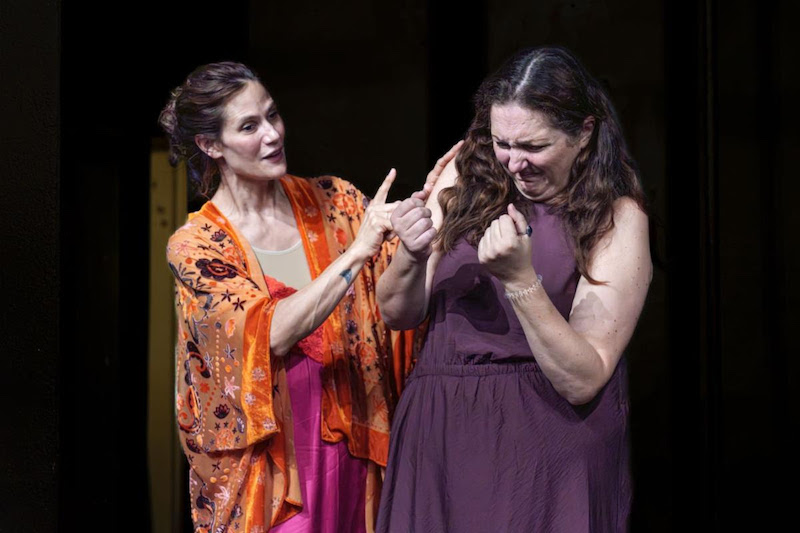
Perhaps appropriately for a play about Alzheimer’s, there are a lot of gaps in Rosalind Philp’s semi-autobiographical debut, Waving. The piece, a kind of narrator-less memory play, takes us through a series of time-shifted scenes depicting the waxing and waning of the relationships between an unnamed dementia-struck artist and her children, Miles and Lena.
Poet and songwriter Miles, played by charismatic, flirtatious newcomer Ben Levy, is his mother’s favourite. He has drug and alcohol problems and a difficult relationship with his on-off girlfriend Clare. He is also possibly delivering paid sex work for family neighbour Fabian (“a generous man who’s easily bored”, we hear), whose presence on stage in the form of a delightfully camp Paul Stone adds light and shade, but detracts somewhat from the family focus of the piece.
Daughter Lena (Philp performs as well as writes), who does most of the heavy lifting in caring for her slowly dementing mother, has a failing relationship with her husband. She finds escape in creative writing classes, penning letters to her younger self, and solace in the arms of a man in Cornwall she met online. Then there is the artist (Ava de Winter) herself. Seemingly, she moved from America to become a big fish in the UK’s small artistic pond, but her style of painting has fallen out of fashion, and Alzheimer’s is robbing her of her talents.
There is little storyline in the time shifts. Miles, doomed to addiction, is always coming or going from somewhere, and flustered, resentful Lena is always one stage or another in her relationship break-up. A car crash emotional climax of sorts arises when the artist melts down at a gallery opening, screaming “what a lot of boring cunts” at her punters. “Do I detect Rothko?” Fabian purrs caustically. The why of it remains elusive.
Does one detect a nod to the form and mechanics of Florian Zeller’s truly masterful portrayal of dementia, The Father, in what Philp is aiming at? Possibly. Making the audience do the work is theatrical best practice, but here the randomness in the glimpses we get of this family leaves us with more questions than answers. Who are these people, really? How do they truly feel about each other?
There are moments of pathos in Waving that anyone who has personal experience of a family member with dementia will recognise. But the overall effect here is bitty and thin. Imagine spending 50 minutes with a handful of ghosts, drifting frustratingly into and out of the ether, and you will get the idea.
Runs until 1 August 2026 and then at Edinburgh Fringe
