

Author: Michael Morpurgo
Adaptor: Nick Stafford
Director: Tom Morris
Revival Director: Katie Henry
Designer: Rae Smith
Puppetry: Adrian Kohler – Handspring Puppet Company
The acclaimed War Horse, whose first production by the National Theatre debuted in 2007, comes to Leeds in a thrilling revival that has lost none of its awesome power and majestic spectacle. The story is well known from the original book and film version directed by Steven Spielberg and is classic in its simplicity and poignancy. A foal is auctioned to a Devon farmer and grows up with a farm boy called Albert. He names the horse Joey as he trains him and the two form a friendship that proves to be unbreakable and enduring. But they are separated when Joey is bought by the Army as war is declared on Germany in 1914. After disastrous cavalry actions Joey, along with his companion horse Topthorn, are captured by the German army and put to work pulling a heavy gun. During their time behind German lines the horses are loved by a young girl, Emilie, and protected by a soldier called Friedrich. As the British army advance Topthorn dies of exhaustion and, running from a tank, Joey escapes from both armies. He finds himself in no-man’s land where, by the toss of a coin, he is reclaimed by the British. In need of medical attention and saved from being shot by a fortuitous jamming of a pistol, he is eventually reunited with Albert (also injured) who has enlisted (under age) specifically to find his beloved horse. They nurse each other back to health in a fitting and highly emotional climax.
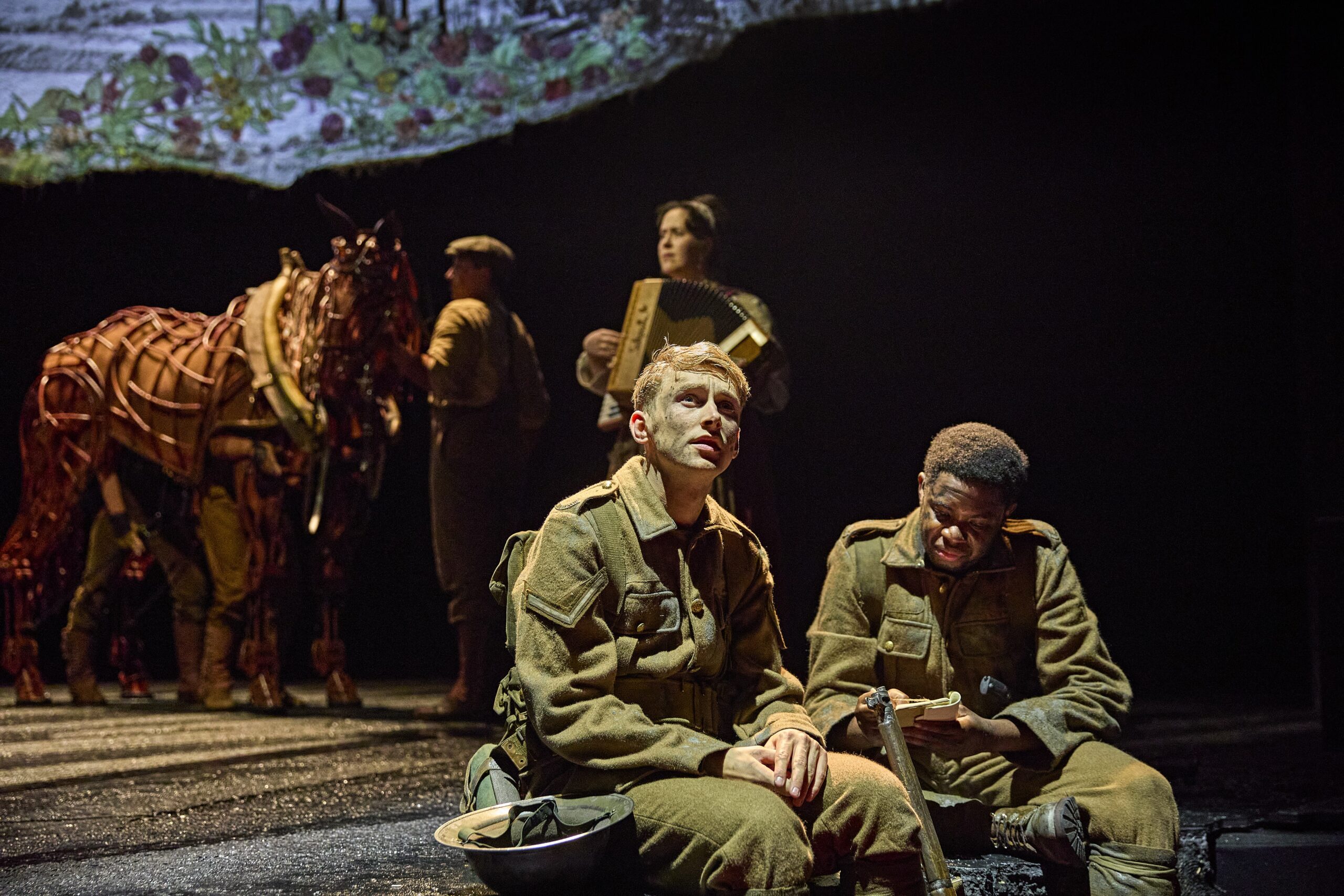
Of course, in order for this whole production to work it has to rely on the skill, expertise and sheer brilliance of the team of puppeteers who have the responsibility of bringing the horses to life. The celebrated South African puppet company Handspring do a remarkable job in this regard. Although they are visible throughout, either beneath the horses or fully alongside them, they are never obtrusive or distracting from the action and, indeed, complement this in a seamless synergy. All the sinuous movements of a horse, the swish of the tail, the pricking of the ears, the muscular power of the limbs, the turning of the head, are all fully synchronised and coordinated to such a degree that the audience suspends its belief and it is as if real life-size horses are cavorting on stage before its very eyes. There is real emotion when Topthorn dies, so poignant is the scene, and audible gasps of disbelief can be heard when it looks like Joey is about to be put down by a soldier’s bullet. The audience identifies with these horses as living characters that it has come to love and admire for their bravery, fortitude and endurance in the face of intolerable cruelty and hardship, and no praise is high enough for the way Handspring pull this off.
The set design by Rae Smith is simple but highly effective, with a screen in the form of a vivid streak of white stretching cross the entire back wall upon which drawings and live action can be projected. These are highly evocative and are a clever way of adding to the action and atmosphere. Sometimes the action on the screen is synchronised with what is going on stage as in marching soldiers or a cavalry charge increasing the realism. All this is complemented by extremely loud bangs and all the noises of war, liberal use of dry ice and swirling mists, sympathetic lighting and spot on costumes and props. Two images that spring to mind are when the fully adult Joey first emerges from the background darkness in all his glory and the sight of a tank being hauled across the stage in partial silhouette but these are just two among many such scenes of heroism and authenticity.
The whole company are deserving of mention but the demands of space dictate only a few can be individually named. Tom Sturgess makes for a very appealing Albert Narracott, the young farm boy whose enduring love for Joey forms the backbone of the story. He convinces with his youthful exuberance, his early attempts at training the horse, his relationships with his parents and his eventual enlisting before he is legally able to do so (an experience that many volunteers actually undertook) in order to find Joey. His heartfelt reunion with the horse after all the trials and tribulations both have endured is a sight to behold. Jo Castleton as Albert’s mother Rose brings out all the hardships and stresses of trying to run a farm in a wartime economy with a drunkard and unreliable husband (Karl Haynes) whom she loves at heart and sees the good in him despite his outward behaviour. Gareth Radcliffe as the aptly named Sergeant Thunder excels as the loud, in-your-face terroriser of all new recruits and brings some much needed earthy humour to his role. Alexander Ballinger has a rather complex role as the conflicted Captain Friedrich Muller and gives a sensitive and nuanced performance. Sally Swanson plays the Singer and pops up at different points both on the stage and even from the side dress circle, singing a variety of ditties and songs that comment on the action and all accompanied by her own playing of the accordion. Swanson has a strong, confident singing voice that perfectly contributes to whatever scene she is in.
It has been estimated that over a million horses died on the Western Front and of those surviving, only around 60,000 are said to have been returned to Britain at the war’s end. Whilst the events of War Horse are fictional they are grounded in fact and reality. This show cannot be recommended highly enough for its spectacle, emotion and drama and new audiences and generations will thrill again to its sheer brilliance and raw power.
Runs until 6 September 2025
