

Book: Rob Drummond
Music & Lyrics: Dave Hook
Director: Orla O’Loughlin
Mainly thanks to Mel Gibson, the Australian-American actor and filmmaker, the name of William Wallace is well known around the world. Add a hip-hop musical to the mix, and if you came to Wallace: A Musical for the first time, you might imagine that this would be another Hamilton, the musical that famously demonstrated the enormous potential, particularly commercially, of combining musical theatre with hip-hop. Yet Rob Drummond, who wrote the book, and Dave Hook, who wrote the music and lyrics, deliberately take another route to one of Scotland’s most familiar national legends. It is a choice that feels timely at this moment in history.
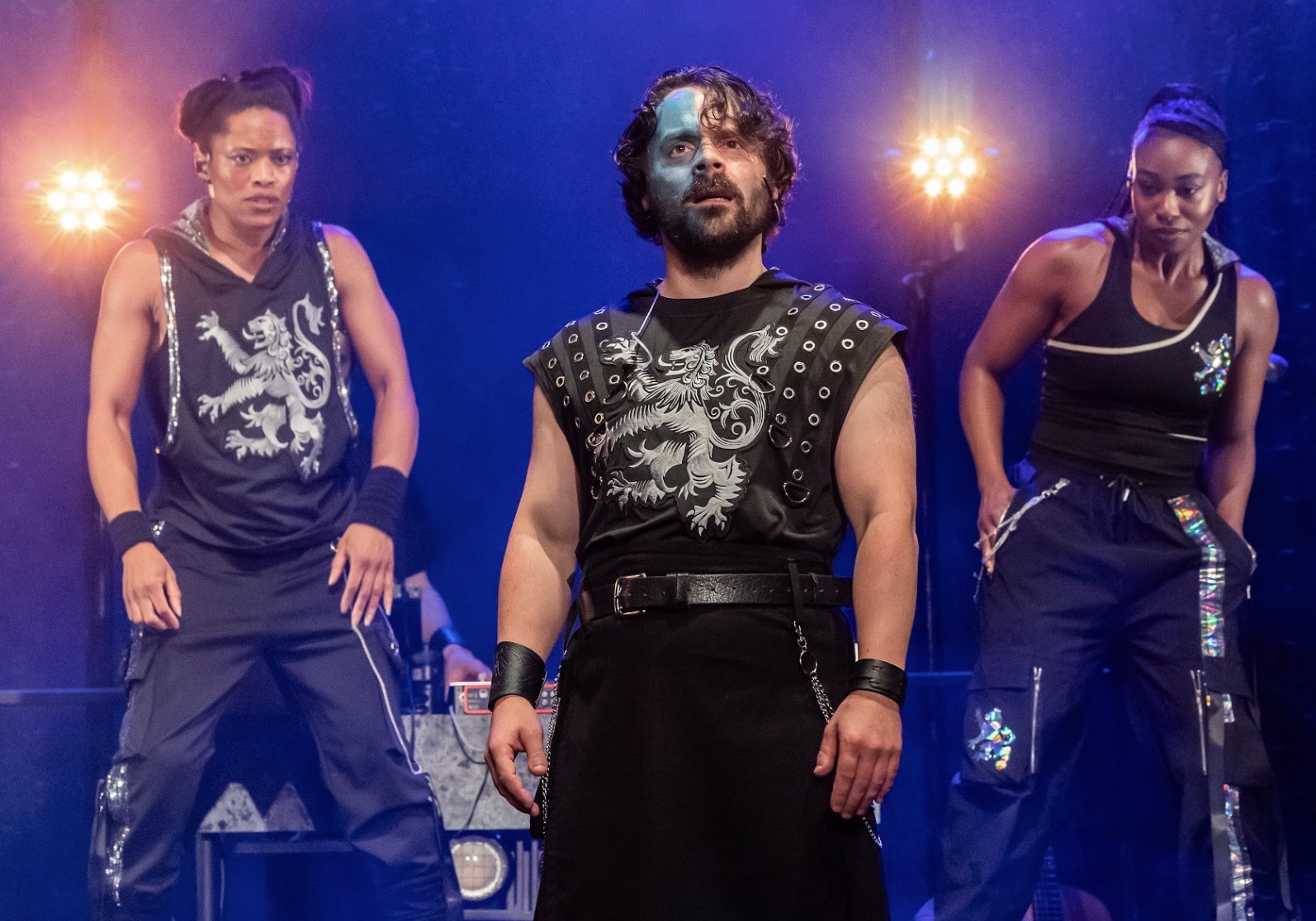
Evolved from their previous production, this ambitious two-hour show begins with Scotsman, played by Ross Mann, acting as the narrator and presenting Wallace, played by Hook himself, as a hero. Sassenach, played by Manasa Tagica, initially represents King Edward I. Yet as the show progresses, Sassenach begins to challenge this heroic account, questioning the violence of war and what Wallace actually achieved. The Wummin, played by Patricia Panther, Madeline Grieve and Kimberley Mandindo, then take turns challenging Scotsman and asking what a hero really means. They attempt to demythologise Wallace further, beginning by claiming that he never existed, while seeking to reconstruct his history primarily from a feminist perspective.
Drummond and Hook clearly want to challenge the heroic narrative that Hamilton so successfully deploys, while questioning the very methodology through which history is constructed in popular culture, where narratives have traditionally been shaped and controlled largely by heroic male figures. At the same time, the show questions the idea of freedom as something that must be achieved at any cost. The constant changes of narrator, and the struggle for control over the narrative itself, are an effective way of reconceptualising these ideas. Yet under Orla O’Loughlin’s direction, the constant switching of roles can also become confusing. With six actors repeatedly moving between characters and narrators, it can be difficult to keep track of who is speaking, while the accumulation of competing perspectives occasionally becomes messy.
The set by Neil Haynes could also have done more to visualise the complex questions the show wants to address. The production takes place on a huge set of steps, with Hook, as the MC, positioned at a control console above the performers. Yet the scale of the King’s Theatre stage can make the six performers feel oddly exposed, even when they are attempting to stage something as epic as a battle, and at times the staging becomes slightly awkward as a result.
Wallace also invites comparison with Six, another musical that began its journey at the Edinburgh Fringe, in the way both productions play with the mechanisms through which history is constructed. But where Six uses the concert format as the organising principle of the entire show, allowing its performers to reclaim the narrative through the form itself, Wallace already contains battle rap without making it the structural framework of the production. The rap battles are often energetic and effective, but they remain one element within a much broader theatrical language rather than becoming the mechanism through which the competing versions of history are continuously fought over. It is perhaps here that the production misses an opportunity to make its form do more of the conceptual work for it. The Scottish musicality also seems strangely absent in places where it might be most effective, although the score does find moments, particularly in the second half, where its music creates a genuine emotional impact. Its range of musical styles, meanwhile, does not always feel as diverse as the premise might promise.
Indeed, the show often feels as though ideas that could have been communicated more subtly are instead delivered rather straightforwardly. This is particularly noticeable because the production has already found a compelling theatrical mechanism in its battle between narrators, and could perhaps trust that mechanism more rather than repeatedly explaining its political implications through dialogue.
The story ends on the idea that we can all rewrite the history of tomorrow because today is ours to make. For the show itself, despite having so much to say that it sometimes becomes overly talky and loses momentum along the way, there is real potential in its attempt to challenge the mainstream narrative and remind us what independence and freedom really mean, and what they are ultimately meant for.
Runs until 3 Oct 2026 | Image: Sally Jubb
The Reviews Hub Star Rating
-
8
