

Writers: Amalia Paschalidi and Nikos Lekakis
Director: Nikos Lekakis
Amalia Paschalidi and Nikos Lekakis’s hurried slice of metatheatrical absurdism, The Window Project, has many, perhaps too many, interesting ideas bubbling beneath the surface. So much is going on, and so breakneck is the momentum, that it is hard to pin down what point they are trying to make.
Paschalidi and Lekakis seem to be late to a show. White bed pillows hang from the theatre ceiling, so perhaps they have slept late. The duo’s faces peer with rictus grins through what might be an imaginary window, wondering when the performance is going to start. “I think we’re the show,” says one. “Let’s pretend we’re the performers,” says the other.
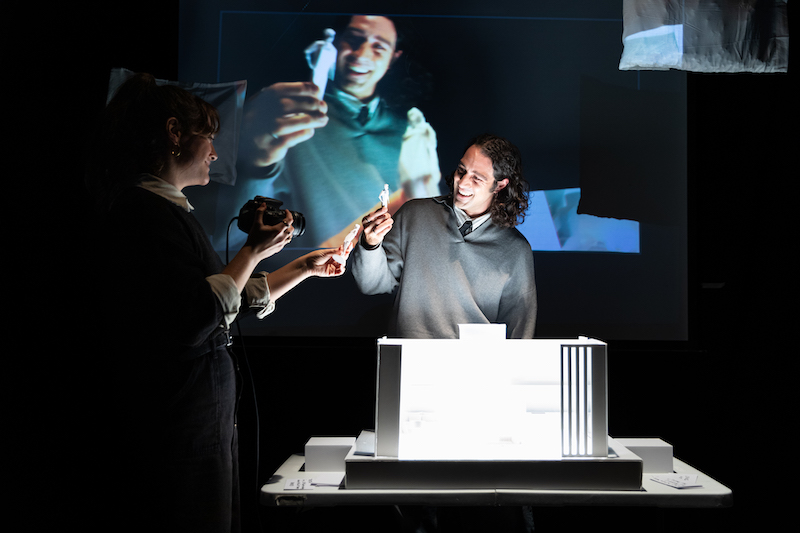
First off, they have to think up some characters. Paschalidi decides she is a photographer. Her camera livestreams much of what takes place onto a screen at the back of the stage (“I’m trying to stay true to the backstory,” she tells us at one point). Lekakis chooses to be an architect named Socrates. Cue the line “I build from the outside in, you build from the inside out,” a piece of dialogue that, like much in the show, almost makes sense but doesn’t.
The show in question turns out to be a kind of truth-or-dare board game in which the pair ask each other questions while moving figurines around in a beautifully constructed doll’s house (think TV’s Big Brother house writ tiny) that sits centre stage. “Say something you’ve always wanted to but never have” is one question, “If your life were a room, what would it be?” is another. Given the pair is playing invented characters, the answers are obviously fake. Still, they strive to find some inner psychological truth anyway (“this game is not a performance, it’s us,” one says). Being phoney while striving for authenticity is an ongoing motif.
There is a hint, not really followed through, of a burgeoning romance between the pair. We also get a clue that they live in a dystopia in which, courtesy of “The Transparency Act”, everyone’s windows have to be open all the time. At a pinch, one supposes the piece has a point to make about the performative nature of modern life. We are always on display, one way or another.
The piece closes with a video showing the couple, hair streaming in the wind, dodging traffic in Camden High Street. “Is there a reason for the game?” one character asks the other, neatly capturing the core concern of much absurdist theatre. The answer seems to be, possibly, but possibly not. The dialogue can be snappy, but it all ends up a bit fuzzy.
Runs until 16 November 2025
