

Writer: Nikolai Gogol
Adaptor and Director: Angelina Voznesenskaia
A religious student unleashes supernatural evils when he kills a witch. This is the basic plot of Nikolai Gogol’s strange, unearthly 1835 novella Viy. Gogol’s vivid story has inspired several adaptations for stage and screen over the years, including a 1960s Soviet horror film. Angelina Voznesenskaia’s new stage version hews closely to the original tale, but audience members unfamiliar with the source material might struggle to work out exactly what’s going on at times.
Viy is a demonic creature that Gogol claims is taken from Slavic folklore, but is chiefly known from this story. The name is taken from the Ukrainian word for an eyelash. The monster is supposed to have a “subterranean voice” and a fatal gaze, covered by heavy eyelids that need to be lifted for him.
The student of philosophy Homa Brut, who murders a tormenting crone (only to find she is a beautiful young woman), is then ordered to pray over her body for three nights. Gogol’s language is deliberately strange in places, mixing archaism and neologism, and it’s hard to know how much this sometimes-awkward script reflects that and how much is simply smudged in translation.
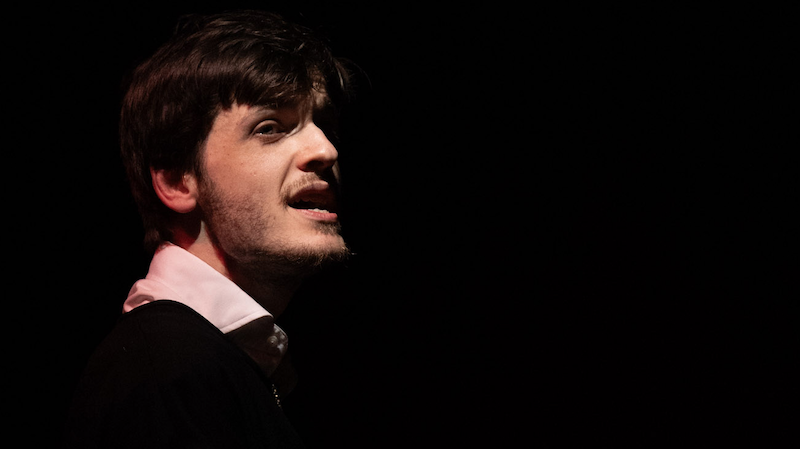
Ross Barbour plays Homa, whose crime and punishment lie at the heart of the tale. It’s an accomplished performance, conveying both existential dread and leavening moments of comedy. “May lightning strike me down if I’m lying,” says Homa with an amusingly tell-tale glance at the sky. Together with fellow itinerant students Tiberius Gorobets (Olivia Merritt) and Halava (Morgan Avery), there are scenes of drinking, stealing and wandering. Later, the two companions double as servants, who drink with Homa, and there is a spirited Cossack dance that contrasts beautifully with the fear-fraught nighttime scenes.
Rianne Snape plays the witch-crone/beautiful woman, daughter of Cossack chief Sotnik (Callum McGregor, who is also the narrator, rector and Viy). Snape’s dancing and screaming are extraordinary, physically conveying the occult thrill as she’s apparently wrenched from her coffin by paranormal forces. These scenes rely on sinister red lighting and sound effects, and attempt to create a nightmarish epic in the intimate theatre. The creepiest moments include the anticipatory pauses: stillness and shaking, and composer Karim Shohdy’s transporting music.
Set designer Daria Gorbonosova has done her best, with a low-budget selection of hessian, plant matter, candles and straw, to recreate the nineteenth-century Ukrainian countryside. Ivy winds round handrails, moss grows over seats as if the theatre is becoming overgrown like the spooky abandoned church, where young Homa is locked in, alone, with the fiendish corpse and all the horrors of hell.
Voznesenskaia sees the story as a “cautionary tale about consequences in a landscape where Christian morality and spirituality are turning stale and stagnant” and a relevant moral warning for those who try to use religion as “a tool for manipulation”. But it’s not easy to make out much of a contemporary reading through the textured layers of Ukrainian folklore. Viy is an entertaining hour of theatre with some stand-out moments of levity and terror.
Runs until 21 February 2026
