

Writer and Director: Avelina Prat
The premise behind Avelina Prat’s Vasil sounds so unlikely one assumes the audience will have to suspend disbelief when watching the film. Yet, in the grand tradition of truth being stranger than fiction, the story turns out to be based upon an authentic incident involving the writer/director’s father.
Former architect Alfredo (Karra Elejalde) is not so much retired as waiting to die. Despite having resided in his current apartment for over a decade the widower has not unpacked all his belongings and cannot be bothered to sew his trouser cuffs making do instead with staples. Emotionally remote, he is a most unlikely benefactor but takes into his flat Vasil (Ivan Barnev), an unemployed and homeless Bulgarian immigrant. However, Vasil’s skill as a bridge and chess player along with his understated charisma make him popular with some members of the community whilst incurring the enmity of others.
Avelina Prat sets an extremely discrete tone for her comedy of manners. Scenes in the bridge club are played with an undertone of barely concealed resentment, with eyes glaring and mouths pursed. Alfredo has so little parental interest in his children he has never read any of the articles written by his translator daughter Luisa (Alexandra Jiménez). Weekly lunch dates between father and daughter are filmed by Prat as exercises in exquisite embarrassment.
Generally, in stories where a stranger is taken in by a family (Tartuffe, Down and Out in Beverly Hills) drama is generated by the possibility the outsider is dishonestly exploiting the goodwill he is shown. But Ivan Barnev plays Vasil as above suspicion. In a scene where he plays multiple games of chess at the same time, he carries himself with a military dignity and his opponents seem honoured to have had his attention. Although Vasil accepts money at the bridge club it is unclear if this is a tip from his prosperous partners or his share of winnings. Vasil becomes something of a life force- his open-hearted attitude making other characters appreciate things they have started to take for granted.
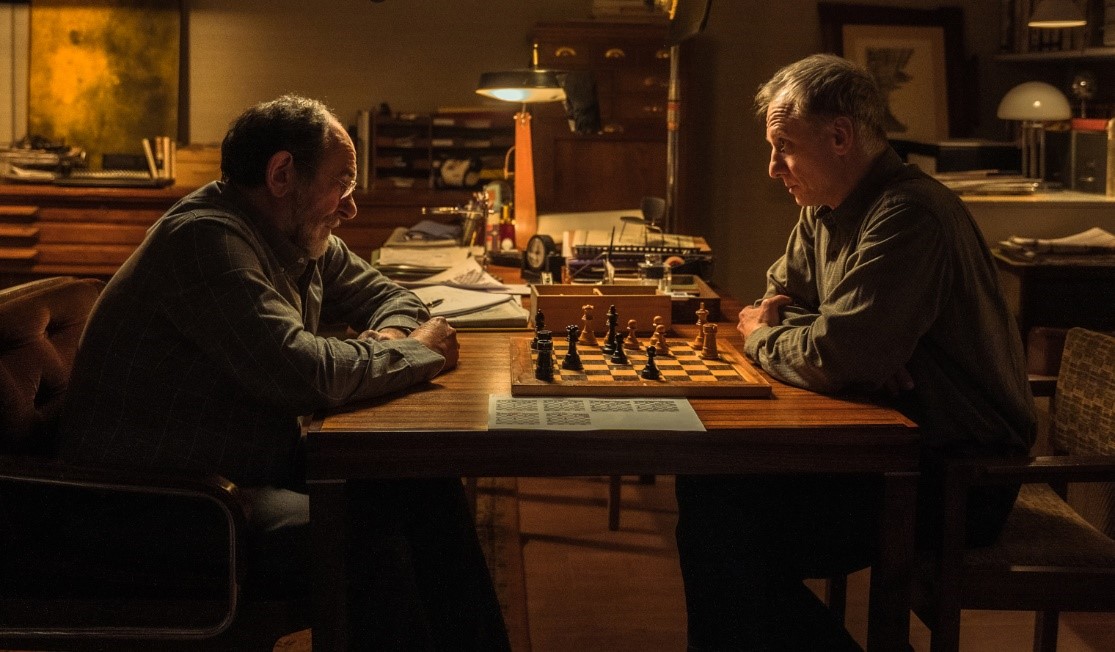
It is possible Vasil falls into disfavour because people find him too good to be true and resent both his abilities and his saint-like restraint. During a conversation/ chess game between Alfredo and Vasil the former becomes increasingly irritated as Vasil ‘checks’ every move he makes in the game apparently without any effort.
The contentious issue of immigration does not arise in the film. Vasil is such an appealing character Priti Patel would probably offer him accommodation. The theme of the movie is less about the need to extend charity to immigrants than how people cope with different types of isolation and loneliness. Alfredo has cut himself off from human contact so effectively although he offers Vasil practical assistance, he cannot bring himself to take an emotional interest in his guest. Until prompted by his daughter, he does not ask about Vasil’s origins or why he left his birth country.
Vasil has a restrained attitude, showing no negative emotions and behaving as the perfect guest; undertaking odd jobs to repay his benefactors. Yet when Alfredo speaks a few halting Bulgarian words Vasil’s desperation to make a connection with his homeland is so great he cannot hold back a grateful babble in his birth tongue. Vasil is so overcome upon meeting a pair of fellow countrymen he gets drunk lamenting they are not staying in the town.
Vasil is not a film in which grand emotions and gestures play a part. The conclusion in which Alfredo shows halting efforts to break down his emotional isolation and make a connection with others is, therefore, a gentle triumph. Checkmate.
The Viva Festival runs at HOME in Manchester 10th– 30th March 2023
