

Writer and Director: Seemab Gul
In Ghost School writer /director Seemab Gul employs the well-worn narrative device of using the viewpoint of an innocent child to expose corruption which jaded adults take for granted.
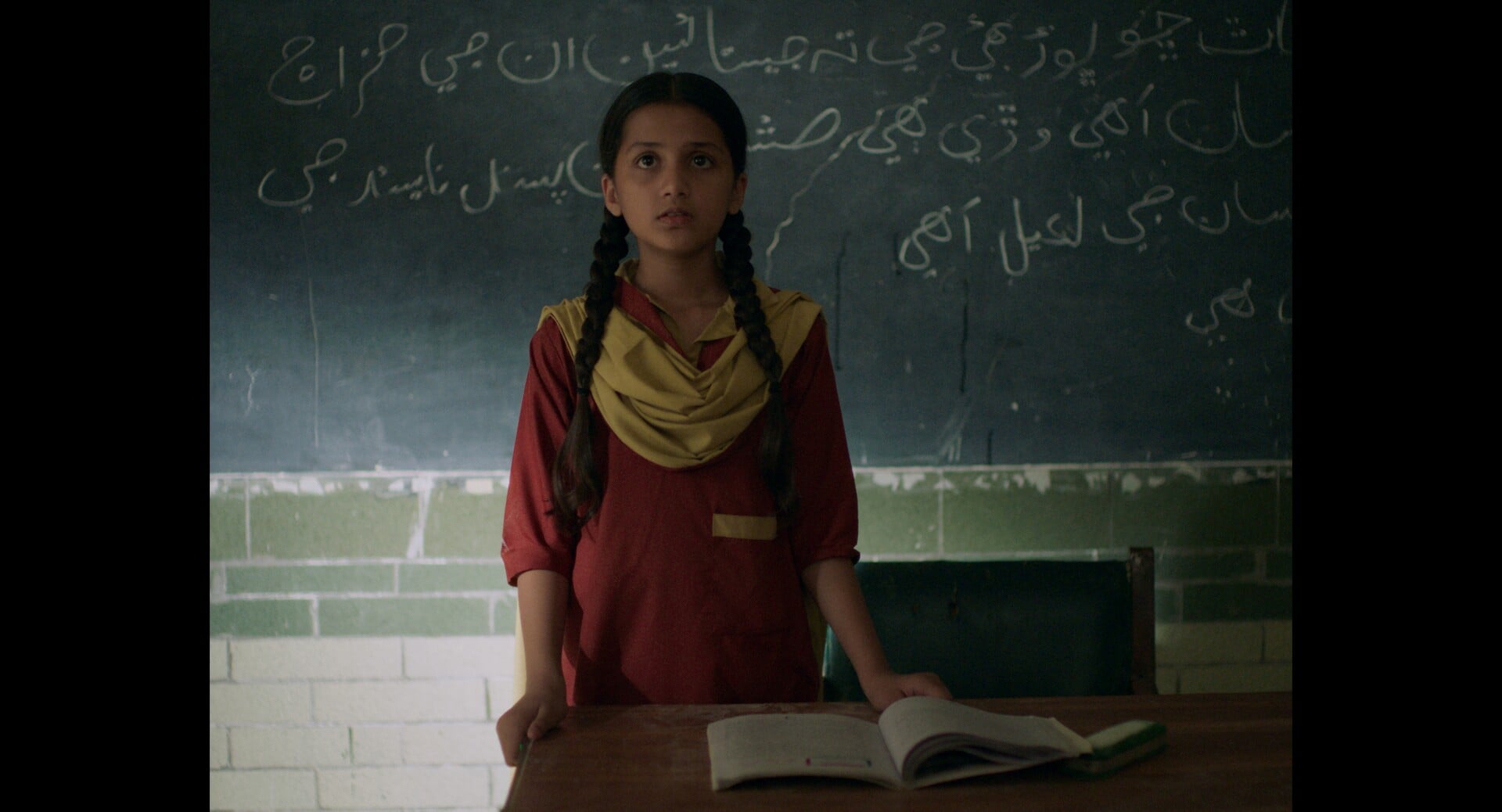
Ten-year-old Rabia (Nazualiya Arsalan) lives in a Pakistani village so poor there are no automobiles and, in the absence of playgrounds, children play football on rubbish tips. The villagers are also prone to superstition and accept the explanation that the only school in the village has been closed due to one of the teachers becoming possessed by an evil spirit. Rabia, however, is not so easily persuaded and sets out on a quest to uncover the truth.
Rabia is given an unwanted education in the ways of the world. Her teacher explains the village is run along feudal lines to benefit the wealthy landowners to whom he was expected to pay bribes for the privilege of teaching. The village school is not, actually haunted but classed as a Ghost School -an abandoned building no longer in use, often due to neglect or corruption. As Rabia is constantly frustrated in her efforts to re-open the school she devises an imaginative method to secure her own continuing education.
Nazualiya Arsalan plays Rabia as a dutiful student rather than a rebellious tomboy. There are only two occasions when Rabia loses her temper- screaming her frustration into a well and mocking a jobsworth security guard. In the main Nazualiya Arsalan is very much the representative of the audience, trying to make sense of a series of baffling events. It is an excellent performance from such a young actor leading to Rabia teaching the lessons she has learnt on her journey to an empty classroom and concluding communities have a responsibility to question everything.
Rather than relying solely on Rabia to tell the story in a gentle exploratory manner director Seemab Gul occasionally employs other characters to bluntly set out the themes of the movie. Rabia encounters an old man who advises her not to trust the lies of politicians while her uncle points out a lack of education does not make people stupid. The film most effectively makes points by way of demonstration- a market stall holder is taught basic addition and subtraction suffice to enable him to do his job but denied a higher standard of education which might enrich his life.
Rabia not only exposes the effects of institutional corruption she also confronts the prejudices of her community. Education is not held in high regard in Rabia’s village. Rabia’s mother (Samina Seher) advises it is better to be illiterate than an educated servant and the process by which the villagers ‘exorcise’ the haunted school looks a lot like vandalism. The closure of the village school is not regarded as a priority as there is another school; albeit one that admits only boys, in the neighbouring village.
Ghost School is staged as a voyage of discovery with Rabia travelling outside her village seeking answers. This enables director Seemab Gul to demonstrate visually the effect of the corruption with abandoned colleges and hospitals covered in vegetation. But as Rabia can only proceed at a walking pace there is little momentum or drama in the film.
The ending of Ghost School is both inspirational and downbeat. A widespread defeatist attitude gives the impression only exceptional individuals can escape the harsh circumstances. Rabia’s imaginative solution defies the pessimistic outlook and is a complete and delightful surprise- visually equated by director Seemab Gul to a riding a flying horse.
The rational examination of the impact of institutional corruption in Pakistan is analytical rather than emotional. Ghost School is, therefore a film which informs rather than excites but does feature an appealing and inspiring heroine.
Ghost School is screening at the 28th UK Asian Film Festival
The Reviews Hub Star Rating
-
6
