

Writer: William Shakespeare
Director: Max Webster
Is there any better theatre experience than watching Shakespeare in the place of his birth? The Royal  Shakespeare Company succeeds again, putting on a phenomenal performance of Titus Andronicus which lives up to its history and reputation for being the bloodiest of Shakespeare’s works. And with the belief that it is Shakespeare’s first tragedy, the performance is packed full of harrowing visuals of violence and murder and heart-wrenching lamentations from its faultless cast.
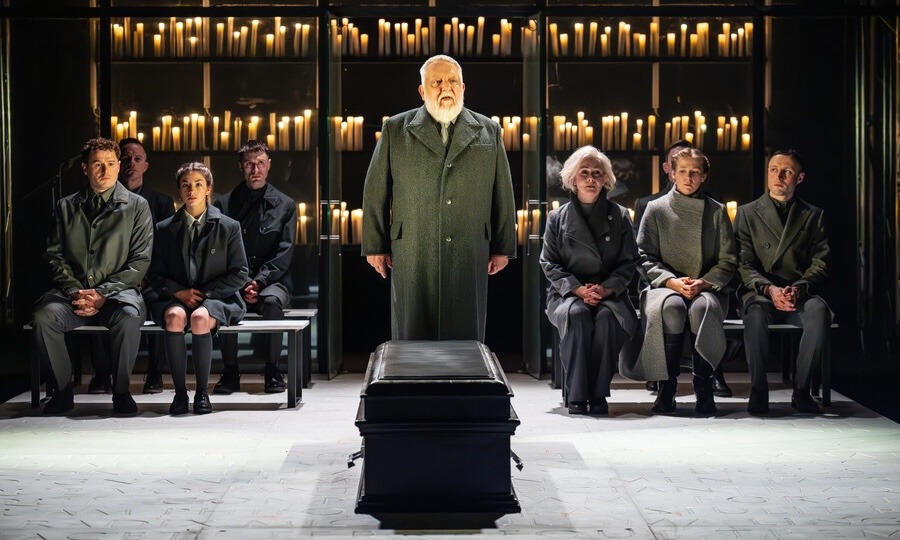
This performance is a modernised interpretation of Shakespeare’s work. While it remains true to the script, the setting and the subject matter, the production uses subtle but extremely effective modernisation techniques to bring the production forward into the 21st century: from the choice of costumes, moving away from Roman dress to suits and floor-length coats to the adoption of modern tools for violence and mayhem, such as guns and chainsaws.
The venue for this modern classic, a deep thrust stage made to look like the granite that built ancient Rome, is similarly adorned with words carved into it, as great leaders had their deeds carved into their tombs. The rest of the set, designed by Joanna Scotcher, is simple: just a series of metal benches and tables easily moved and removed by the actors themselves, although with the help of movement director Jade Hackett, even the removal of props and the cleaning of blood is turned into a dance mimicking the passage of time. The set also features an overhead rail with winches and pulleys used to great effect throughout the play and a removable section of flooring where a particularly villainous character could hide his misdeeds.
The costumes and their colour play a massive role in the production, once again masterminded by Joanna Scotcher. They alone do so much to situate the characters and develop them as individuals, with the dark greys and blacks worn by the Romans and blue worn by the Goths who begin the play in blue jumpsuits depicting them as prisoners, slowly shedding these costumes to adopt more fitting attire. For example, the young children of the Empress wear a tracksuit and a suit in blue and black showing their now mixed identity, as sons of the Goth Queen and now also, sons of the Roman Empress. But it is not just the Goths whose clothing sheds a light on their positions in the play; the new Emperor himself wears grey in public showing his proud Roman stature, but in private his wardrobe has more shades of blue as the influence of his new bride begins to twist and poison his mind against his people.
A play of this magnitude, with a script so complex and detailed, needs a strong cast. The entire ensemble performs admirably keeping the audience on the edge of their seats, never knowing what is to come, be it a powerful speech filled to the brim with sadness or vitriol; to a heinous act of revenge perpetrated against one’s enemies. The stand out performers include Simon Russell Beale who plays the titular Titus Andronicus. His performance bears much of the emotional weight of the entire production as he goes through every emotion imaginable, and does so with poise, grace and quality. From the proud and noble hero of Rome to the broken and beaten grieving father, his performance is so raw as to bring us to tears along with him.
Natey Jones who plays the Goth Aaron is another of the standout performers. A true villain with a wicked demeanour and a chilling stage presence; at times he needs only to roar or howl like a vicious beast to make the audience feel ill at ease. But there is depth to this villainous portrayal, as we do see his softer side emerge and it becomes clear that there is more to him than just the evil schemes that he masterminds. He even brings some much-needed humour to the tragedy in true Shakespearean style following the height of tensions, be it with clever wordplay or a fourth-wall-breaking gesture.
With a production this raw with emotion and so full of potential discomfort, it is important that the actors are comfortable and able to perform without suffering the ill effects of what is being asked of them, whether it is the intimacy of a passionate romance scene or a disturbing depiction of violence and murder. The RSC brought in intimacy coordinators Rachel Bown-Williams and Ruth Cooper-Brown to ensure that all precautions are taken, a brilliant step to ensure that the play can be seen and enjoyed by the audience without fear of anyone breaking down and being unable to perform. A move towards this being an industry standard for performances of this type would be a welcome sight for sure.
Overall, Titus Andronicus is at times harrowing, disturbing and even stomach-turning, but at all times it is magnificent, masterfully directed by RSC debutant Max Webster and wonderfully performed by the whole ensemble who throw everything at the performance and leave a crimson red stain on the stage and the audience’s memories.
Runs until 7 June 2025
