

Writers: Olivier Assayas and Emmanuel Carrère adapted from the book by Giuliano da Empoli
Director: Olivier Assayas
Adapted by Olivier Assayas and Emmanuel Carrère, and directed by the former, The Wizard of the Kremlin seeks to demonstrate how the rise of Vladimir Putin was pre-determined by events within Russia and the attitude of the Russian people.
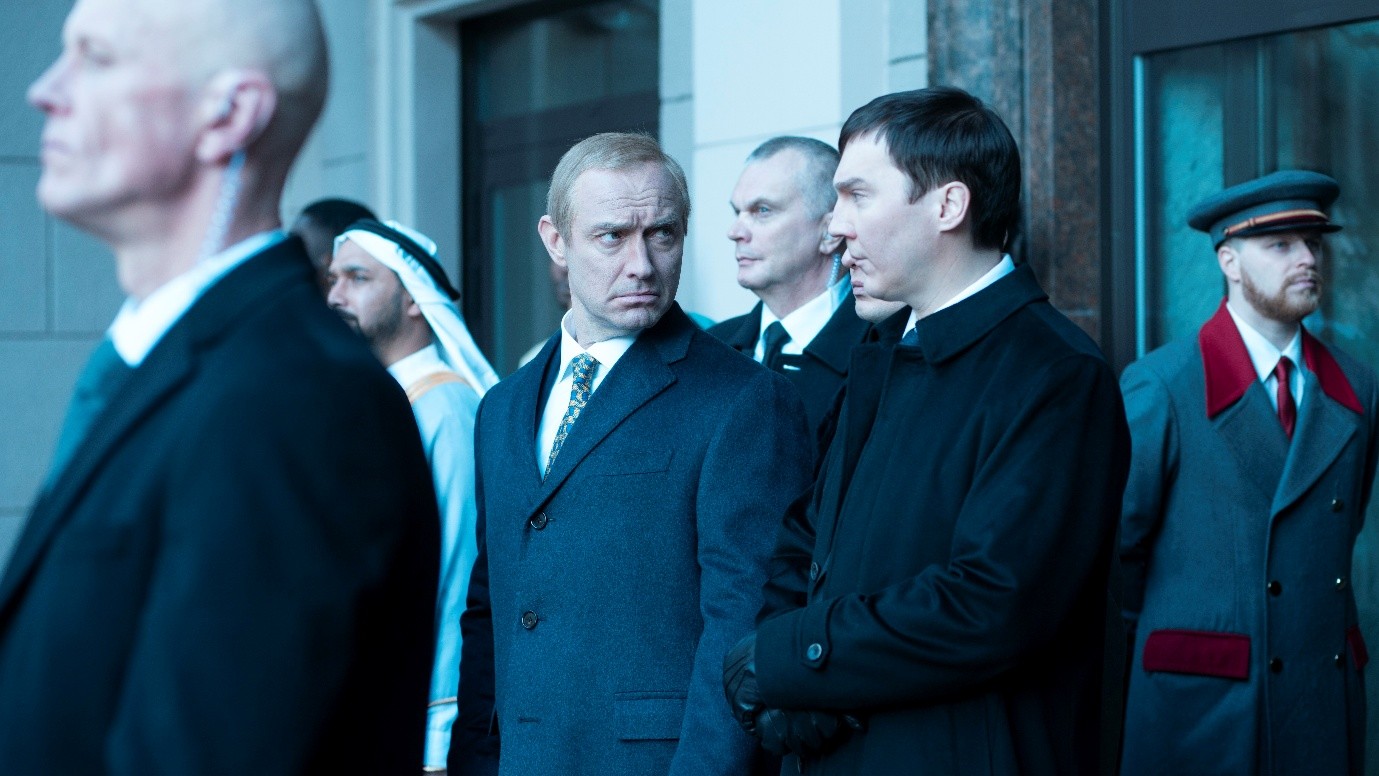
In 2019 American journalist Lawrence Rowland (Jeffrey Wright), in Russia for research purposes, is stunned to be invited to meet Vadim Baranov (Paul Dano) who is credited with helping Vladimir Putin (Jude Law) rise to, and retain, power. Baranov explains, as the health of Soviet leader Boris Yeltsin began to fail, oligarchs with a vested interest in maintaining the status quo decided to invent a new leader and picked Putin as a suitable candidate; thinking he could be controlled via their careful guidance. Putin, however, has other ideas and prefers to take advice from Baranov so their relationship becomes the modern-day equivalent of the Tsar and Rasputin.
Although set in Russia The Wizard of the Kremlin is aimed at western audiences necessitating Paul Dano serving as a narrator figure and Baranov’s autobiographical recollections also providing viewers with factual details. Director Olivier Assayas does not, however, stop there and fills dialogue with exposition resulting is stilted speeches. When Baranov first meets shady television proprietor Boris Berezovsky (Will Keen) their conversation conveniently informs the viewer about the lawless state of Russia by outlining Berezovsky’s dodgy dealings and allowing him to detail the violent actions of his gangster-like rivals. All of the characters in the film serve to illustrate viewpoints- Alicia Vikander is a love interest for Baranov but also comments on the stale decadence of Russia in the Yeltsin period and on the limitations of wealth.
Stories involving one person helping another rise to power often involve a loss of innocence. This does not really apply with The Wizard of the Kremlin where all of the characters are nihilistically cynical. Before Baranov adopts a bohemian existence as an avant-garde theatre director in Moscow he is a hustler, peddling knock-off electrical goods. There is even a Russian equivalent of Gordon Gekko with Tom Sturridge’s Dmitri Sidorov promoting the virtues of greed and opening a bank. It is, therefore, more a film about greedy, ruthless people encountering someone who is even worse.
Paul Dano’s Vadim Baranov (a fictionalised version of Putin’s Spin Doctor Vladislav Surkov) is a frustratingly enigmatic figure. Possibly overwhelmed by the verbosity of the script Dano plays Baranov as a soft-spoken bureaucrat devoid of opinions. When Jeffrey Wright’s Rowland mentions evidence the Russian authorities fabricated a terrorist outrage within Moscow to justify the Chechen wars Baranov falls back on the bland politician’s response that such things were above his pay grade and he cannot comment. The dispassionate approach applies also to the relationship between Putin and Baranov so there is no dramatically-satisfying sense of betrayal or of friends falling out.
The heavy-handed narration makes for a sluggish pace. Rare visual storytelling comes as a welcome change- an ailing Boris Yeltsin is incapable of sitting erect or completing a speech and so has to be strapped into a chair and his speeches compiled for television using cut-and-paste from past recordings.
Power is a major theme of the film; Baranov explains in America, money is everything; but in modern day Russia, if you don’t grab power it grabs you- as personified by Jude Law’s Putin. Law dials down his charisma for a dead-eyed thuggish interpretation of a mobster turned politician; in a possible poke at the current occupant of The White House he claims to have no interest in The Nobel Peace Prize. Putin’s lust for control is so great Baranov even manufactures dissenting groups on the internet to keep possible opposition under his thumb. Putin’s ruthlessness is demonstrated in him allowing the crew of the stricken Kursk submarine to perish despite public protests and offers of help from other nations.
The suggestion that Putin’s political longevity is attributable to Russian disdain for liberal democracy (even if it brings the benefits of capitalism) and nostalgic preference for strong leaders, through whom they can channel their rage and resentment, is deeply depressing. The emphasis in The Wizard of the Kremlin is on informing, rather than entertaining, the audience so satirical barbs and dramatic developments are kept to a minimum and the emotional impact of the film is less than might be expected.
The Wizard of the Kremlin is only in UK & Irish cinemas from 17 April. Distributed by Signature Entertainment
The Reviews Hub Star Rating
-
6
