

Writer: Polina Polozhentseva
Translators: John Farndon and Kseniia Kozilevska
Director: Valery Reva
Anybody who’s ever travelled to rural locations, or has relatives who live in such places, knows that there are pockets that feel untouched by the wider world, as if they exist in a pocket of time where the 21st century – sometimes even the 20th – has yet to discover them.
To modern metropolitan sensibilities, they can feel like backwaters. But in a country like Ukraine, which has been embroiled in war for the last four years, any such place could offer a welcome respite.
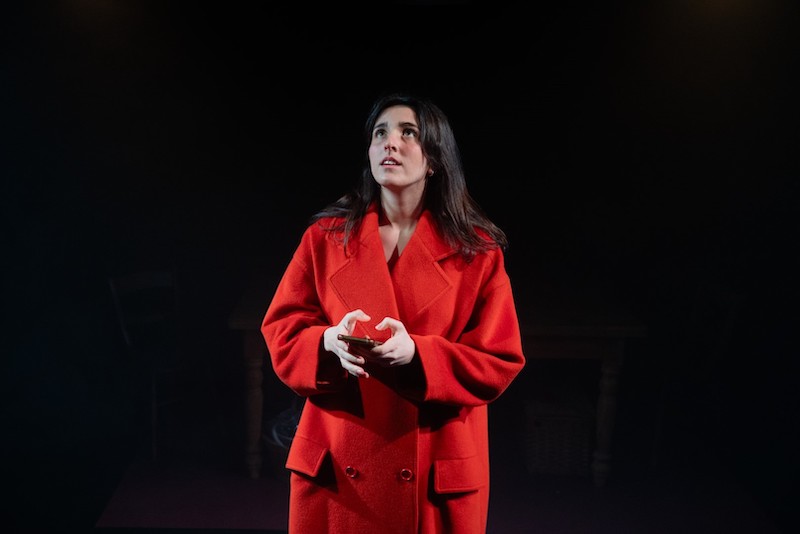
Such is the fictional village in which Sofia Natoli’s Lukyana finds herself in Polina Polozhentseva’s The Village Where No One Suffers. Lukyana, who left Ukraine to work in Poland, has returned to the place where her grandmother raised her, challenged by the matriarch’s dying wish that she stay for at least a month. Despite being near the larger cities of Kharkiv and Dnipro, the community is largely free of the drone attacks that the rest of the front line has to deal with, and none of its residents has yet been called up to join the army.
For Lukyana, there are more pressing concerns: no local shop and a very limited bus service mean she must be more self-sufficient than she is used to. Natoli gives us a spiky, not always warm lead character, a woman who is happy to reunite with her ex, Pasha (Christopher Watson), even as her attentive fiancé calls and texts regularly from Poland. Watson’s character is similarly elusive, his motives unclear other than to illustrate the allure of a previous, simpler life than the one Lukyana had built for herself in Poland.
Completing the cast is Nailah S Cumberbatch as the neighbour, Aunt Valya, whose relationship with Lukyana’s grandmother helps to drive the show’s magical realist side. The grandmother was, we learn, something of a local shaman, whose healing hands did not work as well once she started charging for her services.
As Lukyana gradually adapts to a simpler way of life – a spot of dough-making here, a hole-ridden wool jumper there – modern life starts to encroach. An air-raid alert joins tales of men being conscripted, as the modern Ukraine finally catches up with this small enclave. The implication, made explicit by Aunt Valya, is that it was the grandmother’s magic that was protecting the village, which kept it off the map both literally and figuratively.
As the one-hour play reaches its climax, Lukyana must decide whether to take on the role her grandmother once played. While Polozhentseva’s script leans into the story’s fabulist side, one can see the morality behind the metaphor. Communities such as this Ukrainian village survive only through personal sacrifice. Her grandmother helped the village, but was stuck in an unhappy marriage with a drunkard, Lukyana’s father, for a son.
Her granddaughter’s decision involves saying goodbye to a life in Poland and returning to the shop-free, bus-light village – but in doing so, and if she can tap into the same mysticism exhibited by her grandmother, may just save the community from the devastation of war. And if one village can hold on, then maybe, just maybe, the country can too.
Runs until 28 February 2026
