

Writer: Alex Rugman
Director: Anna Ledwich
With echoes of two literary sci-fi novels, Martin’s McInnes’s Ascension, longlisted for the 2003 Booker Prize, and Samantha Harvey’s Orbital, which won the Booker in 2024, The Urmetazoan follows a female scientist preparing to enter space and set up home on Mars. It’s a strong debut by writer Alex Rugman and impeccably directed by Anna Ledwich. However, the discussions about space travel and the possibility of extraterrestrial life are more compelling than those of doomed love affairs and sororal bonding.
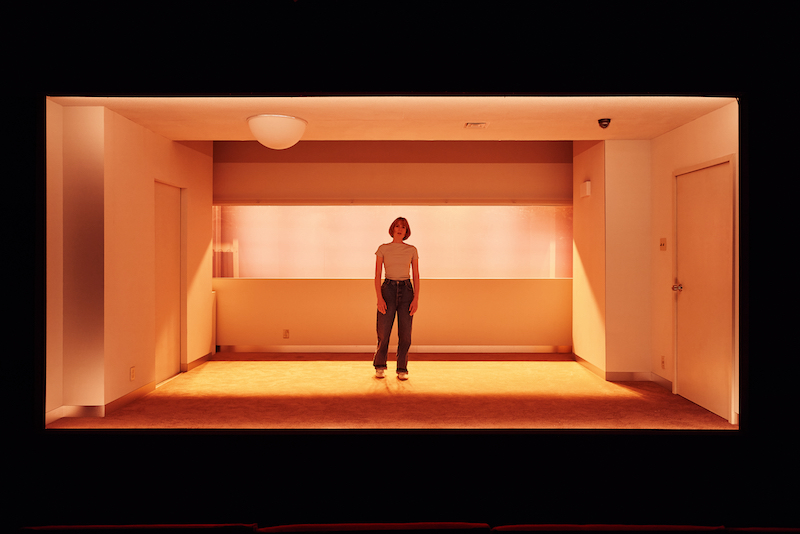
With just a few weeks before rocket launch, Alice is in a Florida apartment packing up her stuff in boxes and deciding what to take with her to the biodome on the red planet. Her sister Abigail has come to stay. They’ve not spoken for seven years, and their relationship is uneasy. There’s talk of Abigail once stealing Alice’s friend Lydia, but the tension between them suggests that other family secrets have driven them apart.
Meghan Treadway’s Abigail is fun, but with a malicious streak, goading her sister all the time. When Alice (an excellent performance by Dorothea Myer-Bennett) talks about her research that won her a Nobel Prize in Medicine, Abigail feigns disinterest and accuses Alice of being self-obsessed. Abigail is pointedly bored when Abigail explains to her the Fermi Paradox, which asks why, with so many billions of other planets out there, we haven’t found any trace of extraterrestrial beings.
With the stage dark and lit up like a planetarium, Alice continues with the darker answers to the question: that there were once other forms of life in the universe, but they are now dead; that indeed, we could be the only life left, but destined soon to join the intergalactic graveyard. These ideas are marvellously fictionalised in McInnes’s Ascension, when a female astronaut sets out to find this event that impels life to destroy itself.
But Rugman in The Urmetazoan brings us back to Earth when Alice’s ex-boyfriend Will is introduced. His appearance in his first scene, when Alice begs him for sex before she goes into space, is played in shadows, adding some mystery and illicitness. But his later scene with Abigail goes on for far too long, particularly when the rest of the scenes are short. Ben Allen gives a strong performance, but this play could work better as a two-hander between the sisters.
Ledwich brings a sense of eeriness to the play by inserting enigmatic tableaux between the scene changes. At one point, Abigail is holding a dead animal in her hands, but when the lights come on again – time has passed – the animal is gone, but her hands are still lifted, cradling loss. These directorial decisions ensure that every moment is loaded with meaning. Jonathan Chan’s lighting design, mostly shadows with daylight seeping in behind the condo’s blinds, maintains the tension as the lift-off beckons.
That we can’t escape being human, even if we decide to leave Earth, perhaps explains Will’s presence in this play. But The Urmetazoan’s other ideas about ecology, science, space and neo-colonialism are gripping and smart. This is an intelligent debut by Rugman,
Runs until 24 October 2026
