

Writer and Director: Emilie Blichfeldt
Adapting classic fairy tales for the screen is currently a risky business. Disney’s filmed version of Snow White crashed and burned. Yet the daring approach taken by writer/director Emilie Blichfeldt to The Ugly Stepsister successfully turns Cinderella into an imaginative, if occasionally stomach-turning, cautionary tale/satire on the present-day obsession with beauty as a pathway to desirability, success, and social status.
In the fairy-tale kingdom of Swedlandia Elvira (Lea Myren) is a typical teen – subject to spots, pudginess, wearing braces on her teeth and dressing like a country bumpkin. However, Elvira’s shortcomings do not matter until Prince Julian (Isac Calmroth) invites all women past the age of puberty and still a virgin to a royal ball to audition to be his bride. Alma (Flo Fagerli), Elvira’s younger sister, enters puberty after the invitations are issued but before the ball takes place so becomes eligible to attend but , upon seeing the physical hardship inflicted upon her sister, wisely keeps her mouth shut and stays home thus proving herself to be the most sensible character in the movie.
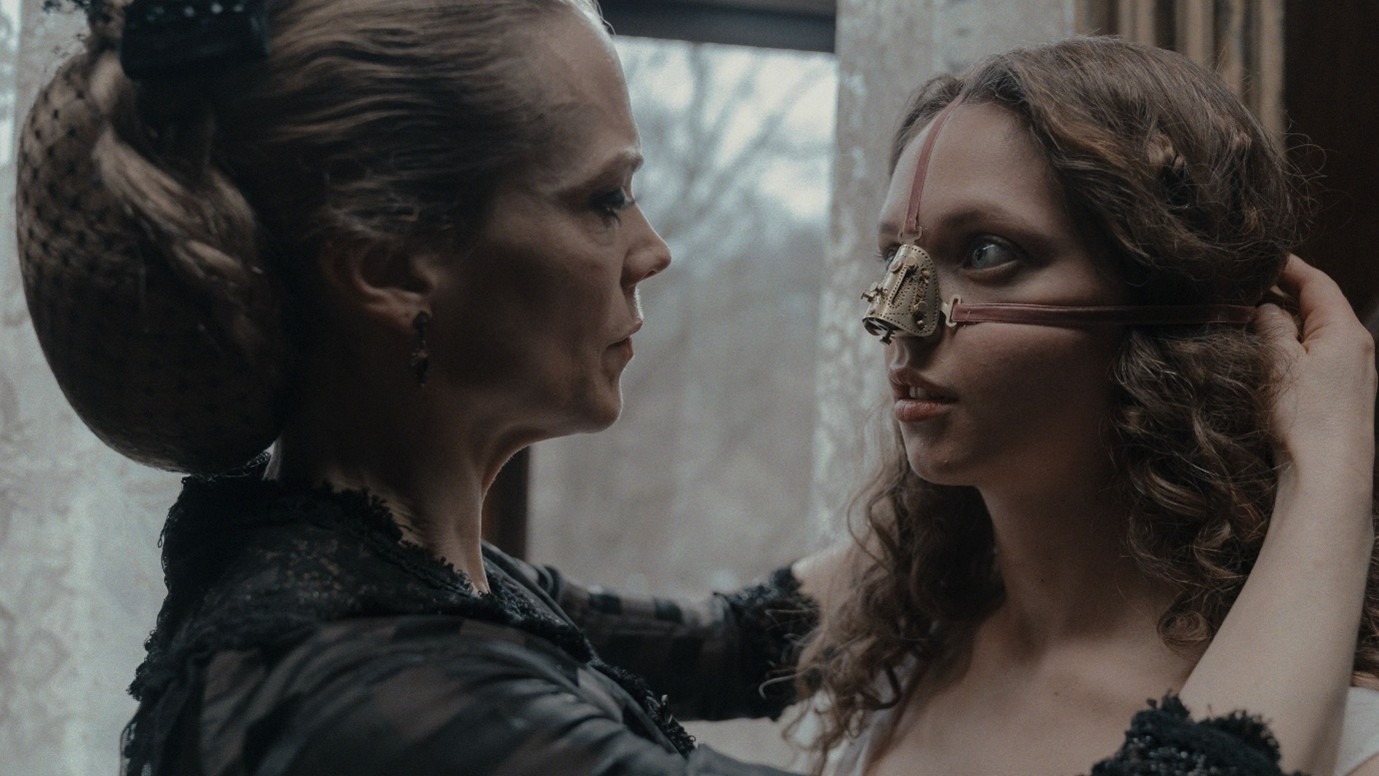
Elvira’s mother Rebekka (Ane Dahl Torp) has recently remarried and almost instantly becomes a widow. Elvira is initially in awe of her new stepsister, Agnes (Thea Sofie Loch Næss) who is comparatively urbane, well-dressed and confident. But the invitation makes Agnes a rival for the Prince’s affections. Agnes has obvious advantages being blessed with natural grace and attractiveness whereas Rebekka has to bribe dance instructors and teachers of deportment to take her daughter as a pupil. To please her mother Elvira submits to primitive beauty procedures and becomes increasingly obsessed with her appearance.
When Agnes disgraces herself having a fling with the stable lad, she is consigned to work in the kitchen and sleep in the cinders leaving the way clear for the new, improved Elvira to seduce the Prince. However, this does not take account of possible mystical intervention.
A grim irony hangs over The Ugly Stepsister. Despite the title, Elvira is awkward rather than ugly. Elvira is a romantic at heart and genuinely enjoys reading the poetry attributed to the Prince. However, when she and other candidates are paraded (in the manner of contestants in a beauty pageant) before the Prince and their hobbies are listed this fact is ignored. The central irony is that Elvira is only trying to capture the heart of the Prince because she is desperate to please her demanding mother.
Writer/ director Emilie Blichfeldt is merciless in satirising the extremes of the beauty industry. The primitive rhinoplasty endured by Elvira (basically, just breaking her nose with a hammer and chisel) is one of many sequences hard to watch. One of the more infamous scenes in movie history is the opening of Un Chien Andalou where a razor slashes across an open eyeball. A gory sequence of sexy fluttering eyelashes stitched into Elvira’s eyes is just as disturbing and lasts longer.
Elvira endures casual groping from the dressmaker and leering and crude remarks from the Prince’s friends. There is an urban legend that eating tapeworm eggs will cause the parasite to grow in one’s stomach and consume calories thus allowing eating without gaining weight. The horribly graphic way in which director Blichfeldt shows the tapeworm purged from Elvira’s stomach will deter anyone from considering this daft practice. When Elvira shows signs of strain, with her hair falling out, her mother’s response is pragmatic not sympathetic; she does not reduce the pressure on Elvira but has her fitted for a wig and fed, possibly addictive, sleeping potions.
Blichfeldt shows respect for the source material but adds a peculiar/ perverse twist. As told by the Brothers Grimm, mystical silkworms spin the silk for Agnes/Cinderella’s dress. However, the silkworms hatch from maggots that grew in the rotting flesh of her father’s corpse. Blichfeldt adheres to the legend that Elvira mutilates her feet to get them to fit into the mystical slipper but adds an unbelievably cruel punchline.
Binge eating symbolises Elvira’s corruption and acceptance of the concept of idealised beauty. For most of the film Lea Myren portrays Elvira as an innocent pushed out of her depth. She maintains childlike facial expressions of puzzlement and disappointment moving to glee as she begins to acknowledge the possibility of success. Greedily stuffing her face in a gross manner, confident she will not gain weight, is the only indulgence Elvia can allow herself in a situation where all her actions are determined by the need to pursue beauty.
The Ugly Stepsister subverts the concept of ‘body horror’ to demonstrate how the relentless pursuit of ‘beauty ‘gives rise to the unnatural transformation of the human body. A challenging script and strong performances hold viewer attention despite the temptation to look away during some of the more gory scenes making the film a tremendous , if discomforting, success.
The Ugly Stepsister will be In US Cinemas from 18th April and UK Cinemas from 25th April and available to purchase across digital platforms from 9th May
