

Writer: Wole Soyinka
Director: Dr Mojisola Kareem
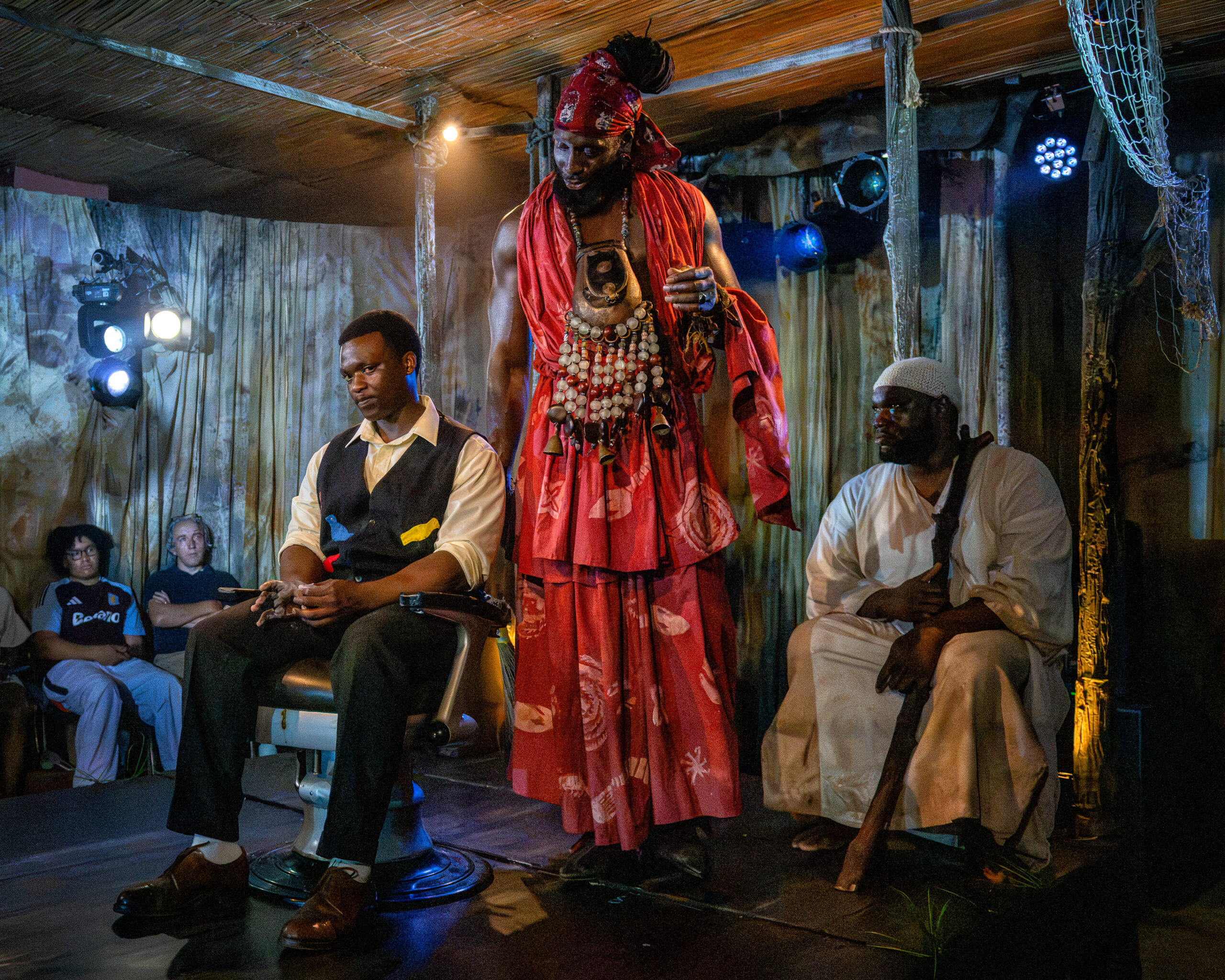
The impact of this spell-binding play begins when you enter the theatre. One presumes that it’s simply a large performance space in its everyday life, but we enter through hangings redolent of a swamp with rushes on walls and ceiling. There in the centre is the stage, with gnarled wooden supports on all sides (design by Sarah Lewis-Cole). The furniture is limited, but there is a barber’s chair, the sort that goes up and down, round and round, placed prominently. Before the start we know that we will be sharing the action and the ritual.
This is an early play of Wole Soyinka, written in 1958, just after his graduation from Leeds University, just before Nigerian independence. It contrasts the old Nigeria of the villages with its binding superstitions with the modern Nigeria of the city, with its obsession with wealth (via oil or timber or whatever), which is superseding the life of the villages. Soyinka does not take sides in the generational conflict; he deals with humanity.
Initially the play begins with an extended duologue between Makuri and Alu who has a mother’s divination that her sons are dead. One has been ten years in the city becoming (apparently) very rich, but never communicating with his parents. His twin, Igwezu, has just returned from the city to see how things are with his plot of land – sadly, submerged by the excessive rainfall – and has not come back from checking it out. This opening section is frequently comical, with Makuri mocking Alu’s belief that her son could forget the way so soon.
The spiritual asserts itself with the arrival of a blind Muslim beggar who has witnessed the destruction of his whole village’s crops by locusts and therefore has decided to follow the river as far as he can – which is Makuri’s place as the river gives way to swampland at this point. His acceptance of all that Nature has to offer contrasts with the arrival of the Kadiye, priest-servant of the Serpent of the Swamp, who grows fat on the gifts of the villagers.
Igwezu returns totally ruined financially and now brought to destitution thanks in part to his brother who has lent him money against his next, now lost, crop. Almost the last scene of the play sees him confronting the Kadiye in the barber’s chair where the priest has determined to have his first shave at the cessation of the rain, having renounced all bodily cleanliness during the extraordinary rains.
Dr Mojisola Kareem balances the naturalistic and the ritualistic perfectly in her production. Theo Ogundipe (the Kadiye) takes forever to reach the stage through the audience, heralded by the astonishing drummer Ayan de First and followed by an attendant with fly-whisk at the ready (Omobolanle Akanbi). If perhaps not quite as fat as the text suggests, Ogundipe cuts a really impressive figure, his complacent delivery moving from dominant to neighbourly – until Igwezu disturbs his bland acceptance of power.
Obi Maduegbuna’s Beggar radiates spirituality and glories in Soyinka’s poetic passages about natural growth and destruction and as Igwezu Joshua Roberts-Mensah, in his suit a contrast to all other characters, provides an almost silent commentary on the village-city divide – until he finally explodes at the Kaidye in the play’s most shocking moments.
Jude Akuwudike (Makuri) and Urielle Klein-Mekongo (a gloriously expressive Alu) set us off to a fine start and Akuwidike’s increasingly taut and desperate performance becomes a study in torment – how is he to appease the Kadiye?
The Swamp Dwellers apparently was performed in the UK soon after its completion and then never again until now. It’s tempting to say it has a place in the repertoire choices of modern theatre companies, but that presumes productions as enthralling as Utopia’s.
Runs until 11 July 2026
The Reviews Hub Star Rating
-
10
