

Music: Benjamin Britten
Libretto: Ronald Duncan, after the play by Andre Obey
Directors: Eleanor Burke and Alex Gotch
Benjamin Britten’s chamber opera is not an easy evening. Written in 1946 to a libretto by Ronald Duncan, it tells of the violation of the Roman noblewoman Lucretia by the Etruscan prince Tarquinius, and her subsequent suicide. It is a work of shattering moral weight and extraordinary musical economy, scored for just 13 instruments and eight voices. Getting it right demands singers who can carry the full dramatic burden of the piece without an orchestra to hide behind. Hampstead Garden Opera, performing in the converted church space of Jackson’s Lane in Highgate, largely delivers.
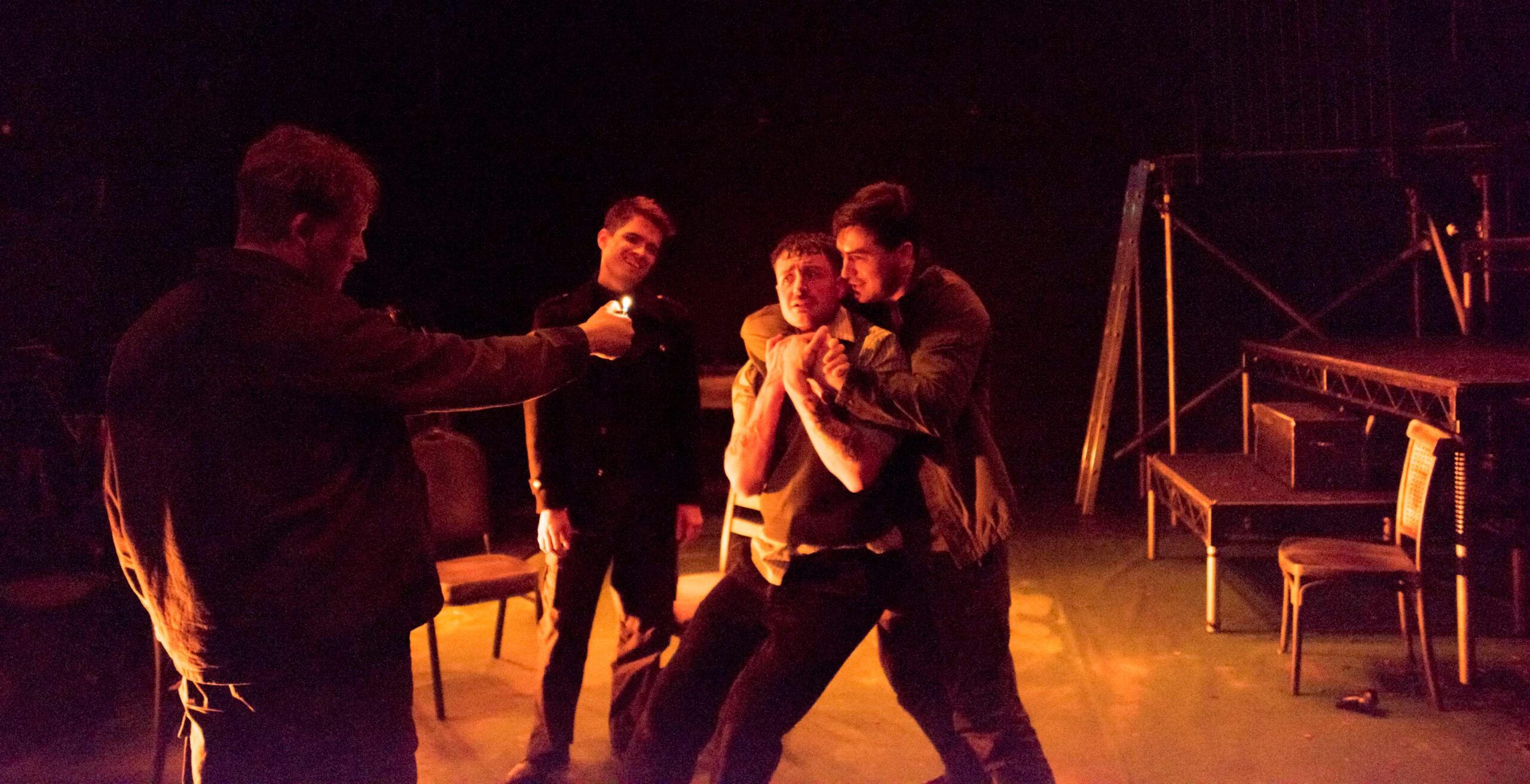
The staging itself is one of the production’s most striking decisions. Rather than a raised stage, the action unfolds on the floor of the venue, with the audience seated on raked tiers in front. The chamber orchestra, under Oliver Cope’s assured musical direction, occupies the left third of the performance space, the remainder given over to a multi-level scaffolding structure that is industrial and spare in equal measure. What makes this design genuinely memorable, however, is the lighting. With the primary source coming from the orchestra side, the cast spend much of the evening in heavy side-light, one half of their faces illuminated, the other cast into shadow. It is an elegant visual metaphor for a work preoccupied with the duality of human nature, and it gives the whole evening an ominous, unsettling quality that serves the material well.
At the centre of it all is Emma Roberts as Lucretia, and she is exceptional. Vocally she is stunning, with a richness and precision that fills the space with ease, and dramatically she makes Lucretia’s transformation from serene domesticity to broken despair feel entirely credible. It is a performance of real authority. Stephen Whitford brings brooding conviction to Tarquinius, and Daniel Gray Bell navigates the Male Chorus role with intelligence, if the narrating function itself remains one of the opera’s more structurally awkward features.
Olivia Rose Tringham as the Female Chorus brings considerable vocal power, occasionally to the point where she tips the balance against her fellow performers, though this is a minor friction in what is otherwise a uniformly committed ensemble. The voices and the chamber orchestra fill the church acoustics with something close to beauty, which is precisely as it should be.
That beauty, though, is also where the production runs into difficulty. The opera’s two most consequential scenes, the rape itself and Lucretia’s suicide, are handled with a stylised restraint that is clearly deliberate and, in its way, tasteful. But tasteful is not quite what Britten’s score demands. Both moments feel underplayed to the point where their dramatic impact is absorbed rather than landed. The horror and the tragedy are present in the music; the staging seems to deflect them. For a first-time audience, in particular, there is a risk that the central acts of the drama pass without registering the full weight they should.
The absence of surtitles adds to this difficulty. Jackson’s Lane is not a purpose-built opera house, and the practical realities of Hampstead Garden Opera as a charitable company mean that certain resources are unavailable. It would be churlish to penalise a production that achieves so much within its means, but those unfamiliar with the libretto will inevitably find themselves tracking the emotional shape of scenes without access to their finer detail. On a work this compressed, where every line carries significance, that is a real loss.
HGO’s production of The Rape of Lucretia is a genuinely impressive achievement, distinguished by staging that finds visual intelligence in its limitations. The bleakness of the work lands, and the evening carries real weight. Where it falls short is in its handling of the opera’s most pivotal moments: a restraint that reads as artistic choice but functions as emotional evasion, leaving the two scenes on which everything turns feeling curiously muted.
Runs until 26 April 2026
