

Writer: Ellis Green
Director: William Homer
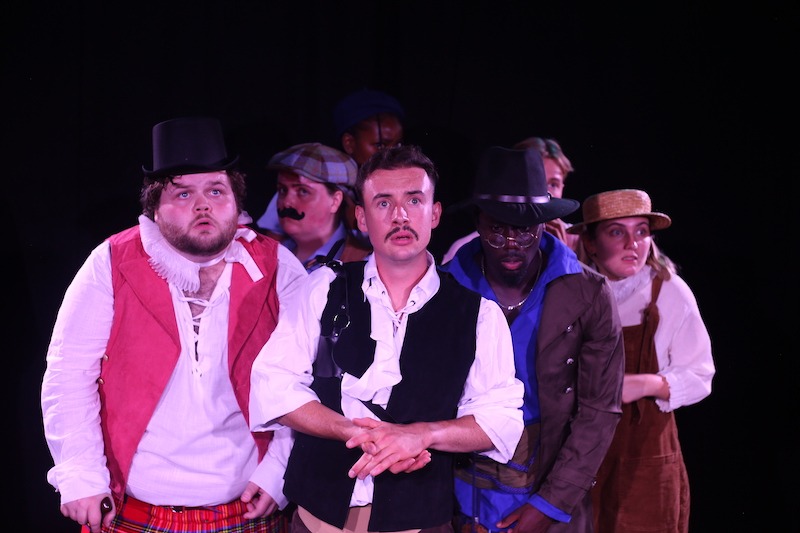
In a faraway kingdom, an acting troupe has been performing the legend of the nation’s ruler, King Diadon, for over 18,000 performances. But finally, the king has grown bored and demands some other form of entertainment. If they fail, the players face execution. So, no pressure then.
The Players of Diadon started life as a devised piece by eight graduating students from Guildford School of Acting for their end-of-year showcase, a performance ultimately cancelled due to Covid-19. And that shows in the ensemble nature of the piece, with nearly every character being given a moment in the spotlight.
Initially starting as a farce, the broad comedic strokes may remind one of commedia dell’arte with its Renaissance trappings and story of a troupe of actors travelling the country and delivering their tale with no sense of subtlety. That sense permeates into the characterisations of the actors in their offstage moments, too. Everyone is an extreme here, from Emily Candice’s Knobby, a former Colonel in the army now condemned to a life in the arts, Jessica Enemokwu as the ambitious Camille who feels she should be the lead and Matt Wake’s Calvin, who is the true lead and refuses to give up the position because he can do nothing else.
In truth, the exploits of the troupe as led by their director, Wandsworth (Ellis Green), have a more limited scope for comedy than the writing recognises. The joke of this broad sitcom-like structure wears thin quite quickly. The introduction of new player Ricky (Toby Thompson), who has committed the sacrilegious act of thinking up other stories, helps to move the story onwards, especially in his friendship with the company’s most eager player, Chloe Cooper’s Huzzah (an odd name that seems to have been created for one joke).
As the company struggles to come up with a replacement play in the few days that they have been given, character conflicts emerge, especially between Rick and the author of the original play that the company has been performing. Tijan Sarr’s Polonius – as convincing an old man as it is for a young actor to achieve – is wary of change, having written the company’s long-running work based on being present at the events he has chronicled.
In the latter stages of this play, the farce fades away, and the mood shifts to other matters. When the king’s history has been immortalised in one form, and when that has become the established “truth”, what happens when the players attempt to dramatise what really happened?
There are philosophical questions at play here about how history is written by the winners, and how that means that other narratives, events and motivations are susceptible to erasure. But while The Players of Diadon does express some of that, it does not help itself by introducing the character of King Diadon as a disembodied voice with which the onstage cast argue and debate.
The conclusion of the story thus feels muted, neutered even. While the onstage antics of a group of caricatures can grate, their interactions are so much more involving than those they have with their king. And that means that the shift into seriousness, while mercifully truncating some of the forced comedy of the play’s opening moments, also robs The Players of Diadon of its central charm.
Reviewed on 29 July 2025, then at Other Yin – Patter House, Gilded Balloon, Edinburgh 16-25 August 2025
