

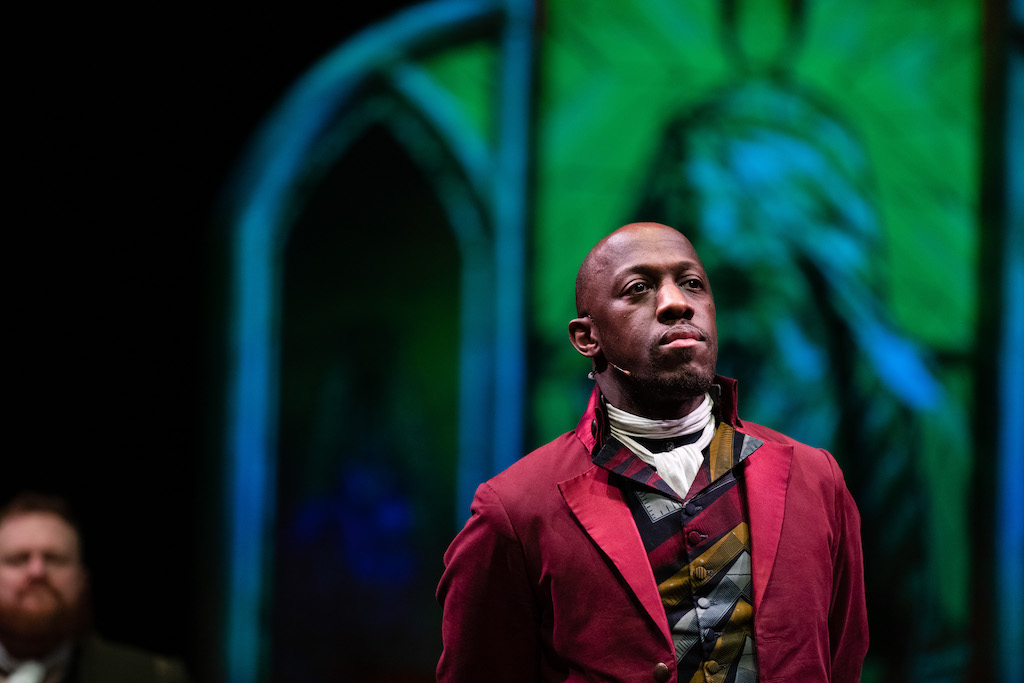
Writer: Giles Terera
Directors: Tom Morris and Giles Terera
First performed as a radio play during the pandemic, Giles Terera’s play The Meaning of Zong received its stage premiere at the Bristol Old Vic and is now touring. It is a multi-layered piece about black identity, the attention given to slavery as an experience within British rather than African history, and a determination to outlive it. Terera’s play is based on a true story, a legal case that turned an insurance claim into an accusation of murder, and combines court transcripts, real and imagined scenarios and the published account of campaigner Olaudah Equiano known for a time as Gustavus Vassa.
In 1781 the crew of the slave ship Zong throw 132 slaves overboard, leaving them to drown, claiming shortage of provisions. Later an insurance claim for the ‘lost cargo’ is approved by a British court. When a chance to contest the decision arises, Gustavus Vassa approaches Granville Sharp, a legal expert, to protest the proceedings by documenting and printing a transcript of the case. Deeply affected by three women lost on the ship, Vassa starts to accept his own heritage and embraces his true name.
The Meaning of Zong was a really atmospheric experience on the radio and Terera, along with co-director Tom Morris, has transferred much of that to this expanded production that travels seamlessly between the courthouse, various London locations, the bowels of the slave ship and to a mystical place in Equiano’s imagination. There are some strikingly theatrical moments in Jean Chan’s set design that brilliantly transforms Westminster Hall into the inside of the ship using some upturned buttresses, as well as a long sequence staged in the water as the character of Ama fights for survival among a combination of blue ropes, swirling animation created by Tom Newell and Zeynep Kepekli’s lighting.
And the story is well constructed on the whole, blending together the London action with the developing experience of the slave women seized in Africa and kept in terrible conditions on the ship. The longer Act One is the stronger, using the build-up to the legal battle to frame the story and give it momentum as Equiano gathers his evidence, and Terera finds lots of contemporary commentary about hiding or embracing black identity, the inherently racist nature of British society and its willingness to turn away. “They know it’s wrong,” Terera’s dialogue exclaims, “they just don’t want to do anything about it.”
Act Two does lose some of that momentum spending a long time exploring the last days and moments of the women onboard and the sensation of drowning that becomes an almost spiritual experience. This is where most of the new material has been added, an important focus on the consequences of the dry legal distinctions happening thousands of miles away, but it means the piece feels like a different kind of show in the final hour.
Terera has been entirely dedicated to the stage in recent months with back-to-back performances at the National Theatre (Blues for an Alabama Sky and Othello), going straight into this tour but his passion for the character and for telling this story is clear. Tristan Sturrock’s Granville Sharp is challenged by his new friend and forced to consider his own innate prejudices while Kiera Lester as Ama, Kezrena James as Riba and Bethan Mary James as Joyi evoke the fear and momentary hope of the women relying on their heritage and their courage to see them through.
Occasionally the dialogue is a little stilted as it tries too hard to signal its underlying messaging but The Meaning of Zong uses its staging choices and the development of its central character to deliver an important lesson in British history.
Runs until 23 April 2023
