

Writer: Alys Williams
Director: Andrea Heaton
In a rare repertory season, Park Theatre’s Make Mine a Double night presents two contrasting shows by female artists. Alys Williams’ The Light House is a single narrative about mental health structured a little forcibly around the naval man overboard protocols as the narrator tries to support a partner in distress. Not quite doing enough to ground the central love story in either of its characters, Williams’ play takes an innovative approach to audience engagement but leans into unearned sentimentality in the unfolding of the story.
Alys and Nathan fall in love in Paris, walking along the Seine and talking into the night but months later, Nathan is admitted to hospital in Ireland following a suicide attempt. Trying to navigate social and in-patient care becomes harder to fathom as Alys tries to keep Nathan afloat.
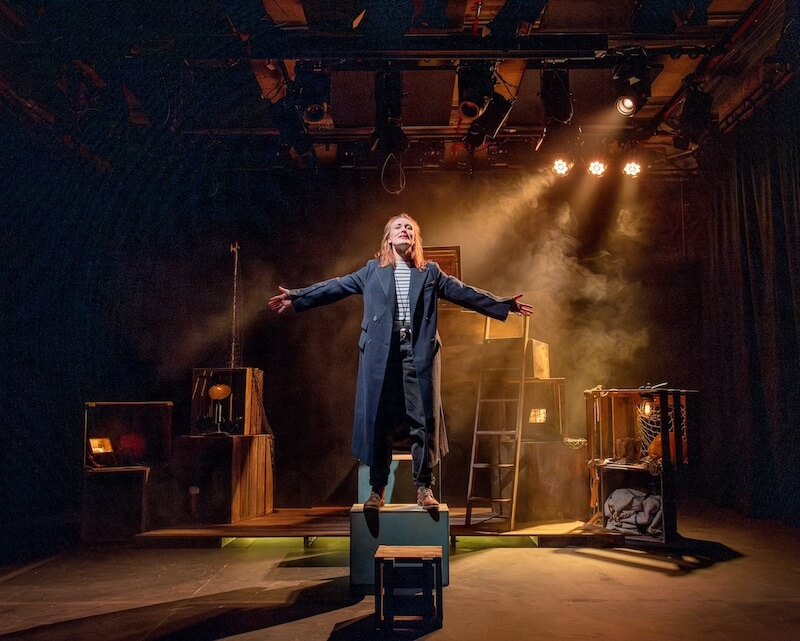
Williams’ play begins with a direct address to the audience, asking for volunteers at crucial moments to act as echoes around the room, blow an alert whistle and take on core roles in this mix of reconstructed memory and direct storytelling about Alys’ experience including a helpful postman and Nathan in Paris – although he is inexplicably played by an angle-poise lamp in the rest of the drama. All of this helps to build an immediate rapport with the viewer who becomes the recipient and participant in a story that Williams conjures from boxes and props that rely on collective imagination to fill the gaps.
The central shaping device is the blending of the naval protocol with the mental health crisis. The concept opens the show and becomes a rather repetitive marker throughout used to anchor the story and is perhaps more successful on the page than it is to experience. Other than the direct reference in the conclusion and the embedded lighthouse symbolism throughout, there is no direct link between this man overboard metaphor and this story so a more direct relationship to Alys and Nathan’s tale would make this stronger.
Part of the issue is that the characters in The Light House have very little bearing. We learn next to nothing about either of them in the course of the story beyond basic facts and it makes the love affair far less tangible, harder to invest in as a result. Instead, Williams leaves Nathan to be defined almost entirely by his mental illness and Alys’ hopes for his care, telling us they are in love but never showing two real, complicated and frightened human beings beneath the surface trying to fit in a care system that defies nuance. Emotion comes instead from schlocky music by Leonard Cohen and Glen Hansard that tries to fill the gap left by lyrical if shallow descriptions of love.
Williams as a writer and performer has a lovely stage presence, a warmth that communicates with the audience from the start, even making the anxiety of unsolicited audience participation palatable. And while The Light House wants to be uplifting and optimistic the plotting could be stronger and the characterisation more willing to embrace the darkness to give this piece the emotional impact it seeks.
Runs until 13 April 2024
