

Writer and Director: Paul Hendy
If you ask people to name three comedians who encapsulate the unique nature of British comedy, more people will give the same three names: Eric Morecambe, Bob Monkhouse, and Tommy Cooper. Few come close to the legacy they have left on comedy and entertainment, but for those who missed the opportunity to see them live Paul Hendy’s The Last Laugh provides an insight into the comedy – and minds – of Britain’s comedic heritage.
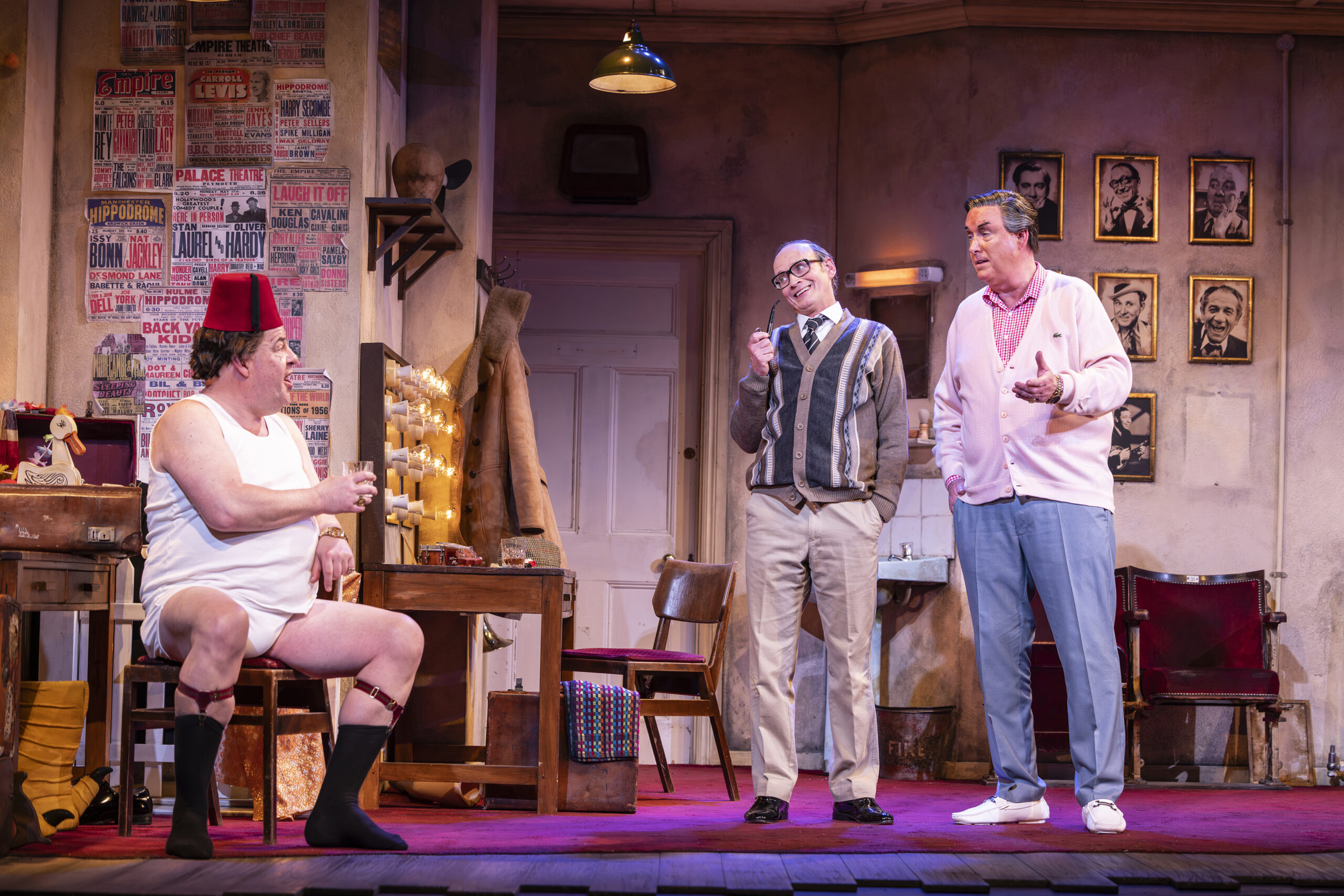
Hendy’s script is not a cheap reenactment of the acts of yesteryear. It is a well-crafted look at the people behind the names, set in a dilapidated dressing room that could be any regional theatre. Designed by Lee Newby, ripped wallpaper and faded posters create the theatrical setting while old dressing room tables, complete with bulb-framed mirrors, give Johanna Town the perfect opportunity to create a chilling atmosphere with her lighting design.
The first comedian on stage is Tommy Cooper, brought to life by Damian Williams. In a pair of pants, some comedy shoes, and the trademark fez Williams doesn’t even need to speak to get the audience laughing. Williams’ admiration for Cooper is clear as he delivers each line in a way which guides his audience to the show’s conclusion. His natural understanding of comic timing and structure shine through in a cast made up of stars.
He is joined onstage by Steve Royle as Eric, one half of double act Morecambe and Wise. Unlike Willaims, Royle is a comedian through and through, turning his hand to acting for this tour. His career as a comedian serves him well as he becomes Morecambe, with an expert grasp on the precise timing Morecambe was loved for. Morecambe is writer and director Hendy’s self-confessed hero, and that is obvious throughout. Hendy hasn’t given Royle the funniest lines (saving those for Williams’ Cooper) or the most structurally important (those are given to Simon Cartwright’s Bob Monkhouse), but it is Morecambe who ties the show together – much like he ties Hendy to the entertainment world he has made a career in.
Completing the trio is Simon Cartwright as Bob Monkhouse. Monkhouse’s style of comedy is different, more crafted, than that of his contemporaries and it is in that methodical thinking that Cartwright is given the opportunity to present Monkhouse (who, he revealed in a post-show Q&A, he met on several occasions receiving advice on how to impersonate Monkhouse from Monkhouse himself) as a man at the centre of the comic world. He shows someone for whom comedy is not only a passion but a saviour, and he does so with ease.
In fact, each of the three play men for whom comedy is a vital part of their identity. Behind this, however, sit three men who are battling their own struggles with confidence, with relationships, and with alcohol. For a show about three of the funniest men of the 20th century, The Last Laugh is much more than a comedy. It is an exploration of the mind of an artist, a moment for reflection. It is undeniably funny. Hendy is a master of humour, combining the trio’s own jokes with his personal style of joke telling. Beyond that, there is sadness and tension – moments of stillness and silence among the laughter.
The Last Laugh will appeal to fans of its featured comedians, but its appeal stretches far beyond that. It is a brilliantly crafted piece of theatre; a perfect blend of comedy and sentimentality. Audiences of all ages will find something to enjoy in Hendy’s offering, right up until the moment the basis of the title is revealed.
Until Saturday 23 May, then on tour.
