

Composer: Francis Poulenc
Writer: Jean Cocteau
Director: Alejandro Bontatto
Alejandro Bonatto directs this new production of Poulenc’s last opera The Human Voice for five performances at the Charing Cross Theatre. Jean Cocteau’s original play, La Voix Humaine, written in 1928, has long fascinated directors – witness Pedro Almodóvar’s 2020 film version starring Tilda Swinton. Cocteau daringly suggested that the telephone would be seen as central to modern relationships, his entire drama being played out in the course of an unnamed woman’s final phone conversations with her lover. The technology which promised whispering intimacy can create terrible isolation.
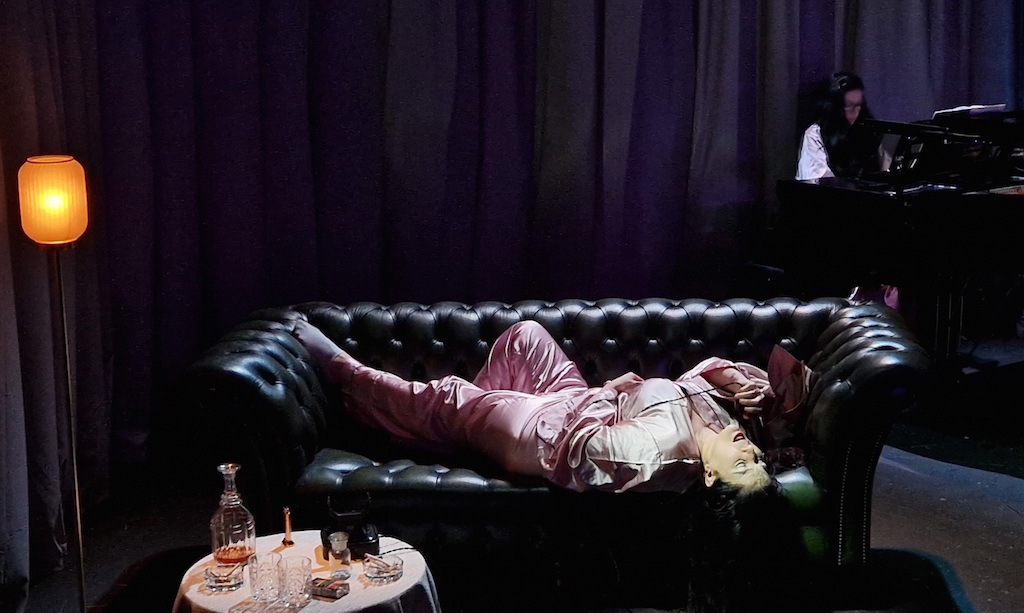
Poulenc’s opera, The Human Voice, developed with Cocteau and first performed in Paris in 1959, is both a stark and a lyrical work, a human drama stripped down to its essentials. Soprano Natalia Lemercier is alone in an apartment, an unnamed woman newly abandoned by her lover. The opera consists of her desperate attempts to rescue her relationship through an extended, often fractured telephone call. At first it seems comic when the telephone connection fails as it does repeatedly. She shares a party line and we hear her furious attempts to insist another user to get off the line. But these interruptions take on a darker note the more we hear of her despair.
It’s a work about lies and lying. The woman at first tries to insist that her life is fine, telling her lover that she’s spent the previous evening out with her friend Marthe. She admits she has taken a single sleeping pill but later reveals she has tried to commit suicide. Poulenc consciously represents the cadences of spoken conversation in his writing. Even the repeated rings of the telephone are signalled in the scoring.
Lemercier is compelling as the woman, creating both a lyrical intensity and a forcefulness in her performance. She and the pianist Elspeth Wilkes look identical, both with long black hair, both costumed in sultry pink satin pyjamas. Pianist and voice are, by implication, one and the same person, the scoring for piano an extension of the human voice. The intimacy of the tiny performance space suits the almost claustrophobic intimacy of this stripped back work which is in turn complemented by the simple but evocative set by designer Andreas Scourtis and clever shifts in lighting by Rob Halliday.
It’s a powerful, if challenging production.
Runs until 30 December 2022
