

Writer: Alan Bennett
Director: Florence Carr-Jones
History and performance merge in Alan Bennett’s The History Boys as a group of grammar school boys in Sheffield take extra lessons in manipulating and contorting history in order to pass their Oxbridge entry test and interview. Glassroom Company offers up a slightly cramped and chaotic production at the Old Red Lion Theatre that underplays the sexual abuse of teenagers groped by one of their teachers but emphasises Bennett’s still shining script.
The History Boys is an examination and celebration of different forms of intelligence; the traditional school learning that helps pupils pass standard exams, and the cultural and social, literary education, the knowledge of everything from Now Voyager and twentieth-century poets to pop music and Carry On films that underpin real, eclectic appreciation and substance. In Florence Carr-Jones’s production, this direct comparison between the methods of teachers Hector and Irwin is clear, and the side-by-side that Bennett presents feels intimate in the small Old Red Lion space as these minds of impressionable young adults are shaped by their devotion to older, seemingly wiser men.
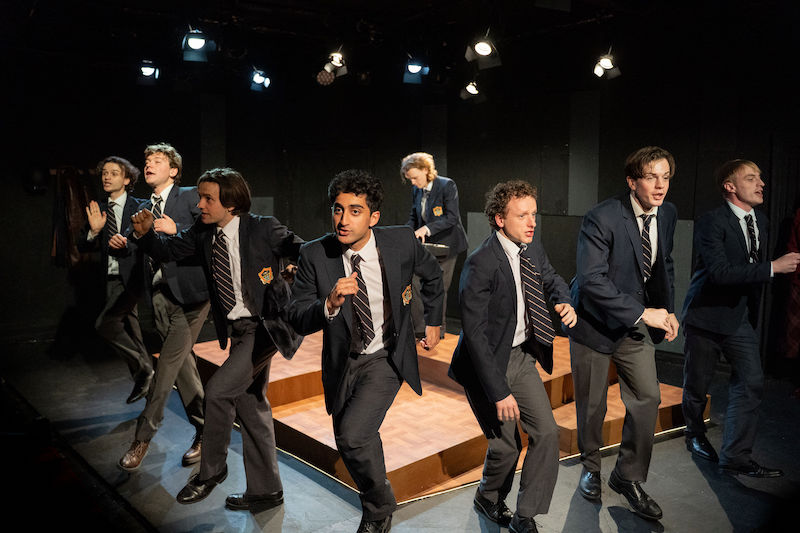
Carr-Jones’ approach is largely representative, a central platform which becomes the classrooms, corridors and offices in which Bennett’s expansive tale takes place. Yet, with a full house and a dozen cast members, some of the character clarity is lost, especially over the extended 2-hour and 45-minute running time. The camaraderie of the boys is well played but other than the sexually rapacious but perhaps not charismatic enough Dakin (Jake Dove) and his devotee Posner (Jack Calver), the rest of the class feel less well defined than previous productions, a melee of rowdy male voices all delivering the writer’s sharp lines but never individually distinct enough to invest in separately – here they all just sound like Bennett.
Ultimately, Glassroom Company need a little more space to deliver the combination of physical theatre, music and narrative, and as the cast charge about the interpretation does feel restrained in every sense. This is most notable in the interpretation of Hector, performed by Duncan Hess as a muted, bumbling figure, lacking the eccentric charisma that makes him a favourite with the boys. Times have changed since the play was written but this production chooses not to engage with Hector’s predatory side, the potential danger he might pose and while Bennett’s story plays out as written, the implication of his physical abuse become only words, never evident in the glee the character might express in the presence of his attentive pupils or the physical proximity he would certainly insist on.
Carr-Jones’ production is far more successful in its casting of Irwin, the radical thinker whose different but no less persuasive influence grows on the boys and the audience as the weeks of cramming unfold. Leonardo Shaw is a notable Irwin, plagued by his own self-consciousness but adept at turning history on its head, so the scenes discussing new approaches to clichéd questions are some of the best. The extent to which Irwin also starts to compromise himself as he becomes attached to his charges is also well developed, as his methods earn their adoration while creating considerable conflict in himself.
The History Boys remains one of Bennett’s finest pieces of writing, and Glassroom Company largely do it justice, but more than two decades after it first appeared, productions do need to engage more with the ambiguous and formative teacher-pupil relationships that it presents.
Runs until 25 April 2026
