

Writer: Bertolt Brecht
Adapter: Nina Segal
Director: Anthony Lau
The Good Person of Szechwan was written between 1938 and 1943 but sadly, with its themes of relentless financial pressure and a system rigged from above, remains as relevant as ever. While many adaptations and iterations have been brought to the stage in the intervening years, something about staging a production amidst a cost-of-living crisis bears more than a little resemblance to Brecht’s overt political messaging. Though this new translation brings contemporary flair, director Anthony Lau has elegantly executed the epic theatre style of neither leading nor lecturing an audience but rather raising a question and letting it hang in the air.
Three Gods arrive in Szechwan, in search of a truly good person to persuade them that the earth deserves to be saved from the apocalypse. With few candidates around, water seller Wang suggests they stay with his friend Shen Te, a prostitute with an inability to be unkind. Pleased with her generosity they present her with an opportunity, the funds to open her own tobacco shop and run a good and honest business. Word of her good fortune and generosity spread and soon she is awash with friends in need. Soon she is unable to sustain herself, between her charity and an opportunistic landlord she is close to losing her gift from the gods. Unable to turn people away she invents an alter ego in the form of her male cousin Shui Ta whose churlish abruptness offers the protection she cannot provide herself. This literal divide of the character, the altruist and the capitalist exemplify how leaning too far in either direction will lead to ruin. The gods keep a tenuous eye on the proceedings and struggle to measure this quantifiable goodness. In the end they decide that she may not be entirely good but is good enough to keep the planet turning.

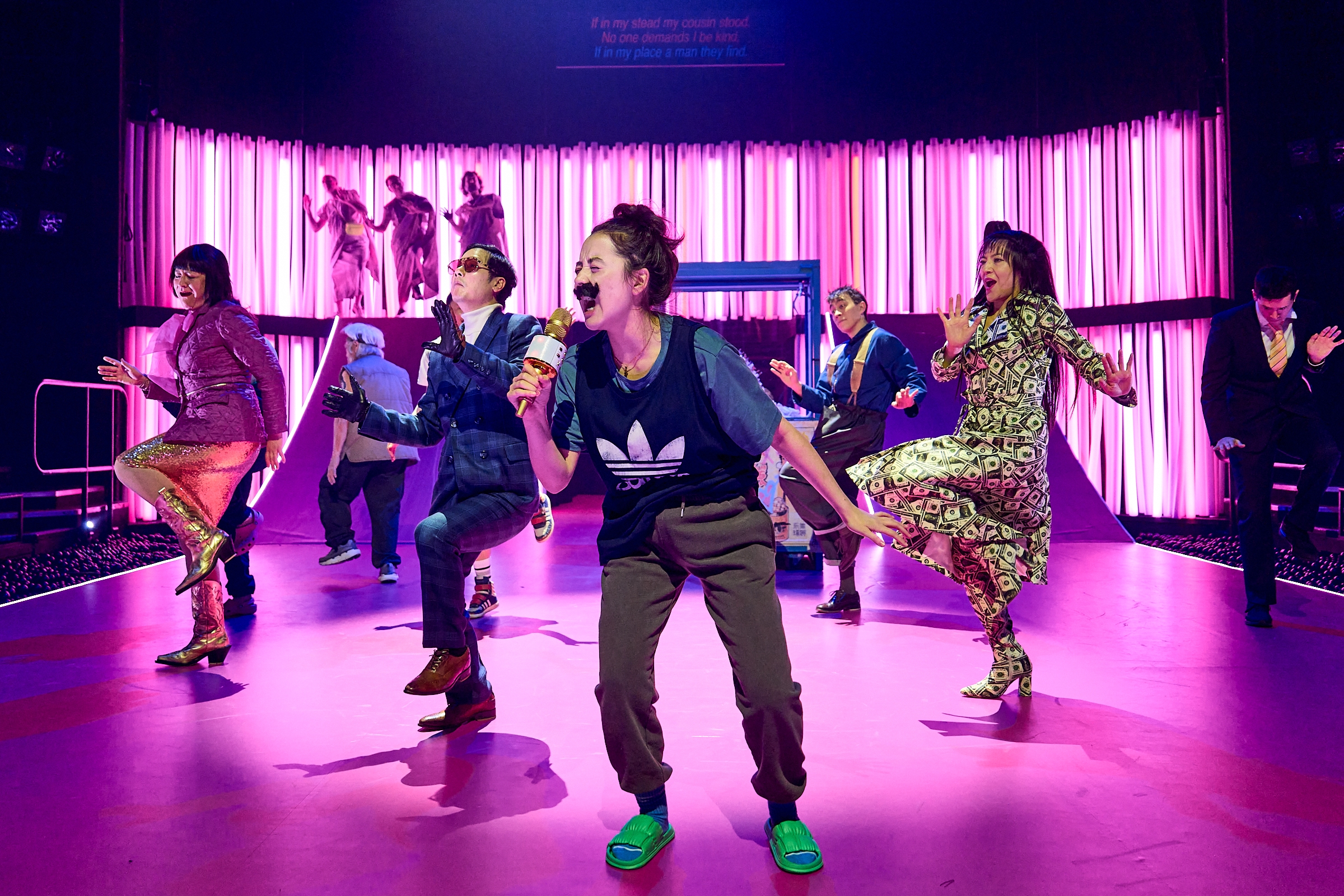
Designer Georgia Lowe has created a veritable playground. The set comprises of two steep, bright pink skateboard ramps that lead to a semi-circular stage. The backdrop is a curtain of dangling fluorescent tubes. This is all surrounded by ball pits filled with black and white balls. A lot of fun is found as actors slide into scenes and wade through ball pits, a brilliant way to suggest water. Deities pop out miraculously from the depths, a delightful moment. The candy colours and neon lights suggest a fruity and playful environment, but subtle details in the costume, the graffiti and vandalised props bely the grimy underbelly and the all too temporary sheen of glamour. In Brechtian style the rich look rich, the poor look poor, and the Gods look like gods, wrapped in Grecian robes. An incredible effort from the whole design team, a visual spectacular. Groans of recognition from the audience as the inevitable Amazon package arrives.
Ami Tredrea masterfully leads the cast as Shen Te. She finds great clarity in her words which beautifully communicate her character’s dilemma. The trio of gods played by Callum Coates, Tim Samuels and Nick Blakely make a wonderful trio, arriving in each scene in a heavenly harmony. The rest of the company play multiple characters and find definition in each role.
It is always exciting to get to see a piece from the great dramatic cannon and this production stays true to the Brechtian ideals with a vibrant modern flavour. A unique and striking production that will stay with audiences long after the curtain has dropped.
Runs at the Crucible Theatre, Sheffield until 1st April and the Lyric Hammersmith, London from 15th April until 13th May.
