

Composer: JS Bach
Choreographer: Anne Teresa De Keersmaeker
Pianist: Pavel Kolesnikov
Audiences familiar with Anne Teresa De Keersmaeker’s work will welcome her response to Bach’s Goldberg Variations. This, Bach’s most complex and pure work, first published in 1741, lends itself to De Keersmaeker’s vision of stripped down, abstract choreography.
Award-winning choreographer and dancer De Keersmaeker is acclaimed for her rigorous, imaginative engagement with the musical structures and scores of several periods of music. With her company Rosas, she created Fase: Four Movements to the Music of Steve Reich, one of the pieces she has performed in the Turbine Hall at Tate Modern. Before turning to Bach’s Goldberg Variations, she created The Six Brandenberg Concertos, performed with sixteen dancers and and the B’Rock Orchestra. ‘Bach’s music,’ she writes, ‘carries within itself movement and dance, managing to combine the greatest abstraction with a concrete, physical and, subsequently, even transcendental dimension.’
De Keersmaeker has always drawn from formal principles from geometry and numerical patterns to offer a unique perspective on the body’s articulation in space and time. The Goldberg Variations, with its set of thirty variations of its opening aria, allows her to create a piece that is austerely beautiful.
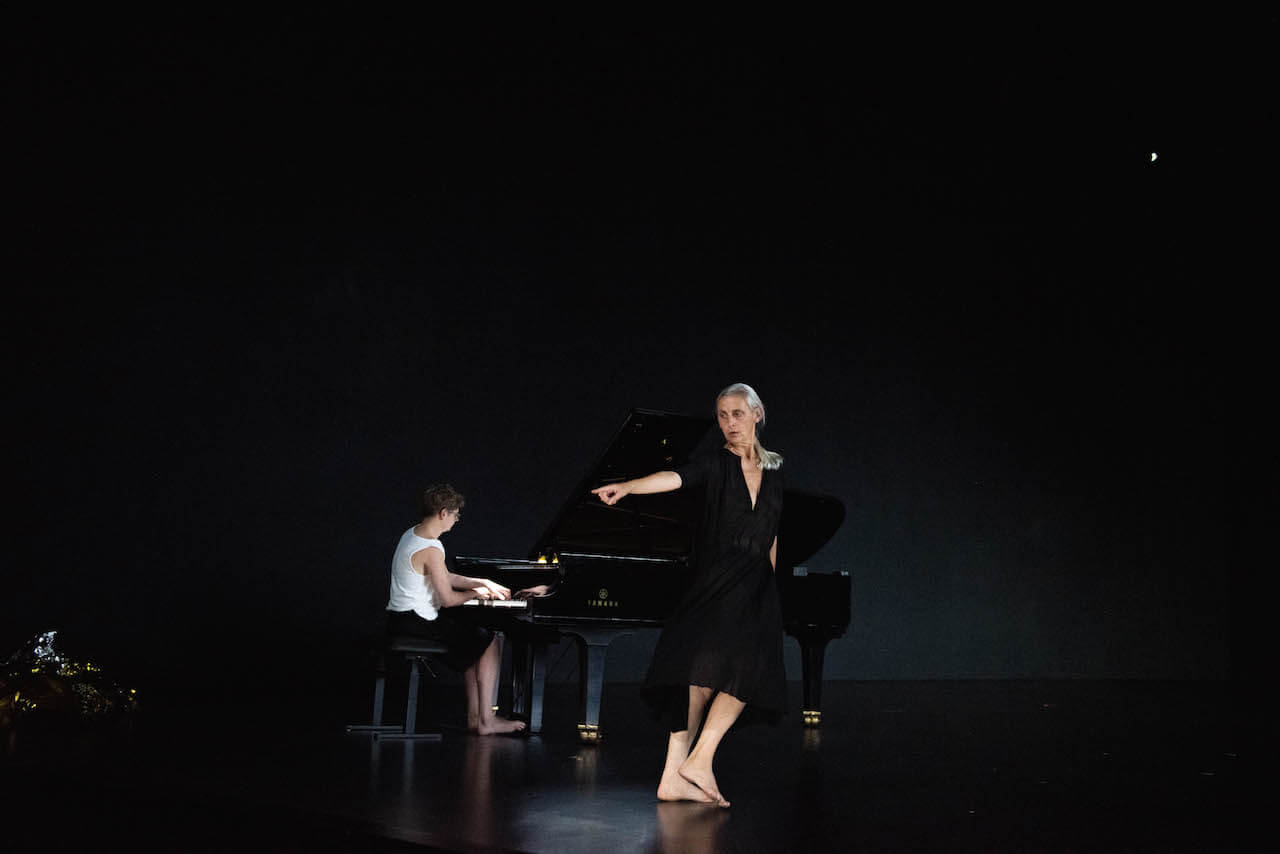
De Keersmaeker’s performance is in her distinctive idiom: repeated patterns of angular movements, often deliberately rigid stretches of her legs, precise quarter turns and marionette-like arm movements. She bends and runs forward and backward, sometimes executing playful movements – half-formed cartwheels, childlike hops and skips. Every so often she engages physically with piano and pianist, at one point pushing Paveel Kolesnikov from his piano stool. She responds joyfully to Bach’s baroque dances, with its sarabandes and gigues. Sometimes she stands or lies completely still. But there are also three not-entirely-explicable costume changes, and a puzzling amount of time spent lacing and unlacing her shoes. Intellectually, her choreography with its endless repetitions and variations, makes complete sense.
But the only issue with The Goldberg Variations, BWV 988 is its length. The music itself can be performed in less than an hour, if played without any of the marked repetitions, as Glenn Gould did in his 1955 recording for Sony Classical. Alternatively some artists, such as Shelley Katz at Snape Maltings in 1997, cut some of the minor variations. But with all the repetitions intact, the full work can take up to two hours. De Keersmaeker and Kolesnikov perform the piece in full without an interval. This is inevitably something of a challenge both to the performers themselves and to the audience.
The stage itself is almost bare except for a pile of glittering silvery-gold on the floor close to the piano, and for the first half, a shimmering silver panel. The lighting is minimal, creating a darkly mysterious performance space. In one memorable part, the stage darkens until only the pianist is spot-lit. The light continues to fade. De Keersmaeker in her pale clothes appears so faintly as to seem ghost-like. Then the auditorium is plunged into total darkness while the pianist continues to play. It’s strangely powerful few mintues as the audience find themselves sitting together in the hushed night space listening to the incomparable music.
De Keersmaeker’s The Goldberg Variations, BWV 988 is a fascinating piece, and without doubt a model of artistic integrity. But with little variation of movement, by the second hour it becomes difficult to maintain interest.
Runs until 7 September 2022
