

Writer: Katie Honan
Directors: Katie Honan & Luke Kernaghan
What happens when the mind can no longer distinguish between what has happened, what is happening and what might happen next?
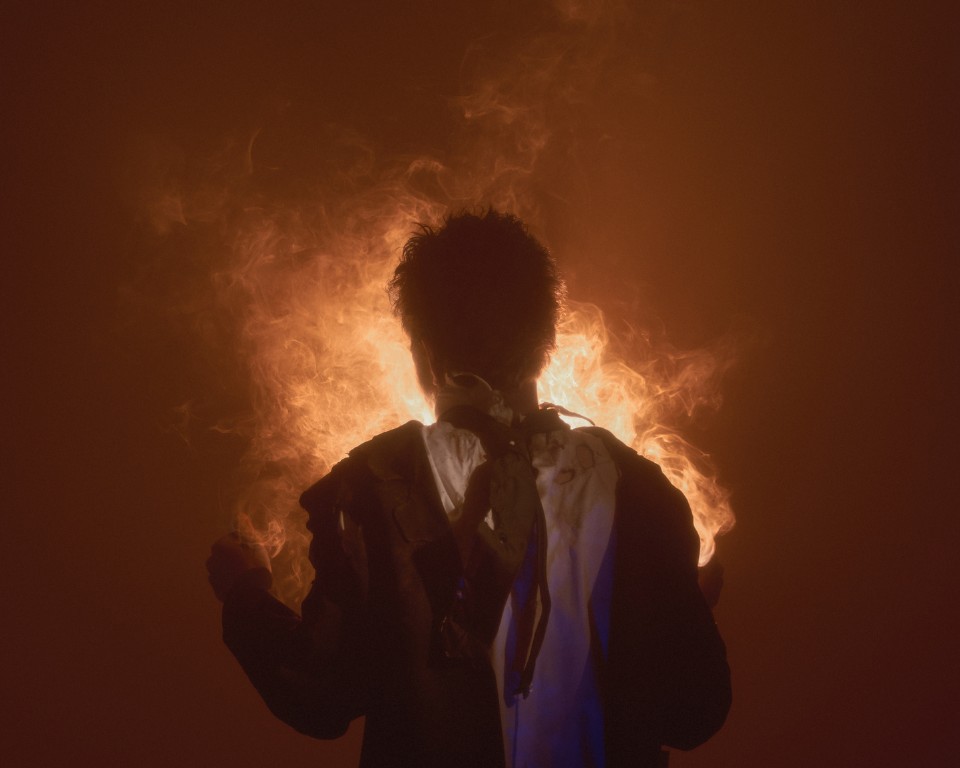
The Far Away Sun, written by Katie Honan and co-directed by Honan and Luke Kernaghan, is a psychological thriller that ventures into precisely this unsettling territory. Following an earth-shattering event, Ralph retreats to a secluded cottage in search of peace, only to find that escaping the outside world does not necessarily mean escaping himself. As memory and imagination begin to collide, the forest surrounding him becomes increasingly difficult to separate from the reality inside his own mind.
What makes the production particularly intriguing is its decision not simply to tell us about Ralph’s internal world, but to attempt to place us inside it. Audiences experience the production through headphones and binaural sound, creating a 360-degree auditory experience intended to bridge the distance between spectator and protagonist. Ralph does not simply tell us what he is thinking; his inner thoughts, memories and imagination become part of the theatrical landscape surrounding us.
It is an ambitious idea, but perhaps more importantly, it is an incredibly human one.
Mental health can often be discussed from the outside. We talk about depression, trauma, memory and the workings of the mind as though they are things that happen to other people. The Far Away Sun asks us to consider what it might actually feel like when your own mind becomes the place you are trying to escape from.
There is something profoundly frightening about that concept. A person can close a door, leave a place and remove themselves from other people, but they cannot simply walk away from their own memories. The mind carries things with it. Sometimes it protects us; sometimes it distorts what we remember; sometimes it fills in the gaps with what we fear.
The production’s collaboration with neuroscientists and psychologists adds another fascinating dimension. The research behind the work explores the relationship between memory and imagination, including the idea that our memories don’t merely belong to the past but can influence how we imagine and navigate the future.
That raises a question which feels much bigger than Ralph himself: how much of the reality we experience is constructed by the mind?
We all carry our own internal archives. Experiences, conversations, losses and fears can remain long after the original moment has passed. We may believe we have left something behind, only to discover that our minds have brought it with us. In this sense, Ralph’s secluded cottage can be read as a representation of the mind itself — somewhere that promises safety and solitude, but where there is nowhere to hide from what lives within.
The title The Far Away Sun feels increasingly poignant in that context. A sun can represent warmth, hope and something to move towards, yet it can also remain distant. Perhaps the greatest challenge for Ralph is not finding a physical escape, but finding a way back towards himself.
The use of sound is particularly suited to a story about this internal battle. Hearing thoughts through headphones creates an intimacy that conventional theatre cannot quite replicate. The audience is simultaneously together in a theatre and alone inside the head of another person. That contradiction mirrors one of the most isolating aspects of mental distress: being surrounded by people while feeling completely trapped within your own thoughts.
There is also something deeply universal within that idea. Most of us will never experience Ralph’s exact circumstances, but almost everyone understands what it is to have a thought that refuses to leave, a memory that suddenly resurfaces or an imagined possibility that becomes difficult to distinguish from reality.
The Far Away Sun seems less interested in presenting the mind as a neat, logical machine and more fascinated by its contradictions. It is fragile and extraordinary, protective and destructive, capable of remembering the past while simultaneously constructing the future.
Ultimately, the most profound question raised by The Far Away Sun may be a deceptively simple one: if our minds shape the reality we experience, where does reality actually begin?
That is an enormous question for a 75-minute piece of theatre to take on. But by combining psychological storytelling, neuroscience and an unusually intimate sound experience, Katie Honan’s work invites its audience to look inward — and perhaps to recognise that the strangest, most complicated landscape any of us will ever encounter is the one inside our own heads.
Runs Until 19th Sept 2026.
