

Music: Edward Lambert
Writer: Edward Lambert after Oscar Wilde
Director: Fleur Snow
It seems somewhat surprising that Oscar Wilde’s ill-fated tragedy, The Duchess of Padua, has not been turned into an opera before now. His play has everything you’d expect in a dramatic opera – power, love, jealousy, murder, revenge, betrayal, suicide and more. Well now, thanks to Edward Lambert, it has. The composer has turned it into a musically modern opera.
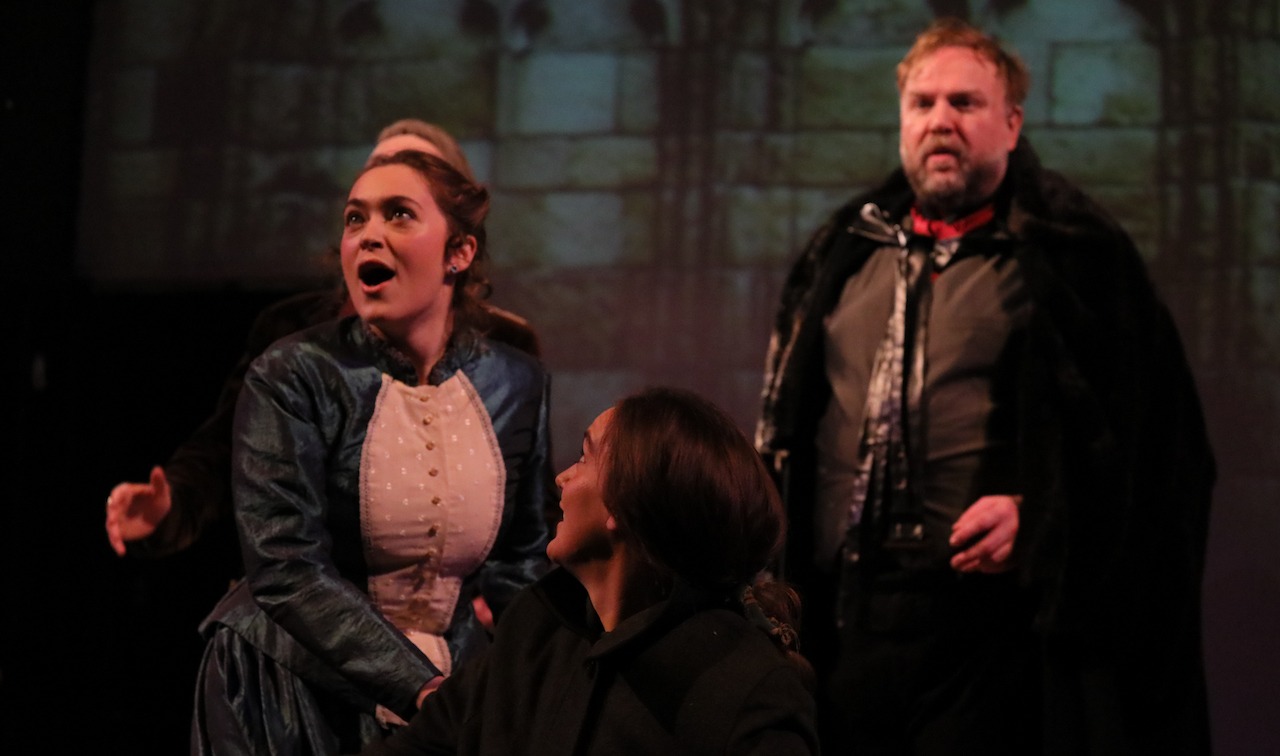
The plot is an over-the-top drama about a young orphan, Guido (Anna Elizabeth Cooper) who seeks revenge for his father’s murder. Unbeknownst to him, Guido was orphaned when his mother died in childbirth on hearing the news that her husband had been executed. Now, some 20 years later, a friend of his father, Count Moranzone (Henry Grant Kerswell), who placed Guido into care, tells him the truth about his family and guides him to take revenge on the man responsible for this, The Duke of Padua (James Beddoe).
To do this, Guido needs to be accepted as part of the Duke’s household but on doing this, he comes across the Duchess (Ellie Neate) with whom he falls completely in love. She herself is unhappy with her marriage. The Duke is old and cruel and as Guido expresses his feelings for her, she too falls in love with him. The story progresses with plot twists aplenty until the final dramatic and, expectedly, tragic ending.
It is an almost absurd, but highly engaging, story that Wilde wrote in blank verse. So, in turning this into an opera, Lambert has used Wilde’s own words, edited and arranged to fit a shorter narrative time.
In Lambert’s stripped-back opera, the music is less melodic and more rhythmic. It’s performed by two pianists (Alex Norton and Adrian Salinero), playing side by side on a single piano. It’s a very modern score that drives the narrative and punctuates the drama. This is not an opera interspersed with arias; it is completely presented as a recitative performed in the bel canto style, so it’s narrative-driven and the focus is on the beauty of vocal performance. Interestingly, the text uses a blend of speech, stage direction and narration, so it feels more like listening to a sung audiobook than a more traditional opera.
The performers are all solid, though Beddoe is and looks, despite his make-up, far too young to be the Duke. His voice, at times, fails to stand out especially when singing alongside other members of the company. The direction is simple, yet effective for the limited space in the venue.
As to whether it’s any good will be very much down to personal opinion. If you like your opera dotted with hummable, memorable arias, this will disappoint. You’ll find very little here in the form of an earworm to keep you humming on your way home. But that shouldn’t put people off. This is a new opera based on traditional foundations but using very modern music. For passionate opera fans, having something so new should come as a welcome joy, and for the more ‘classic’ fans, this is a not too taxing, or long production (it only runs for 90 minutes) that could be a doorway to other forms of opera.
Either way, it’s well worth seeking out.
Runs until 25 February 2024
