

Writer : Jón Atli Jónasson
Translator: Brian Fitzgibbon
Director : Jake Smith
Djúpið, The Deep, is best known in the film of 2012, directed by Baltasar Kormákur. Jónasson’s original play – a monologue lasting just an hour – is touring East Anglia this month, ending, in fine Eastern Angles tradition, in the splendid modern Village Hall at Shotley, where the Orwell meets the Stour and the sea.
The narrative, such as it is, is based on true events. On March 11 1984, Hellisey VE-503 sank east of Heimaey. The play isolates one young fisherman, Gulli. His chance of survival is small; his hopes inevitably fade. It’s often said that the prospect of death causes our life to flash before us. But his life has barely begun, and this story is not so much one of beating the odds in the icy ocean as of the unfulfilled hopes and dreams of a young man with his whole life before him.
We begin with a kind of prologue, a voice sketching in the fishing village coming to life, the morning departure and the rude awakening. And we hear the refrain “soon, soon” for the first time. Then we’re live in the dark bedroom, the 4am alarm and the banalities of the morning routine. There are subtle omens, too – the house his grandfather left unfinished, the brief whiskery kiss a shipmate leaves on his sleeping boys – “they won’t even know he’s gone…” Because we’re never allowed to forget the other men on board – the ill-assorted father and son, for instance, “the old man and the bull”. Black gulls fly projected on the sky as the trawler leaves the harbour for the long haul. There’s the taciturn camaraderie of the mess, with the slightly awkward reference to the VHS of Titanic, and Jack’s fate. Gulli dozes off, and is jolted awake to find his world upside down.
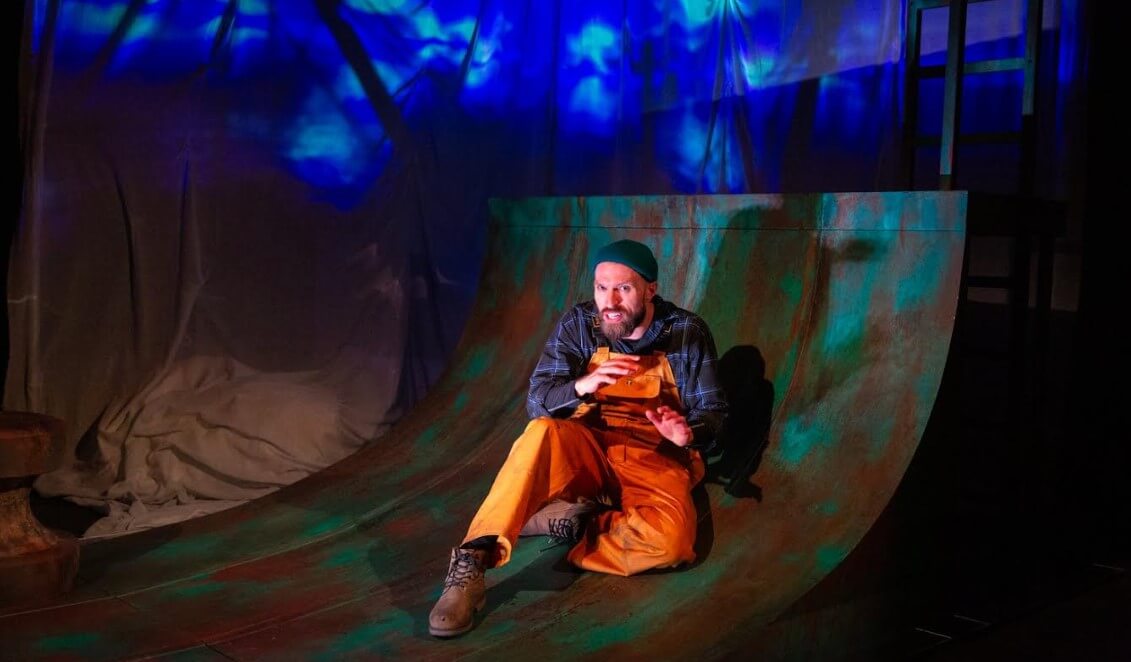
And this is where we’re drawn painfully into the lived reality of the shipwreck. In Jonathan Savage’s compelling performance we feel with him the freezing metal, the jagged glass in the window he smashes to escape. “if you live …” a mate whispers. To sleep, to die. And so his desperate, determined swim to shore begins. A shadow twin swims with him on the backcloth.
Amy Watts’s inspired design is superbly realised in this touring set – an almost abstract structure, a ladder, a single bollard, and a curved slope, a wave, maybe, or the ship’s hull. And in Savage’s impressively physical performance – he trained as a dancer – every inch is used, as his body rises, falls and contorts.
The sound design by Sam Glossop captures the mood wonderfully: rock songs remembered as well as the sounds of the sea. And at the end, a moving hymn, sung live by members of Ipswich Choral Society – “Oh Lord, Guide us into the deep, Oh Lord, Guide us home.”
Jake Smith’s fluent direction moulds all the elements into a powerful theatrical experience. The play is a strong piece. The bird, adopted by the fisherman as companion, and ultimately, guide. The appeal to an unnamed god for one day more of life – we spend it with Gulli as he visits the homes of his crew mates, bringing their families news and comfort, and his distant beloved, whom he never invited for a spin in his Plymouth Barracuda, on order from Switzerland.
The words are perhaps less successful. Neither the poetry nor the voice of the simple seafarer seem quite realised in this translation. One alternative version transported the whole thing to Scotland, with vernacular to match, and I wondered if a Felixstowe setting might have been more textually convincing.
Nevertheless, an excellent, if challenging, choice for Eastern Angles and their faithful audiences across the region. A must-see for anyone who loves immersive, physical theatre.
Touring until 26 October 2024
