

Writers and co-lyricists: Jonathan Ainscough and Caitlyn Burt
Composer and co-lyricist: Yshani Perinpanayagam
Director: Natasha Harrison
The British Youth Music Theatre, producers of The Clockmaker’s City, is a charitable organisation offering 11-21 year olds training and opportunities to realise their creative potential.
The Covid lockdown necessitated changes to working practices including staff working from home and meetings being held remotely over the internet. This introduced a degree of flexibility often perceived as beneficial to staff. The Clockmaker’s City imagines the reverse – a city so tightly regulated deviation from the norm is not permitted and workers are liable to be exploited.
To guard against mounting chaos The Clockmaker built a city where everything runs like clockwork and each citizen completes their assigned work tasks in accordance with a strict timetable. The city functions so effectively the worshipful citizens attribute its smooth running to magic. The Clockmaker’s granddaughters are now scheduled to take responsibility for running the city. This requires them to be made aware of certain secrets: the city is powered by machinery- cogs and wheels- rather than magic and anyone who questions the authorities is liable to be exiled outside the walls of the city.
Kai (Lile McGrath) is the more technically-inclined of the granddaughters and so might be best equipped to cope with the nuts and bolts of the equipment. However, unlike her more compliant sister Chro (Molly Loveday), Kai tends to question the status quo and, as a result, is exiled. Outside the city walls Kai encounters a community sympathetic to her way of thinking but so disorganised they occasionally forget to eat. She wonders if it might be possible to integrate both communities and her suggestion occurs just as the machinery keeping the city functioning begins to fail pushing events towards a crisis.
The Clockmaker’s City is a musical where the songs are more functional than lyrical. The lyrics are descriptive (‘‘At 9.33 I plant another tree’’) or serve as dialogue. The story by Jonathan Ainscough and Caitlyn Burt is oddly downbeat. The conclusion gives the impression authoritarian regimes cannot be challenged or changed so the only options are to comply with, or escape from, their dictates. It is hardly a viewpoint that would motivate the audience to storm the barricades and suggests no-one has learnt any lessons from their experiences and nothing in The City will change.
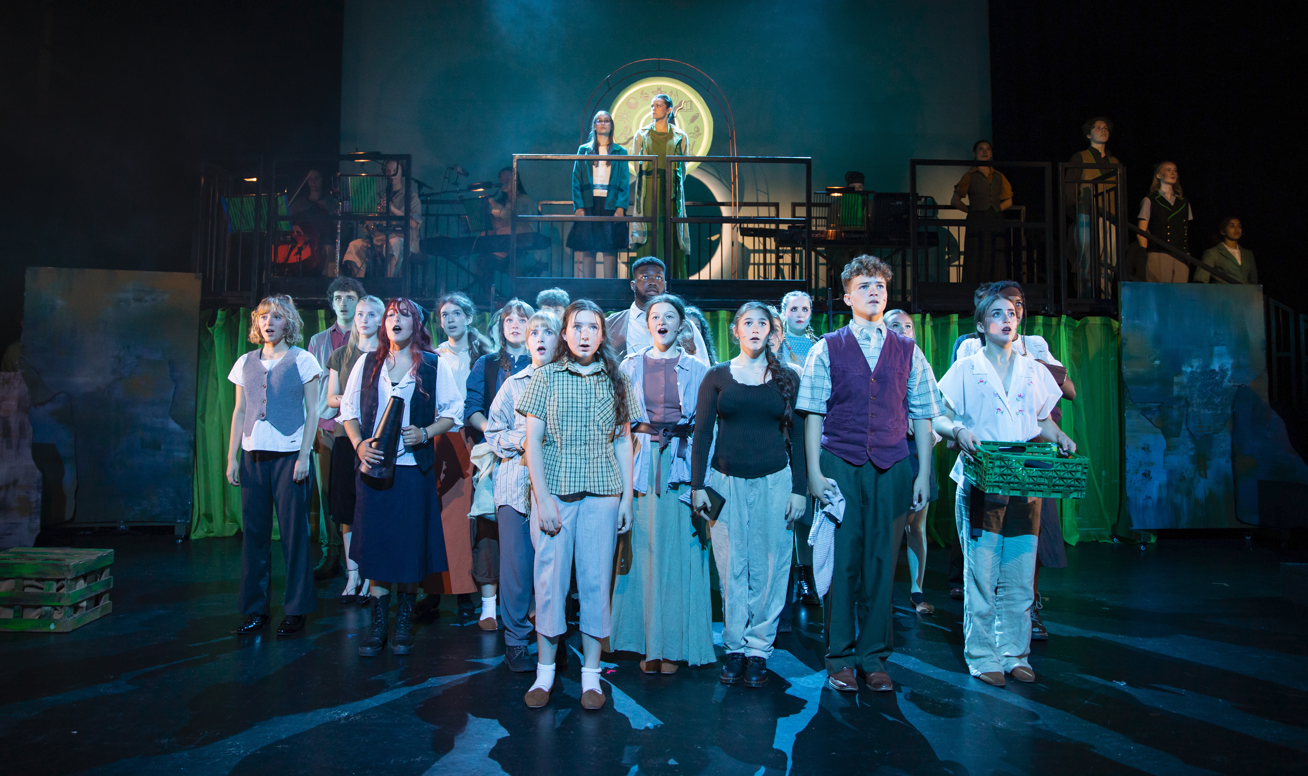
Director Natasha Harrison tells the story through a combination of music and highly-coordinated physical theatre. Paul Smethurst’s choreography is less formal dance moves and more synchronised movements. The opening features the large ensemble moving rapidly around the stage completing their daily tasks clockwork precision. It is a strong opening displaying the disciplined talents of the company and the strictly regimented atmosphere of The City but it also sets the scene for an even more impressive routine later in the show. The authorities decide to speed up the clock movements to promote faster production necessitating the cast repeating the demanding routine at greater speed whilst reflecting more harassed, less satisfied workers.
Within the walls of the city designer Amanda Mascarenhas dresses the cast in earth tones; shades of brown and green with the labourers in olive coloured overalls. The colour-coded regimented style provides a contrast for the less organised community outside the city walls cheerfully dressed in scraps and hand-me-downs.
On opening night there were intermittent technical issues with feedback from the microphones but the singing by the cast was flawless. Whilst The Clockmaker’s City does an admirable job in promoting the talents of the young cast the extent to which it appeals to young audiences is debatable. There is little humour and audience involvement, such as crowd-pleasing singing or clapping along, is absent.
Whilst the story of The Clockmaker’s City is downbeat the staging is inspirational. It is a practical demonstration of the value of the British Youth Music Theatre’s policy of cultivating and promoting the artistic skills of young people. It also provides audiences with a production featuring a large-scale cast the like of which can rarely be afforded in these times of financial restrictions.
Runs until 2nd August, 2026
The Reviews Hub Star Rating
-
8
