

Writer: Ian Henery
Adaptor: Emma Cooper
Director: Marcus Fernando
The horrors of trench warfare in the First World War are well documented, including the huge death tolls on both sides. And that death toll led to problems – back home, women could step up and take on jobs  previously taken by men, but at the front, shortages of manpower needed a different solution, one that few are aware of these days. An agreement was struck with the Chinese authorities to supply a pool of labourers. Technically, these labourers were non-combatants working away from the front line in support of troops; however, the front line could move and they could find themselves in the thick of the fighting. Ultimately, around 100000 men served with the British forces, lured by the promise of higher wages than they could get at home.
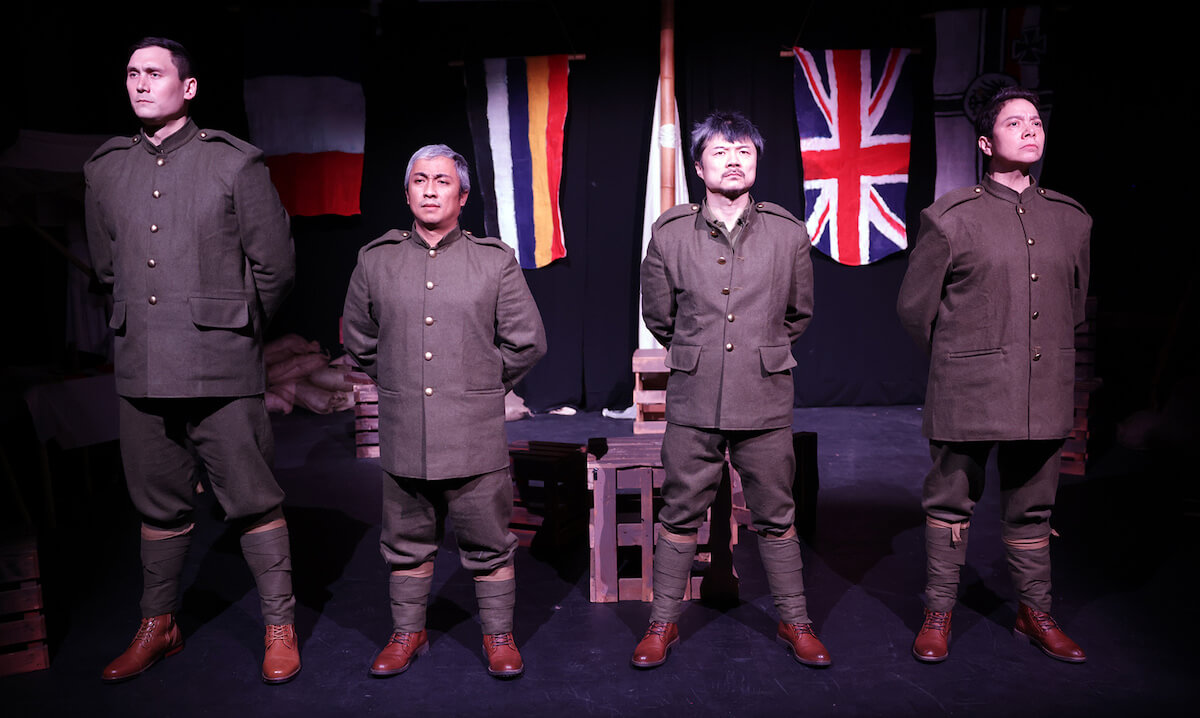
The Chinese Labour Corps seeks to highlight their experiences as we follow four members of the corps: Sun Gan (Nathaniel Tan) a teacher called ‘the scribe’ by his colleagues because of his ability to read and write; Lin Cheng (Tao Guo) a skilled weaver who nevertheless finds himself working as an unskilled labourer; Liu Den Chen (Ali Taheri) an initially easy-going likeable rogue who becomes deeply affected by the conditions and becomes an activist; and a woman, Chinn An Chu (Amanda Maud), masquerading as a man – her father disguised her as a boy to protect her when the Boxer rebellion was crushed some years before.
And so we see our quartet travel initially to Canada, crossing it in trains in poor conditions before embarking on overcrowded steamships to Europe until they arrive at their destination. Through a series of largely stylised vignettes, we are shown the contrast between the labourers’ lives and that of their masters. The well-designed set gives us a feeling of how the labourers live, and one can’t help but feel that they were treated little better than slaves or prisoners. The labourers themselves are somewhat baffled by all that goes on as cultures clash. They see themselves as free spirits, in charge of their own destinies; the British see them only as numbers (literally as there is a language barrier and each labourer is identified only by a numbered tag) who need to have any individuality knocked out in order to work efficiently. This boorish and arrogant attitude is contrasted with the lavish retelling of Chinese folktales – for example, the legend of Nian from which much of the ritual of Chinese New Year originates including a dragon dance, or a story told via shadow puppetry – which shows the audience, if not the British in the play, the vibrant richness of the Chinese culture.
Marcus Fernando’s direction moves the action seamlessly between its elements. However, the balance between the characters’ stories, the folklore presented and the statistic-heavy exposition is not quite right, making the pace occasionally stodgy and meaning that we don’t get to know the quartet as well as we might wish to. Undoubtedly, the exposition has a place – we need some background – but a more consistent focus on the experiences of the characters would help us to understand their situation emotionally rather than at an intellectual distance. Nevertheless, there are poignant moments, for example, when Lin Cheng is rescued from a shell hole by Liu Dien Chen (for which he became one of five labourers to be awarded the Meritorious Service Medal) and is nursed back to health. His interactions with the British nurse and her growing self-awareness are particularly affecting.
The Chinese Labour Corps gives us an insight into a little-known piece of history while celebrating the Chinese culture – it’s both entertaining and educational.
Runs until 5 February 2022
