

We’re told the reason behind the name. There’s a South African saying, it seems, that goes “if the best doctor in town cannot cure you, find the less good one.” The Centre at the Barbican however was set up to nurture creative ideas that spring and tumble out from the “good” ideas, and to see what comes of following secondary thoughts and themes.
The To What End show houses a selection of six short works from South Africa, all unique, all thrilling. Together, they richly discuss distinct local issues and cultural expressions as well as universal themes. Mixing languages, movement, poetry, music, monologue and simple props these short stories deliver heady experiences. While the specific issues addressed may not be immediately familiar to this London audience, the emotional hit is keenly felt.
It begins with Footnotes (concept and direction by Vusi Mdoyi) and a bracing auditory attack – typewriters used as percussion instruments accompany a cry out against unfair eviction processes served by the militaristic Red Ants services. Five performers sing, create music on their typewriters, dance and (alongside audio and visual recorded tracks) absolutely communicate the pain and disruption caused by confusing and abrupt evictions from homes and businesses.
The Weep of Whips (choreographed by Thulisile Binda and performed by him and Micca Manganyefollows) follows – a piece for two where beautifully coloured sjambok whips and the dancer’s breaths provide most of the sound. The cracks and swishes as well as the use of the whip as a tool to bind and lead is altogether unnerving. While they are artistic props here, the danger and threat these objects pose is never far away.
Tony Bonani Miyambo’s highly effective and emotionally charged piece Commission Continua starts out being faintly ridiculous with a photocopier and giggling. It evolves into a cutting and intelligent critique of a wasteful, futile culture of administration and commissioning of inquiries. He makes it clear, through a poetic performance with gorgeous economy of language, that justice is not being served by officialdom, that the voices of the victims are drowned in an avalanche of paper and typescript, and that official processes obscure true atrocities.
Micca Manganye and Volley Nchabeleng’s Sounds of Limpopo is a joyful 20 minutes of music, creatively made using a range of instruments, some expected and some very unexpected, to bring the province to life. It’s an injection of freshness and light that follows quite an intense first half.
We’re then into an ambitious and difficult piece, Pitsana. Conceived and choreographed by Thulisile Binda and directed by Phala Ookeditse Phala, it layers folk-like storytelling over dance and physicality. A man sits eating what a girl has just given him, while she steps in and out of the hot cooking pot as if pressured to do so by an unseen force. Her pain and desperation grows and when she breaks out of the cycle we see her small community’s confused reaction.
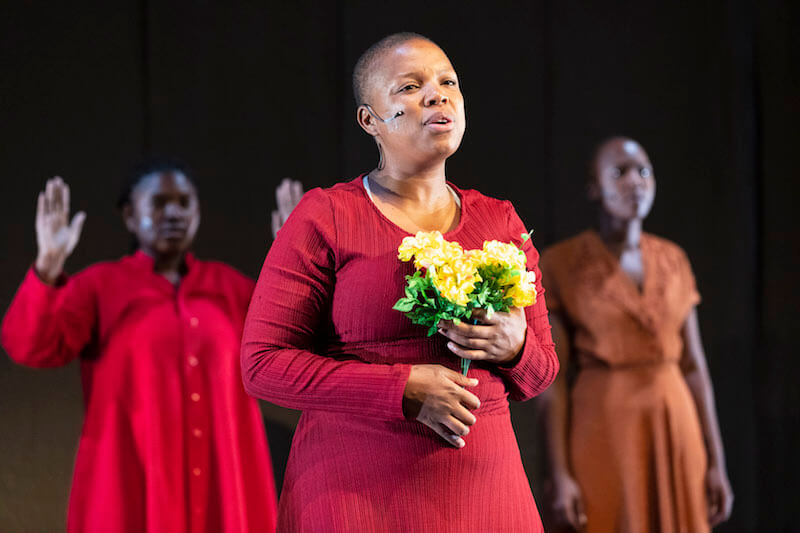
It finishes with the incredible Umthandazo. Widows of some of those killed at the 2012 Marikana Massacre take it in turns, within the society of the five other women, to play with, enjoy, own the artefacts of those they have lost – boxing gloves, cameras, hats etc. They collectively celebrate and grieve for those they loved, and everyone else, who are no longer with them. It’s a heartstopping, heartbreaking few minutes of music, support and social commentary.
Founded by artist William Kentridge, the Centre is a physical thing, a space in South Africa’s Johannesburg which has gathered together disparate cohorts since 2017. In its ninth season now, around 700 artists, performers and creators of all kinds have passed through. The Barbican show, the first to be shown outside of SA, doesn’t feel like a highlights production or something representing this current cohort. It feels more like a representation of the stories those creators at the centre are telling and feeling at this moment – not an endpoint or culmination but a slice in an ongoing timeline. And it’s beautiful.
Runs until 9 October 2022
