

Writer: John Niven
Director: Matthew Dunster
It’s the mid‑90s, and there’s a renewed spirit of optimism around Britain—reflected in a resurgence of British culture. British guitar‑based pop music is also flourishing, soon to be labelled Britpop. Full of distinctly British reference points, the movement becomes hugely successful at home, though it struggles to achieve the same impact in America.
If proof were needed that Britpop had truly arrived, it came at the 1995 Brit Awards. Blur took home awards for British Album of the Year, British Single of the Year, British Video of the Year, and British Group, while Oasis won British Breakthrough Act.
This is where we first meet the bands: celebrating after the awards and trading insults. With both groups at their peak, it feels as though the world is theirs. But what comes next?
Both bands are preparing album releases—Blur’s set for 11 September, Oasis’s for 2 October. As Blur’s Damon Albarn notes in the play, the industry standard is to release a single three to four weeks ahead of the album. But Blur soon learn that Oasis plan to release their single a week before Blur, causing concern for Blur and their management. In a momentum‑driven industry, a strong first week for Oasis could overshadow Blur’s subsequent performance – a potentially humiliating outcome. Blur’s only option is to release on the same day: 14 August 1995. And so The Battle of Britpop begins. Which record will hit number one and seize the bragging rights?
The Battle explores this electric moment in British pop history, revealing the inherent tensions of creative industries and the friction between artists and management. The show is neither a documentary nor a tribute – there’s actually very little live music. Instead, it’s a work of comedic fiction, albeit rooted in research and interviews, and featuring frequent strong language and some imagined conversations and events. Thanks to that research, the characters’ traits feel instantly recognisable. Most scenes – some including smoking, drug use, or casual use of strong language – are entirely believable, though there is, in this reviewer’s opinion, one slightly cartoonish, surreal misstep.
In a “contest” often framed as north vs. south or a clash of classes, avoiding caricature is challenging—especially with larger‑than‑life figures like the Gallaghers. Writer John Niven and director Matthew Dunster largely succeed. Paddy Stafford and George Usher shine as Noel and Liam Gallagher, while Oscar Lloyd and Brandon Bendell deliver compelling turns as Damon Albarn and Alex James.
Usher’s street‑wise Liam is unpredictable, loud, and a bit scary. Stafford’s Noel is more measured – though he still manages to make a spectacular misjudgement in a conversation with The Guardian. Lloyd’s Albarn projects an air of calm detachment, though irritation and anxiety simmer beneath the surface. The tensions within Blur, particularly around the direction of the band and a Damien Hirst‑directed video, are well‑drawn.
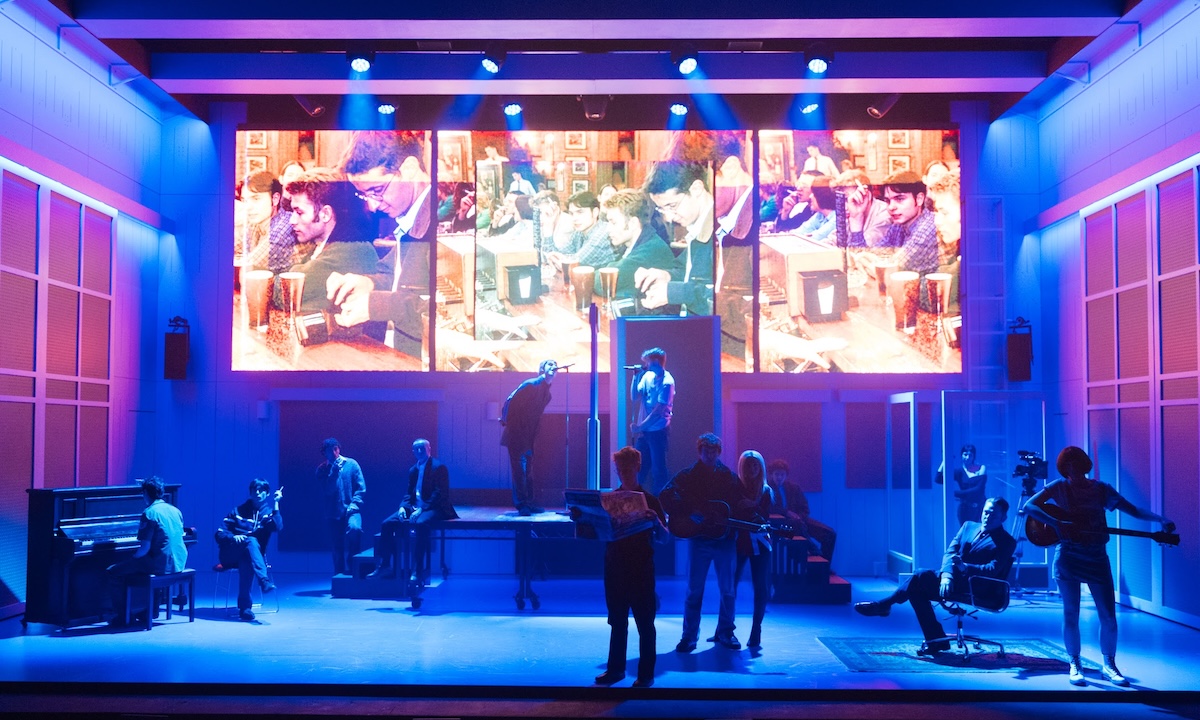
Designer Fly Davis perfectly captures the era through detailed costume work. The set – a flexible recording‑studio‑style environment with large apertures for shifting scenery – transports us smoothly between locations. A huge video screen provides animated commentators of the time (mainly Radio 1 DJs) rendered in a distinctive Beavis and Butt‑Head‑inspired visual style. It also displays snippets of real news footage and abstract visuals.
It’s not difficult to discover who ultimately won the real‑life chart battle, nor to learn what followed. But in truth, the real winner was music itself: the rivalry energised public interest in a way rarely seen.
Overall, this is a bold attempt to capture a defining moment in British pop history with plenty of laughs. It succeeds largely thanks to its grounded dialogue and strong central performances.
Runs until 7 March 2026 and on tour
The Reviews Hub Star Rating
-
8
