

Writer and Director: Douglas Baker
The tiny Brockley Jack Studio Theatre punches well above its technical weight in this adaptation of Nellie Bly’s ground-breaking investigative reporting, with an actor presenting Nellie Bly and a battery of animation, voices-over, video scenography that give her context and characters to play with.
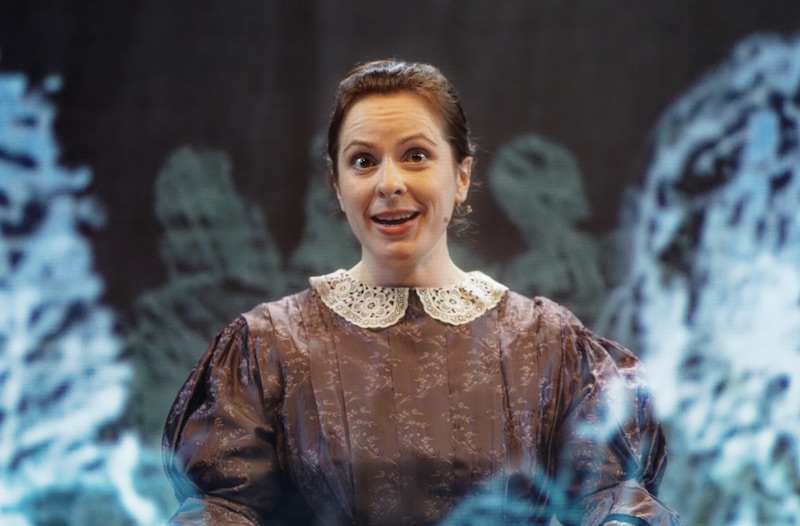
Behind a gauze screen, to an audience wearing headphones, Lindsey Huebner presents the story of Nellie Bly, who pretended to be insane in order to report first hand the treatment of mental patients in New York in the 1880’s. She was employed, and to some extent protected, by Joseph Pulitzer’s campaigning newspaper, the New York World, and spent ten days being processed through various clinics and hospitals, winding up in a Women’s Lunatic Asylum on Blackwell’s Island. The articles she wrote about the experience for the New York World were later published as a book, provoked a Grand Jury investigation, and led to substantial improvements in the treatment and diagnosis of patients with mental disturbance.
It’s an interesting story, full of descriptions of casual cruelty and barbaric treatments, and focussing on the absolutely trivial reasons why women were incarcerated, brutalised, and forgotten about in un-visited, unsupervised institutions. The telling of it, through voices whispering through headphones and monochrome swirling projections, is also interesting, if a little distancing. Huebner is viewed through gauze for almost all the ninety minutes the piece lasts, and headphones are alienating devices. Those things, and the century and a half distance from the events, make for a reflective but a slightly unengaged experience.
Jonathan Simpson’s lighting design, and the soundscape provided by Calum Perrin, are effective, but very much subordinated to the video design of Douglas Baker. Adapter, director, video scenographer, Baker’s a busy man. There are a series of wonderful parodies of nineteenth century advertising, for corsets, caffeine suppositories, and brain tonics, that serve as light relief together with a sense of the disregard for women’s individuality, contrasting with Nellie Bly’s vigorous assertion of her agency and her own importance. Her publisher Joseph Pulitzer instituted his famous prizes thirty years later, and if they were offered retrospectively Nellie Bly would surely have earned one.
The play honours her memory, tells her story, and invokes past injustices. Maybe it is a little carried away by its technical aspects, and misses out on engaging the audience as fully as it could be, but it, and the little studio theatre that hosts it, deserve huge respect for the effective application of theatre technology.
Runs until 2 July 2022
