

Writer: Paul Bradshaw
Directors: Imogen Frances and Paul Bradshaw
First seen in 2021, Paul Bradshaw’s semi-autobiographical, two-hander Tell Me Straight gets a revival at Park Theatre alongside the premiere of the writer’s second play, Aggy. Bradshaw is the first writer to have a double bill programmed at the venue. Both pieces explore queer identities in London, but through different lenses and with decidedly different results.
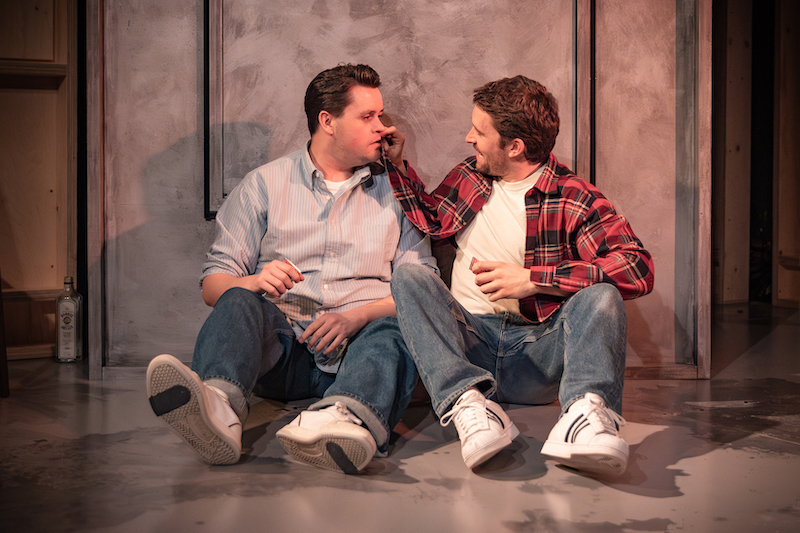
In Tell Me Straight, Jake (Bradshaw performs as well as writes) is a struggling actor who makes money tutoring 10-year-olds how to be articulate, hence getting them into their parents’ choice of school. Aside from “whacking on rain sounds and zenning the fuck out”, his hobby (and seemingly his super-power) is seducing curious straight men, of whom an improbably large number cross his path. Describing himself as “A gay lighthouse on the curious shoreline”, Jake loves the vibe of “forbidden fruit” and the thrill of the hunt.
Amongst the man’s admirers are Scottish fuck-boy Ryan (an excellent Buck Braithwaite takes all the other male roles), who interrupts his serial pursuit of women for an occasional grope in the back row of the local Odeon. Then there is Lee, a fellow actor, who is reluctantly coming to terms with the fact that he may be bisexual and fixes on Jake as a kind of slow-burning experiment.
Sit-com style flashbacks take us to a tryst in a barracks in Kensington with a drunken soldier, playing footsie with a straight man during a game of Monopoly, and it is hinted, though never made clear, perilous late-night adventures somewhere that might well be Hampstead Heath.
What does Jake get out of his hobby? By definition, straight men are emotionally unavailable and therefore simpler, which on the surface suits him just fine. Unseen best friend Dani (voiced by Jade Anouka) says, “You need an actual gay man who likes actual gay men”, but the lad is having none of it.
A complication arises when Jake’s best friend Matt, whose girlfriend Kerry is giving him the run around, decides to let his sexual curiosity get the better of him. The problem of who is using whom comes into stark relief, as does the question of whether it is always possible to take the emotion entirely out of a sexual transaction.
Bradshaw writes witty, naturalistic dialogue and depicts Jake both sympathetically and convincingly. The character evinces the right mix of unimposing self-confidence and easy flirtatiousness to credibly attract the attention he seeks. The piece hints, too, at the complexity of motivations underpinning the urge towards sexual experimentation among the men he meets.
Bradshaw’s second piece, Aggy, is less satisfying. Lawrence (Matthew Jordan paces around, emitting ennui like a bad-smelling aerosol) is an uninspiring white painter who serially dates black men and lives in a plush apartment overlooking the river, bought for him by Mum and Dad. Lawrence’s boyfriend, Mahlik (Jean-Luke Worrell, mashing up working-class streetwise Brixton with adorable camp), a hardworking corporate type, moves in as the play opens. Lawrence admits “I’ve never been in a relationship that doesn’t get stale”, suggesting Mahlik has his work cut out.
There is a problem. Goldsmith’s educated Lawrence really wants to do something “that makes people think,” but cannot get his work exhibited. None of his rich friends can do anything to help. “It would be easier if… I wasn’t white,” he whines. When Mahlik politely hints that he benefits from money and a long lineage of successful white artistic forbears, Lawrence snaps back, “I don’t benefit from their work existing”. You may find it hard to summon up empathy for the character at this point, or indeed any point thereafter, in an overlong 70 minutes.
Worse is to come. The man’s friend and influencer, Rex (Jack Gittins shines in TikTok-style video inserts), is enjoying huge success on the exhibition front after coming out as non-binary. “He’s doing it on purpose… being a ‘them’,” Lawrence complains bitterly. Imitation being the best form of flattery, Larence orders some fancy new finery from ASOS, changes his name to Law and announces he, too, is reconsidering his gender identity. As Mahlik points out, “taking an experience that isn’t yours and benefitting from it” is problematic. What could go wrong? Plenty, it soon transpires. Frankenstein has created a monster, one that soon comes back to bite him.
The performances are great, and there are interesting ideas bubbling under the surface in Aggy: racial privilege, the complexities of identity politics, the headlong rush to ‘cancel’ those deemed insufficiently woke, and the vagaries of the art world, amongst others. But, as with Lawrence’s tedious art, Bradshaw struggles to fix on a theme and peer beneath the surface. We get exterior glitz and the dialogue hums along nicely, but underneath, what drives these characters or what Bradshaw actually wants to say, remains elusive.
Runs until 28 March 2026
