

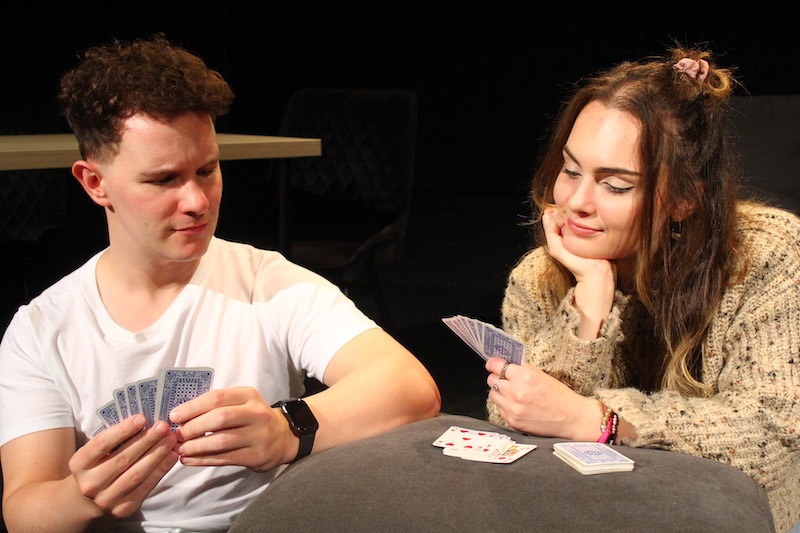
Writers: Aaron Devine and Kimberley Taylor
Director: Tara Noonan
At one point in this 80-minute play presented by Sláinte! Theatre, Sophia bemoans the fact that no one warns against the damage that love can cause. This proclamation comes as a surprise as the hurt that love can bring is surely one of the great mainstays of art, from poetry to music, from painting to literature. All these forms discuss the dangers of falling in love. Both the characters in strings are hurt by love but writers Aaron Devine and Kimberley Taylor struggle to say anything new about heartache.
Sophia (Taylor) meets Alex (Devine) at a party. They get on. Soon, she’s moved into Alex’s flat and given up her job at a bookshop so she can learn how to play the guitar and write music. Alex works as an accountant. Perhaps they discover too late in the day that they come from different social classes. Both of Sophia’s parents are doctors, while Alex’s mother is a cleaner, his father a painter. However, Alex’s pride in climbing the social ladder leads him to believe that he has to provide for Sophia. Thankfully, even though the play strays in this direction, strings is not about gaslighting.
Indeed, it’s hard to find a focus in strings. Themes that could form a heart to the play come and go too quickly: Alex’s jealousy; Alex’s Belfast childhood; Alex’s mild OCD; Sophia’s brother, who is somewhere on the spectrum. As soon as each subject is raised, it seems as if the narrative has finally found its home, but the play rushes off to the next crisis. Only Alex’s depression, caused by a variety of incidents, has any weight to it. Other than this, strings tells the familiar story of falling in and out of love.
The way the play is written, only two outcomes are possible, but there are some stylish interruptions to the story when Sophia and Alex step out of the playing space to address the audience directly. Sophia seems the more honest character, but Alex’s arc is the more interesting. But their mini-monologues are loaded with cliches about the masks we wear in public and the ways in which love turns ugly. These platitudes are told as if they are new ideas, but sadly they’re not.
However, Alex’s depression is represented with acute realism and if there are to be further iterations of the play, perhaps this storyline could take centre stage. When Alex breaks down in tears, Devine’s performance is genuinely moving. It’s not clear whether Alex has been suffering in silence for long. Is he referring to his depression at the very start of the play when he tells Sophia that he is a bad person?
The chemistry between the two characters could be refined, too, as, at the moment, it’s hard to believe that the two are in love or were once in love. Their relationship doesn’t feel as unique as Sophia claims it to be when she talks directly to the audience about string theory. That may be the point, but it doesn’t help that Sophia, despite the details of her life, feels underwritten compared to Alex. A last-minute twist in the story doesn’t help the audience warm to her either.
There’s definitely a future for this play, but for now, apart from Alex’s mental health, strings is just too ordinary, its tune too recognisable.
Runs until 26 October 2024
