

Writer: Andrea Levy
Adapter: Helen Edmundson
Director: Matthew Xia
Matthew Xia’s production of Helen Edmundson’s adaptation of Andrea Levy’s saga of the Windrush generation is wonderfully involving, perhaps marginally less convincing in the shorter second half than in the first which clocks in at 100 minutes, but seems much shorter as it ranges widely over place (Jamaica and Britain), time (from 1939 onwards) and character.
The first half alternates between the stories of Hortense, Queenie and Gilbert, each narrating and enacting the pre-1948 scenes. Hortense is brought up in the oppressively religious household of Mr Philip and Miss Ma, with the mischief of the son Michael the only relief. Michael returns from school with independent thoughts, is banished from the home by his father and then, at the height of a hurricane, reveals his love for the teacher Mrs Ryder rather than the mortified Hortense. Michael leaves Jamaica and joins the RAF in the fight for a better world.
Queenie, looking to escape from her father’s farm, accepts an offer from her Aunt Dorothy to work in her sweetshop/newsagent’s in London and is courted by Bernard – with astonishing reticence. On her aunt’s death, Queenie accepts Bernard’s hand and begins an oddly formal and loveless marriage. Her work on the Home Front finally spurs Bernard to sign up.
Gilbert has aspirations to be a lawyer and, when the recruiting officer in Jamaica talks of wireless operator and engineer, feels that the RAF is for him, only to end up performing menial tasks and discovering early the sense of disillusionment that characterises many of the Windrush immigrants. With Gilbert stories begin to interlock and Michael reappears. Both benefit from Queenie’s liberal attitude, Michael as a temporary lodger, Gilbert as the man who rescues her father-in-law, shell shocked from the previous world war, and is welcomed by Queenie.
The first half brings all these (and more) together. A screen posts newsreels, events seem larger than life and characters emerge vividly in a kaleidoscope of constantly changing places. At the end the stage begins to revolve as Queenie gives herself to Michael on the night before he leaves for Canada. The final act of exposition begins the second half: Hortense lends Gilbert the money for the passage to England, marries him and plans to follow later.
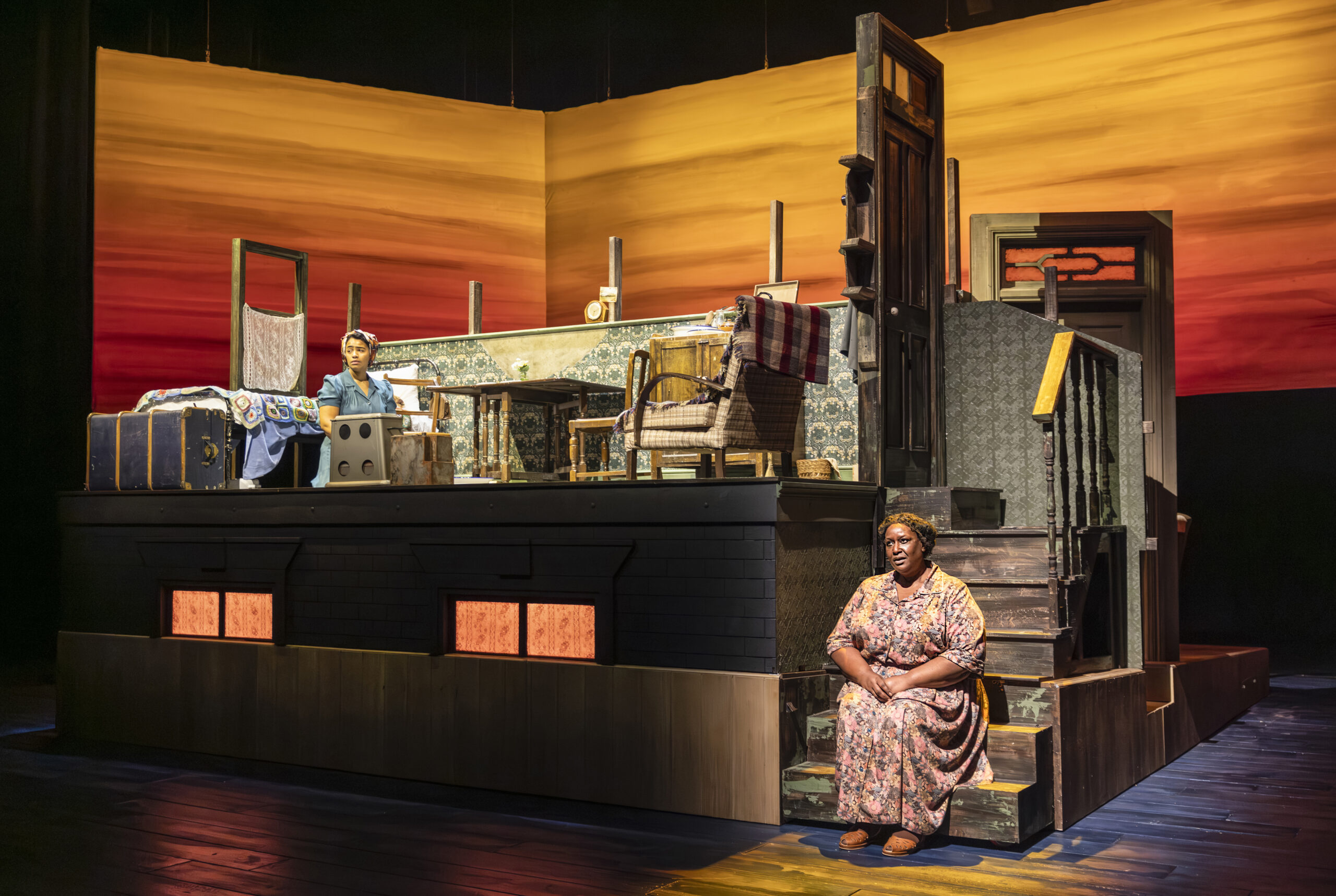
In the second half the free-wheeling spirit in Matthew Xia’s direction disappears: no more newsreels, a set with two rooms on the revolve, Gilbert’s desolate bedsit and Queenie’s traditional sitting room in the same house. And here the issues are fought over. Hortense is appalled at the squalor she is now expected to accept; Bernard, once thought dead, returns like Banquo’s Ghost, his racism even more virulent – and there is an unexpected twist to cope with.
Gilbert’s great speech, quoted in the programme, poses the question, if black servicemen are fit to fight Hitler, how come they are not treated as equal once victory is won?
The reactions of passers-by are treated in a fairly routine way and there is a rather over-the-top neighbour to deal with, but Edmundson’s text and Xia’s direction make their point forcibly, if with no little humour, in part, because of a series of superb performances. The two women who both love Michael are outstanding. Anna Crichlow conveys both the youthful dreamer and the spitfire in Hortense, refusing to be crushed by her rejection as a teacher. Bronte Barbe traverses a whole life in Queenie, the one white person who treats blacks as equals, moving from innocence through, eventually, to being crushed by experience.
Daniel Ward’s Gilbert is a perfect fusion of optimism and occasional fury, while Mark Arends always seems emotionally incomplete as the racist Bernard and Rhys Stephenson is a magnetic presence as Michael. Standing out among the fifteen cast members are Everal A. Walsh as the domineering, unbending Mr Philip. Mara Allen as his warmer, but still doctrinaire, wife and Zoe Lambert as the self-satisfied, but innately kindly, Aunt Dorothy.
Simon Kenny’s set emphasises the difference in tone between the two halves and Luke Bacchus’ music, with its Caribbean edge, is a constant soundtrack.
Runs until 28 March 2026, then tours to Birmingham and Nottingham
The Reviews Hub Star Rating
-
9
