

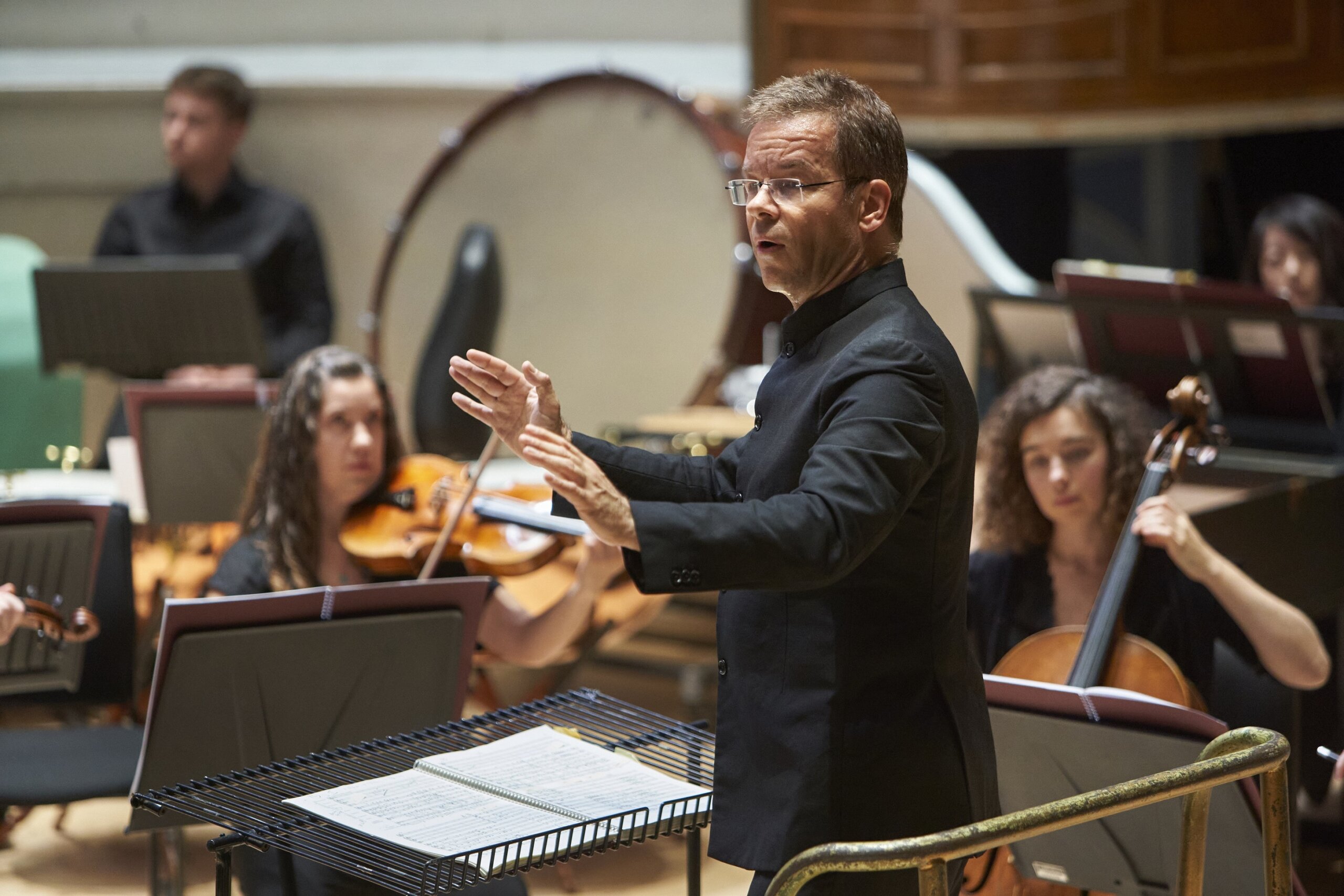
Conductor: Antony Hermus
It says much for the Orchestra of Opera North that it is able to attract soloists of the calibre of Israeli pianist Boris Giltburg and, indeed, has secured the services of Dutch maestro Antony Hermus as Principal Guest Conductor. Together they produced a concert of remarkable virtuosity (from orchestra as well as soloist) to enthral a Huddersfield Town Hall audience far bigger than might have been expected for the performance of two Russian 20th century heavyweights, Prokofiev and Shostakovich.
The programme note on Serge Prokofiev’s Third Piano Concerto points to the dichotomy in his musical personality between the lyrical and the brash – the ironic could have been added. The concerto, in three even movements of about ten minutes each, exploits those contrasts to richly dramatic effect. The second movement, for instance, a set of variations, begins with a sort of hesitating theme before moving on to a deliberately over-sentimental first variation and then everything explodes into tempestuous life with Variation 2. The third movement, similarly, contrasts a strenuous dialogue between soloist and orchestra with an expansive melody for woodwind and a touch of what Prokofiev termed “caustic humour”.

Giltburg sailed through all these contrasts in a virtuoso performance, generating amazing power and accuracy in the dramatic passages, maintaining a rhythmic pulse at all times, relishing the moments of delicate lyricism. And it was with a delicately lyrical piece that he lowered the temperature for his encore.
The Prokofiev concerto also gave plenty of opportunities for orchestra. With Antony Hermus’ inspired and energetic conducting there was never any doubt that it would match Giltburg’s high-speed pianism, but the Shostakovich symphony was to bring all sections to the fore, notably the woodwind, heavily featured amid the clangour of brass and percussion.
Dmitri Shostakovich’s 10th Symphony is one of those works, not uncommon in his case, where the exact political stance is still uncertain. After his 9th Symphony had been the cause of Stalin’s anger, he apparently vowed never to write another symphony while the dictator lived. When Stalin died, Shostakovich was quick off the mark and completed the huge 10th Symphony in months.
One cause of controversy is the short second movement: a portrait of Stalin? Hermus brought out the intense menace that, if it’s not a portrait of the dictator, certainly should be! All this in contrast to the massive first movement, nearly 30 minutes in length, beginning with an ominously subdued string passage and taking us on a roller coaster through delicate clarinet melodies and enormously powerful climaxes. The third movement showcases Shostakovich’s own motto theme, ultimately blended with a frequently repeated five-note horn call (beautifully played by Lauren Reeve Rawlings), then recurring in the triumphant end section of the final movement – no prizes for working out what this juxtaposition of Shostakovich and triumph means.
Antony Hermus’ produced a performance of precision allied to unremitting commitment – and his enthusiasm spread to the brief opener in the series of Minute Masterpieces, Caitlin Strike’s These Four Walls, her first publicly performed work made up of uncertain fragments representing the experiences of lockdown sufferers during Covid.
Reviewed on 26th January 2023.
