

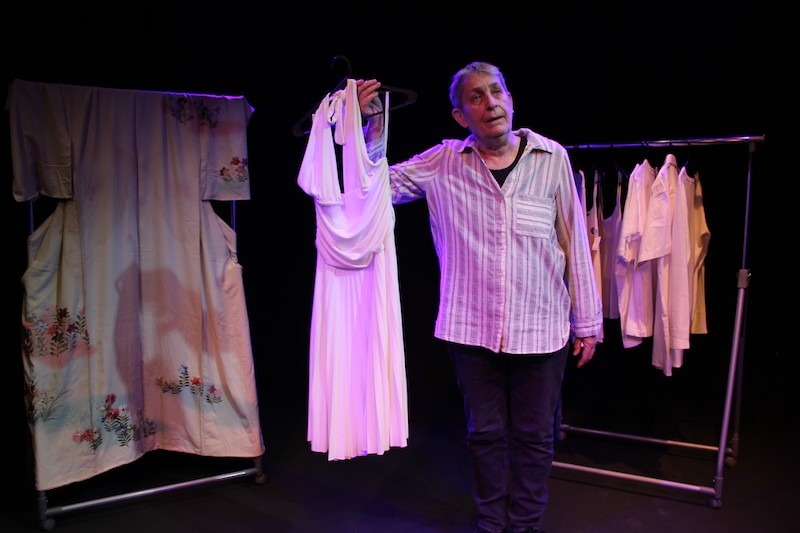
Writer: Claire Dowie
Director: Colin Watkeys
Shopping, death and spirituality are the substance of Claire Dowie’s See Primark and Die, the last of four revival pieces from her 2025 set at the Finborough Theatre, revisiting key plays and performances from Dowie’s 40-year career, a collective entitled Swansong. A story that opens with a panic attack in Primark Peckham and ends with marriage and freeganism, this stand-up style monologue touches on a number of political points from the perils of fast consumerism, NHS decline and gerrymandering via Tesco, but this play, originally performed in 2010, stumbles when it tries to connect those statements to the jumble of personal stories that Dowie includes.
Running for a little under 70 minutes, Dowie’s character is dragged to Primark against her will by friend Andrea and as a result becomes “shopophobic,” determined not to go to any stores and instead makes her way through whatever is in the cupboards. Around this comes a vision of hope from a train window and Aunty Alice’s funeral, which spurs a change of lifestyle and an eye for a different kind of bargain.
The opening sequence of See Primark and Die is its strongest, the vivid impression of the ‘cage’ that is the Peckham branch and the aggressive loom over the landscape of South London that encourages a feeling of going into combat every time Dowie enters it, despite the cheapness of the clothes. And while updates have been made to the final passage of the play, referencing personalities in the current government, the opportunity to look at Primark in context, 15 years on, is missed. Prices are now higher than when the play was written, but far more is known about the ethics of disposable, cheap fashion, and the true price of conspicuous consumption is pertinent to the wider story that Dowie wants to tell about her disconnection from the marketplace, but these ideas are largely absent from the work.
There is a stronger connection to be made between the mass-market high-street stores and supermarkets that feature – along with the customer base that Dowie skewers – and the decision to withdraw from these places. But the narrative is distracted by comic rants about toilet roll thickness and fragrance, or alternative funeral plans to build this through-line. Revisiting this piece more than a decade on is less about things that have stayed the same, but revealing what is absent from the separate strands in See Primark and Die.
Topical references to Keir Starmer and Rachel Reeves cannot prevent the story diminishing as it unfolds – a piece on recycling the dead, a segment about bin diving and finding alternatives to products like toothpaste all point in the same direction, to the problematic nature of economies built on shopping, but that point is never articulated strongly enough. Dowie is a warm presence on stage and an entertaining storyteller. Her connection between abundant NHS funding linked to tax on cigarettes and alcohol when everyone smoked and drank is shrewdly entertaining, but See Primark and Die needs to update its presentation of the politics of shopping for 2025.
Runs in rep until 2 July 2025
