

Writer: Oscar Wilde
Director: Maxim Didenko
If you can’t be with the one you love, then… seek revenge is very much the message of Oscar Wilde’s biblical melodrama Salomé, staged in London at the Theatre Royal Haymarket by Gesher Theatre. Banned for decades in the UK due to its salacious content, several people in this story are in love with people they shouldn’t be. And while there is poetry in Wilde’s text that speaks of obsession, destiny and inevitable violence, Maxim Didenko’s rather flat contemporary staging becomes a clinical and rather unromantic tale of tragic lusts turned sour.
Bored at a fancy party thrown by her stepfather and uncle Herod, titled the Tetrarch of Judea, Salomé is haunted by the beautiful choral voice of Jokanaan, who remains imprisoned in the palace. When he is brought to her by the guards and tries to kiss him, Jokanaan is repelled by Salomé’s physicality. Angered by his rejection and unable to break free of his spiritual hold over her, Salomé bides her time until she can finally touch his lips.
Running for an unbroken 1 hour and 40 minutes, there should be a building tension in Wilde’s play that contrasts both human bodily frailty and the destructive nature of jealousy with the spiritual purity of Jokanaan – known in Christian traditions as John the Baptist. Didenko’s production has moments of drama envisaged on a grand scale by designer Galya Solodovnikova, but becomes bogged down in the words (also Wilde’s fault), actively sagging under the weight of the endless pleading and repetition that takes the story in circles before it delivers the two things everyone is waiting to see – Salomé’s dance for Herod and the fateful presentation of Jokanaan’s head.
And those moments live up to expectation, Didenko staging the dance as a frenzied carnival of movement with Salomé wearing a beast’s head, channelling her erotic fixation for another man as she reveals her nudity to her stepfather – a dark moment that gives her the leverage she needs for the big finale. That too is well staged with a convincing dummy head that looks like actor Shir Sayag and a feeling that something has been ripped out of the world. And this fits nicely with both Herod and a young soldier (Itay Tarhanov) repeatedly advised not to look longingly at Salomé herself, causing a kind of doom to fall upon them all.
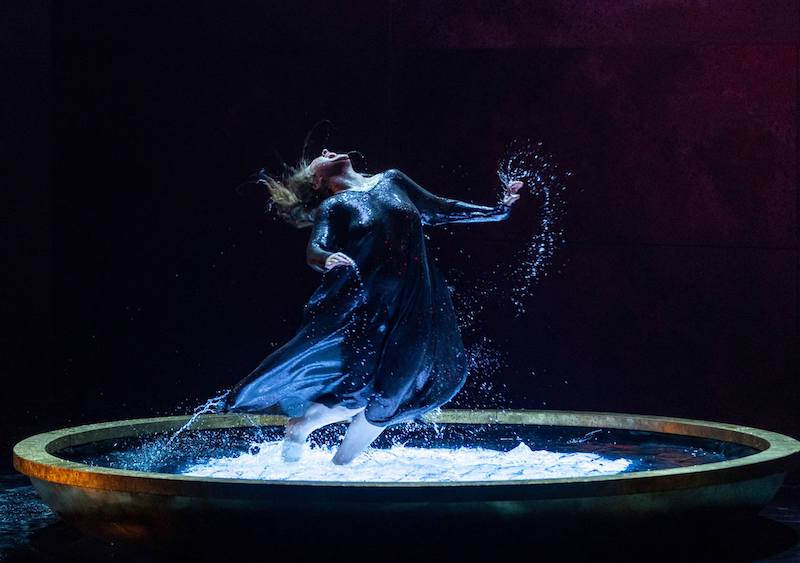
The rest of the time, though, this production of Salomé feels laboured. There is a lot to explain beyond the courtly relationships, including the presence of Romans, Egyptians and Greeks in Judea, the different religious divides and the political control of Caesar, none of which is particularly clear or helpful in explaining the psychology of the characters and why they want the impossible. Solodovnikova’s fancy hotel-like set often impedes the action with a huge water trough centre stage, which, like The Lady From the Sea at the Bridge Theatre, involves actors sloshing about in it with little dramatic purpose and lots of clean up for the stage management team within scenes.
Neta Roth plays a less seductive version of the title character, a tomboyish interpretation who kicks off the heels she is forced to wear and becomes painfully haunted by Jokanaan’s voice. Roth starts as a confident princess and is driven to madness, but there is little time to relish the language or the depths it inspires in her. Likewise, Doron Tavori finds layers of dour humour in Herod in an enjoyable performance, but eventually the tonal variations are too minimal. The big moments deliver on the drama, yet the drama itself slips away.
Runs until 11 October 2025
