

Writer: Alice Birch
Director: Sam Pritchard
Three brothers sit in the ruins of their father’s house and wonder if it was all worth it. A century and a half of demonstrative and controlling masculinity comes to this in Alice Birch’s exciting new play Romans: A Novel premiering at the Almeida Theatre. An exploration of what it has meant to be a man and both the anxiety and inherited toxicity of male tropes, Birch’s panoramic view takes place across a single lifetime but also across the decades of the late nineteenth to the early twenty-first century as the playwright wonders if, beneath the veneer of contrition and self-recognition, the dark entitlement of masculinity persists.
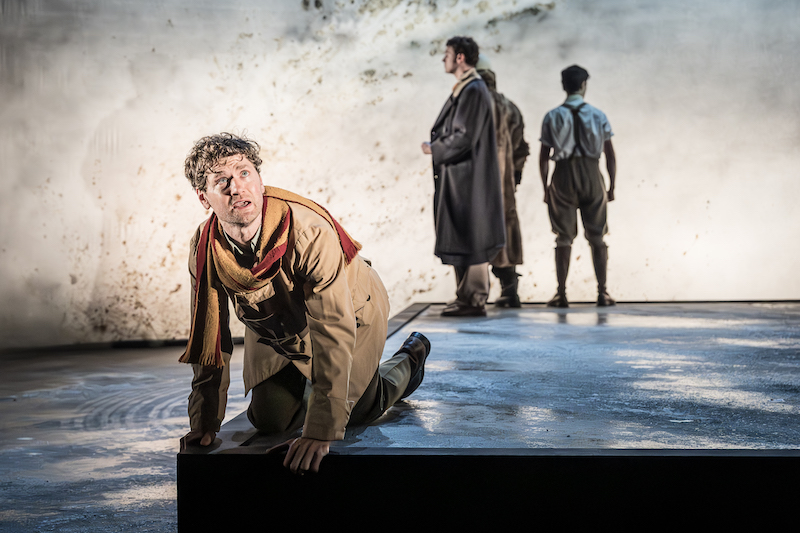
When their mother dies giving birth to Edmund, older brothers Jack and Marlow are sent to boarding school, but with several years between them, they barely know one another. As the years pass, the Roman brothers make their way very differently in the world, two attempting to fulfil expected male tropes to seek adventure and truth, which brings them wealth, fame and influence, while their youngest sibling cannot reconcile with who he is told to be.
Subtitled ‘a novel,’ Birch’s writing certainly captures the huge sprawling and epic life stories beloved of both Victorian and contemporary fiction writers, and there are tones of William Boyd in the style of Sam Pritchard’s production as it envisages locations on a grand scale, taking the viewer from Britain to the Arctic, up mountains and through jungles as the three men explore both themselves and the world.
The early part of Romans: A Novel is narrated in period style with a boys’ own adventure feel as Jack and Marlow journey from the horrifying discipline of their public school, where humiliation and punishment are used to break them down, to a mixed model of heroism and colonial oppression. Jack’s ‘harmless’ physical exertions are played against Marlow’s more savage suppression of communities invaded and resources harvested in the name of the Empire.
And what begins as a good vs bad brother division quickly evolves into something much more complicated as Birch starts to investigate the nature of persistently controlling male behaviours and expectations. When the brothers marry, their wives start to pick at the narrative the men have created about themselves, reminding the audience that what we have seen is their false version of events, and as Jack’s career develops, he fully embraces his privilege, using his influence to control those around him. When the play moves into the 1960s and beyond during the dynamic second part of the play, the threat Jack poses becomes clearer. As the story arrives closer to our times, Birch plays the laddish deification of Marlow as a tech billionaire against Jack’s shallow repentance, recasting the self-aware apologies of recent years as a veil over deeply ingrained male prerogatives inherited across the three centuries represented in the play.
Kyle Soller, onstage almost throughout this 2 hour and 50-minute production, is superb as Jack, capturing a character that grows from a young boy to a man who experiences the world in many forms, but the real quality in the performance is tailoring Jack’s style to the different eras in which he exists, contrasting the humble Edwardian explorer with the laid back mid-century cult leader. Oliver Johnstone is pure menace as the driven Marlow, an imperious figure whose unapologetic manliness also fits the years he plays in each scene. Stuart Thompson’s Edmund completes Birch’s spectrum of masculinity as a quiet figure unsure how to be, although this is less fleshed out and feels more conceptual than other characters.
Birch threads women’s voices through the play, attempting to challenge the male view and simultaneously demonstrating how they are silenced, and there’s good work from Agnes O’Casey as Jack’s wife and Adelle Leonce as a documentary maker railroaded by her subject. It never feels like a long play, although it stops too long in the 1960s, and Pritchard’s production keeps the years moving. It is a risky piece and there’s a great deal to take in, but Birch’s innovative exploration of the crisis of masculinity shows there’s still plenty to worry about.
Runs until 11 October 2025
