

Serenading this small but bountiful exhibition of Asian and Pacific art, carefully selected from various iterations of the Asia Pacific Triennial held at Queensland Art Gallery of Modern Art (QAGOMA) over the last 30 years, is the plaintive voice of Christian Thompson. His song Refuge,2015, performed on video, is entirely composed in Bidjara, an endangered Aboriginal language in south-west Queensland. There is no translation, but its theme of loss and connection is the perfect soundtrack to this fascinating collection.
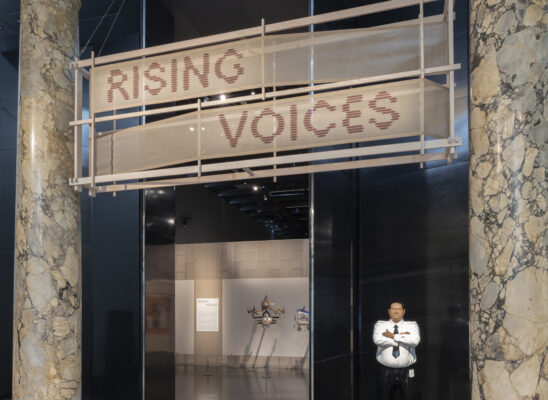
Kensington, 16 May 2026 – 10 January 2027. Photo: David Parry for the V&A.
Thompson’s elegiac voice certainly hits a different note from the first artwork encountered just outside the V&A’s Porter Gallery. A grumpy security guard, arms folded, his white shirt taut against a protuberant belly, stands guard. For a few seconds, he seems real, so stereotypical is his stance and uniform. However, this is a statue by New Zealand artist Michael Parekōwhai, and the security guard’s posture is also reminiscent of a Māori dancer, confident and commanding, the kind of pose we see the All Blacks perform at rugby matches. Kapa Haka (Whero),2003, is one of 15 security guards that Parekōwhai has made, all modelled on his brother, that challenge how Polynesians are seen.
But once through the door, one is greeted with less indomitable art. In the first room, there is work by Judy Watson, perhaps the most famous artist in the exhibition. Her two canvases from 2007, memory bones and passing from the edge of memory to the night, both act as tributes to the dead. The first, with its white vertebrae curve over an ochre storm, remembers Mulrunji Doomadgee, an Aboriginal man who died while in police custody in 2004. The second’s blue spectral figure hovering over the Waanyi landscape is painted for Watson’s grandmother, who died when Watson was working on the piece.
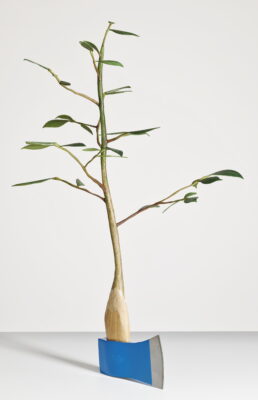
One, 2024 / Purchased 2024 with funds from
David Thomas AM through the QAGOMA
Foundation / Collection: QAGOMA, Brisbane /
© Zac Langdon-Pole
Other work in Rising Voices is more brutal, recalling the days of colonisation. Captain Cook’s axe is rendered into a hickory tree by Tāmaki Makaurau (Auckland) artist Zac Langdon-Pole in Another World Inside this One, 2024, while late Papua New Guinea artist Elisabet Kauage paints Captain Cook’s ship in bright cartoon-like colours with white officers at the top of the ship and South Pacific Islanders below in the hold.
Also describing conflict is Cambodia Svay Ken, who sold his pictures of the Khmer Rouge period to guests at the hotel where he worked. In one of his pictures, bombs fly as ordinary rural Cambodians carry on with normal life. More abstract are Adeela Suleman’s exquisitely painted meat cleavers, their beautiful Himalayan scenes of the border between Pakistan and India at odds with the weight and sharp edges of these utensils.
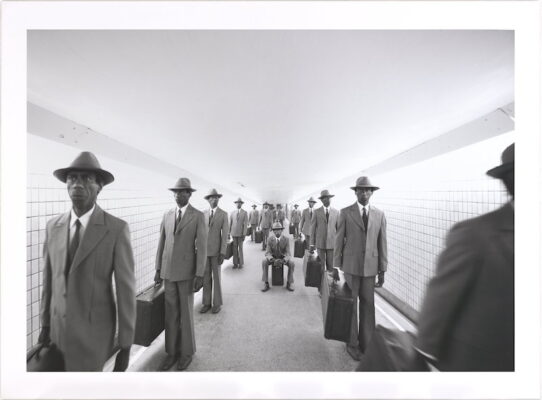
(Tunnel), 2014 / Purchased 2014. QAGOMA
Foundation / Collection: QAGOMA, Brisbane /
© Michael Cook
Playfully interrogating colonialism are the large black and white photographs by Michael Cook. Replicating a single Aboriginal man in a 1940s Western suit, briefcase in hand, Majority Rule (Bridge), 2014 seems to tell two narratives: one that colonial rule imposes different traditions on the colonised and the other an Australia where Aboriginal people have rights and legal freedoms. The accompanying photograph, Majority Rule (Tunnel), 2014, initially appears to tell a similar two-sided story, but here the briefcases have been swapped for suitcases, suggesting arrival or a forced departure.
Tarun Nagesh, the curatorial manager of Asian and Pacific Art at QAGOMA, is committed to customary art too and here at the V&A, it is represented by Lola Greeno’s iridescent seashell necklaces and Sospen Wai’s vibrantly coloured string bags. But the best in this section are Shirley Macnamara’s baskets made from twined spinifex, a common grass in Queensland. With their insides layered with bird feathers (emu and galah), they are invitingly soft, asking quietly to be plumbed.
Installation view of Rising Voices: Contemporary Art from Asia, Australia and the Pacific, V&A South
Kensington, 16 May 2026 – 10 January 2027. Photo: David Parry for the V&A.
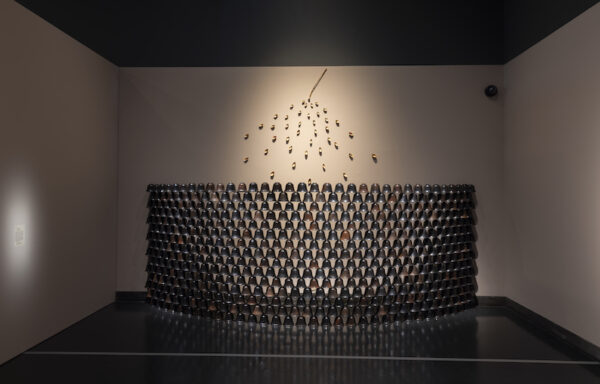
The geographic region Rising Voices is vast, and most of these pieces from over 40 artists have never been seen in the UK before. There are pieces from Samoa, Sri Lanka, China and Japan. There are also works from Iran. But the exhibition concludes with two large showstoppers. Thailand’s Montien Boonma’s Lotus sound,1992, is an enthralling wall of terracotta bells lit beautifully here. Created in response to visiting the temple Wat Phra That Doi Suthep, the bells, each a slightly different hue, give a sense of peace and contemplation and yet a feeling of something sacred that is hidden.
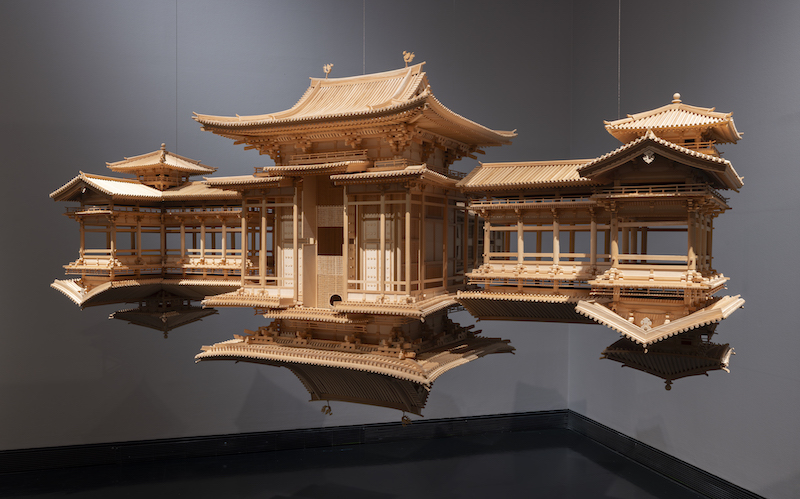
Across the room, Takahiro Iwasaki’s Reflection Model (Perfect Bliss), 2010-12, Kyoto’s Phoenix Pavilion at Byōdō-in temple caught in the sharp reflection of a lake, hangs like a prayer. Made of Japanese cypress, the pavilion is given new layers where the roofs of the various wings of the building are upturned like open books, faith and knowledge fusing in one great symbol. It’s a breathtaking end to a rousing exhibition.
Opens on 16 May and runs until 10 January 2027
