

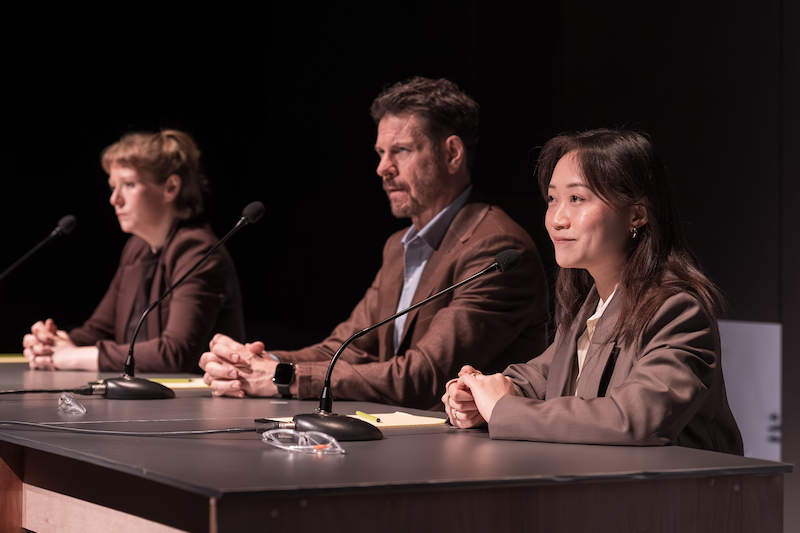
Writer: Aaron Loeb
Director: Chelsea Walker
Aaron Loeb’s immensely entertaining 90-minute dystopian thriller, R.O.I. (Return on Investment), looks at the sometimes murky ethical trade-offs between the needs of profit-hungry investors and those of medical researchers and the wider public. Can the quest for financial returns by a tiny number of elitist entrepreneurs, some with decidedly dodgy politics, lead to equitable returns for humanity as a whole? The subject does not necessarily scream dramatic potential, but Loeb delivers dark humour, twists and turns aplenty, and two gloriously malign central characters to enjoy. Think TV’s Black Mirror mashed up with Ibsen’s Enemy Of The People.
Ambitious venture capital executive and former singer May (Millicent Wong) wants to be a big-hitter in the supposedly ‘ethically sound’ medical investment fund she works for. In practical terms, that means finding her first unicorn (start-ups with $1 billion valuations) to invest in, a process her splendidly amoral boss, Paul (Lloyd Owen), describes as sifting through a lot of “horse shit” to find a pony. Paul calls himself a “fancy loan shark” and once sucked Steve Jobs’ toes in an act of “CEO worship”, so one supposes there is not much he would decline to do for a hefty enough return.
Despairing of pitches from carbon copy medical testing businesses, May takes a meeting with Willa (Letty Thomas), who grew up in a series of foster homes with “no siblings and no heritage”, and apparently has no life beyond work. Willa wants $30 billion for her start-up. “I love your optimism, you’ll need that”, responds the initially bemused May. What Willa is promising is a business called “Precure” that will “diagnose and cure diseases people don’t even know they have”, starting with breast cancer and Alzheimer’s. May’s Mum is in a care home with dementia, so the investment opportunity here, which involves medical interventions that change a patient’s DNA, is personal and seemingly ethical. “Is it good for everyone?” enquires May. “It’s irrelevant, it’s coming”, responds the ethically-challenged Willa.
Fast forward two years, and Precure has doubled the effectiveness of breast cancer screening, with much more success to come. But Willa’s success has raised the ire of big pharma competitors and drawn the attention of suspicious FDA regulators. “Look into my eyes and really hear me”, Paul says, assuring Willa he will use his influence to take the heat off Precure. The stakes are raised when Willa complains of a cabal of “globalist” spies, mostly Jewish, embedded in the deep state, and determined to thwart her increasing megalomania. Her solution is to propose taking the business to an authoritarian state where she can shortcut US regulations and experiment on prisoners.
Fearful for their reputation, the two investors scheme some “classic pharma-fuckery” for which read easing Willa out of the business she founded. After all, as Paul assures us, “It’s never, ever bigger than the money”. However, as Dr Frankenstein found out, a creation can sometimes outgrow its master’s intent. “The Chinese look after the Chinese, the Jew the Jew”, Willa tells us, indicating a world view that suggests everyone has to look out for themselves, which is just what she does. Events unfold, not necessarily to the investors’ advantage. Sarah Lam shows up late on as “the woman” whose presence hints at where one of the characters is headed.
Loeb offers a timely though not particularly novel analysis in R.O.I. (Return on Investment) on the perils of an unregulated alliance between unchecked technology, nasty politics, and boundless greed. The three characters are necessarily archetypes – hand-wringing liberal May, Elon Musk-ish Willa, and amoral capitalist Paul. Loeb, a tremendously economical writer with a fine eye for dark humour, gives them enough of a backstory to make them credible without overloading them with detail.
Thomas faces the challenge that no fictional dystopian character is ever likely to be quite as grotesque, at least in the eyes of North London theatre-goers, as the real-life Elon Musk. Her distant, icy, not-quite-all-there Willa, always two steps ahead of the rest of us, has a hint of the Dr Strangelove mad scientist about her. It is a remarkable turn, one that neatly sets off Wong’s much more grounded and accessible May. Owen’s Paul, bedecked in a Patagonia t-shirt and immersed in a vat of moral ambiguity, delivers eccentric self-righteousness and impeccable comic timing.
Director Chelsea Walker, a Hampstead Theatre regular, keeps the plot humming briskly and brings out a claustrophobic edge to ongoing machinations. Rosie Elnile’s corporate office set sees desks and a table slide out from the backdrop, hinting at hidden influences on unfolding events.
Runs until 11 April 2026
