

Writer, Composer and Director: Finn Beames
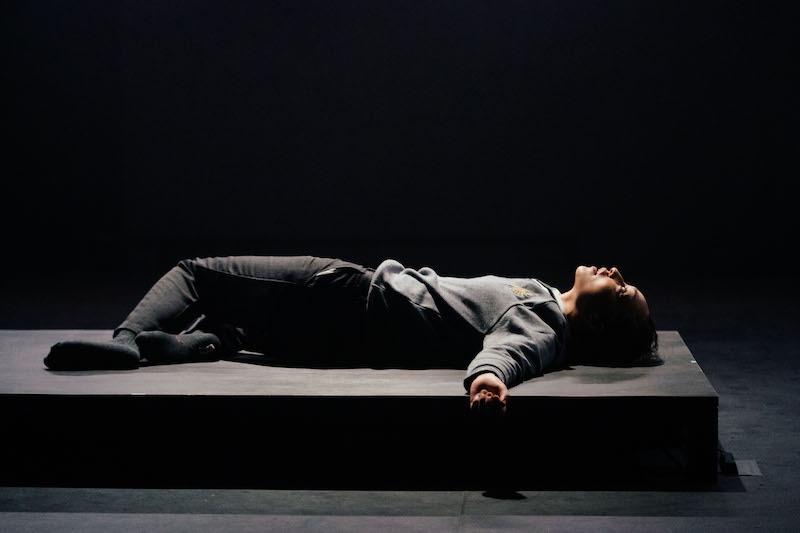
The sword of Damocles is suspended above a platform where a boy lies prone. In the dusk that envelops the stage for most of the 60-minute show, other swords lie, the tips of their blades pointed to the boy, who only begins to speak when the lights are even lower. “Tomorrow is a bad thing,” he whispers. You know that this won’t be a happy show.
Indeed, creator Finn Beames is brave to put on a show that is so full of dread, so quiet and precise. There are a few flashes of humour when the boy, who eventually stands, talks about Miss Herman, the head teacher at his school, but they are fleeting and don’t really fit in with the whole aesthetic of the piece, which also has four musicians picking out doom-laden sounds on their strings and chiming ominous bell chimes on their percussion.
The boy is in Year 8, which makes him around 12 or 13, and is being bullied for being gay. He hasn’t come out, but his fellow pupils can sense it in him by the way he walks and, most tellingly, by the way he talks. In response, the boy becomes a silent creature, raging at his body for revealing its secrets too easily. The boys at school throw names at him; we never know the specific insults. Instead, they are sublimated into the sounds of a violin, its player’s face hidden behind a fencing mask.
As the boy, Academy Award-nominated actor Ruth Negga gives a quiet and powerful performance, never giving too much away. The audience is left to deduce why he can’t produce his bus pass on the journey to school and why his parents are worryingly absent from the narrative. When Negga relates the story of how the boy’s class teacher holds a debate in class, the scene is heartbreaking, gaining its effect by what is not said rather than by what is said. However, the elisions in language go further. The teacher never intervenes as a boy presents his method of eradicating ‘undesirables’ from the world. Only the girls seem to take offence at such a murderous proposition. Set in 2001, it’s clear to see the damage that Thatcher’s Clause 28 had on the school system and vulnerable children.
The strange music that the performers create, along with Bethany Gupwell’s shadow-filled lighting design, exerts a terrifying and hypnotic spell. You can hear a pin drop while waiting for the sword to fall. The ambiguous ending offers little succour.
Runs until 2 November 2024
