

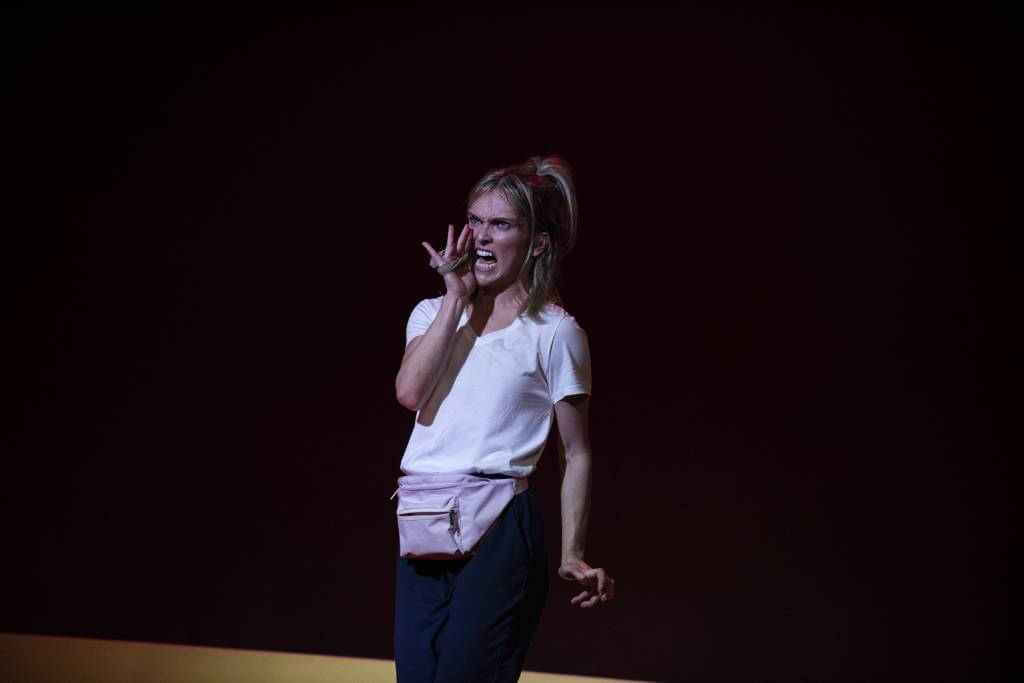
Writer: Sarah Hanly
Director: Alice Fitzgerald
In “a world based on balls-only constructs”, how difficult is it for women to shape their identity freely and honestly? Sarah Hanly argues extremely. Her darkly comic one-woman play follows Irish teenager Saoirse, as she attempts to simultaneously flee and confront the repression that plagues her culture.
Hanly’s writing is scandalous. She explores dark themes with brazen humour. Everything from anal beads and scissoring, to eating disorders, homophobia and grief are explored; each with the same endearing frankness. The multi-layered humour wittily mocks conservatism as well as exposes how we use humour as a survival mechanism. Sarcasm distances Saoirse from reality in order to not let it consume her. At the forefront, Saoirse is grieving. She converses with her deceased friend Ashling. And in examining their past, attempts to forge herself a self-governed future.
The social critique gets away with being in-your-face through its incredible nuances. Religion and education remain central points of criticism. Although the family relations are strained, they are more complex and layered than a straightforward rejection of Saoirse. Hanly demonstrates that even an accepting and loving family cannot protect you from a culture so endemic with sexism and homophobia. The different roles Hanly adopts, from Sisters to sister, and police to parents, shows the various forms of oppression that are placed on just one person. Hanly does not quite master seamless shifts between voices. The accents and tones are not always distinct enough for it to be clear that it is no longer Saoirse speaking. By the time you’ve caught on, the punchline has passed. However, with a protagonist as endearing and enthralling as Saoirse, this can be forgiven.
Saoirse feels bodily shame. Her tragic intent to feel emptiness or pain in order to escape reality is rendered in Hanly’s intensely physical performance. Alice Fitzgerald’s direction powerfully captures the fine line between pleasure-seeking and self-destruction. Unpredictable chaos and consistent despair are both at odds and working together to present Saoirse’s loneliness. And although Saoirse is lonely, the point this play intends on making is these experiences are in no way exclusive to her. Ashling, we discover, died from anorexia. Others in their school suffered in similar ways. Saoirse’s determination to confront the social injustices of the church, and world at large, even makes her mother realise: “I’ve never made as much as your grandad and I do all the work around here.”
If different shaped objects are forced into the same mould for too long then inevitably the mould will break. The play pays tribute to the destruction caused along the way, but its final message is one of hope. Saoirse’s little niece states: “I am not seen in church the way boys are […] which means I am not seen in this man-made world, so how do I know I am seen in heaven?” It seems the new generation are figuring things out at a much younger age.
Runs until 12 February 2022
