

Writer: Tim Price
Director: Sarah Bedi
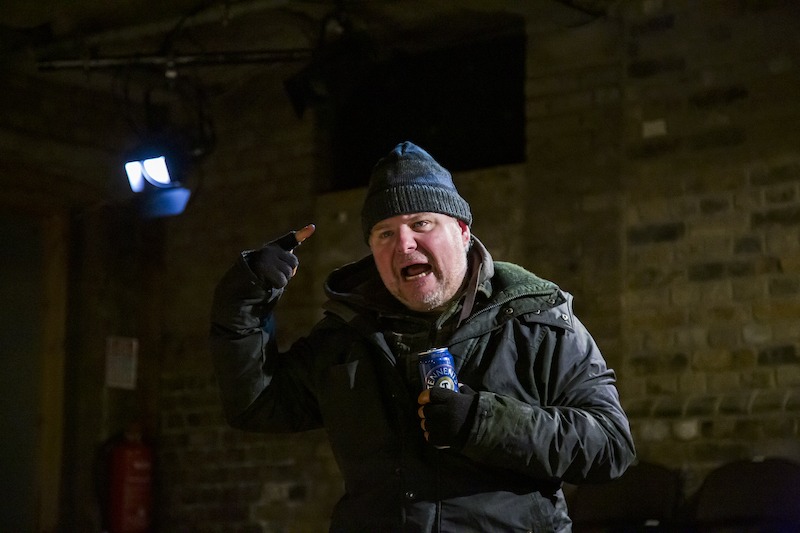
Based on a true story, Protest Song is a clever play where you’re never quite sure what its sole protagonist is protesting against. When Occupy takes over the square outside St Paul’s Cathedral in 2011, rough sleeper Danny is initially furious that the activist movement has gate-crashed his sleeping arrangements. But could joining Occupy be a way out of homelessness? This would be too easy a conjecture.
Anyone who’s been to a protest knows that feeling of togetherness that comes from shared rage and common aims. It’s an exhilarating sensation that is laced with guilt in that one can be so happy and angry at the same time. As Danny works alongside the Occupy volunteers in the kitchen for the camp, he realises that it’s not a bedsit that he craves but a community. When he recounts being kettled on a bridge over the Thames with thousands of other protestors his elation is palpable.
Danny is like the old broken piano that some of the activists have tried to play before one man figures out how to work around the damaged keys and out-of-tune notes. Danny is not broken either and slowly comes to life when he sees the opportunity to build other worlds.
Running for an hour, Protest Song is a short piece, but it’s always intriguing especially when the good guys become seen as the oppressors. Danny doesn’t help matters either; he shouts a lot – although perhaps this shouting takes place more in his head than outside St Paul’s – and steals money that is not for him. We’re given little of his backstory and even less of his future. This is a play as compact as an Alan Sillitoe short story.
However, to flesh out the running time, there is some awkward audience participation in which Danny, played by an irrepressible David Nellist, encourages everyone to sing along to a sweary version of the 12 Days of Christmas. There are also some games with a mobile phone where audience members are asked to shout out their phone numbers. All this feels a little uncomfortable and places too much distance between the audience and Danny.
Director Sarah Bedi’s decision to keep the lights up full and to dispense with any sound design means that Protest Song feels untheatrical. Nellist, also, ignores the wooden set that is placed in the middle of the stage, choosing instead to perform at its sides or sometimes even behind it. If these directorial choices are there to make us feel part of the action or even complicit in the way society ignores rough sleepers they don’t quite work and add to the sense of detachment.
And yet, as the lights finally go down, the futility of protest – the way that revolution can turn sour – is a sobering thought.
Runs until 6 January 2024
